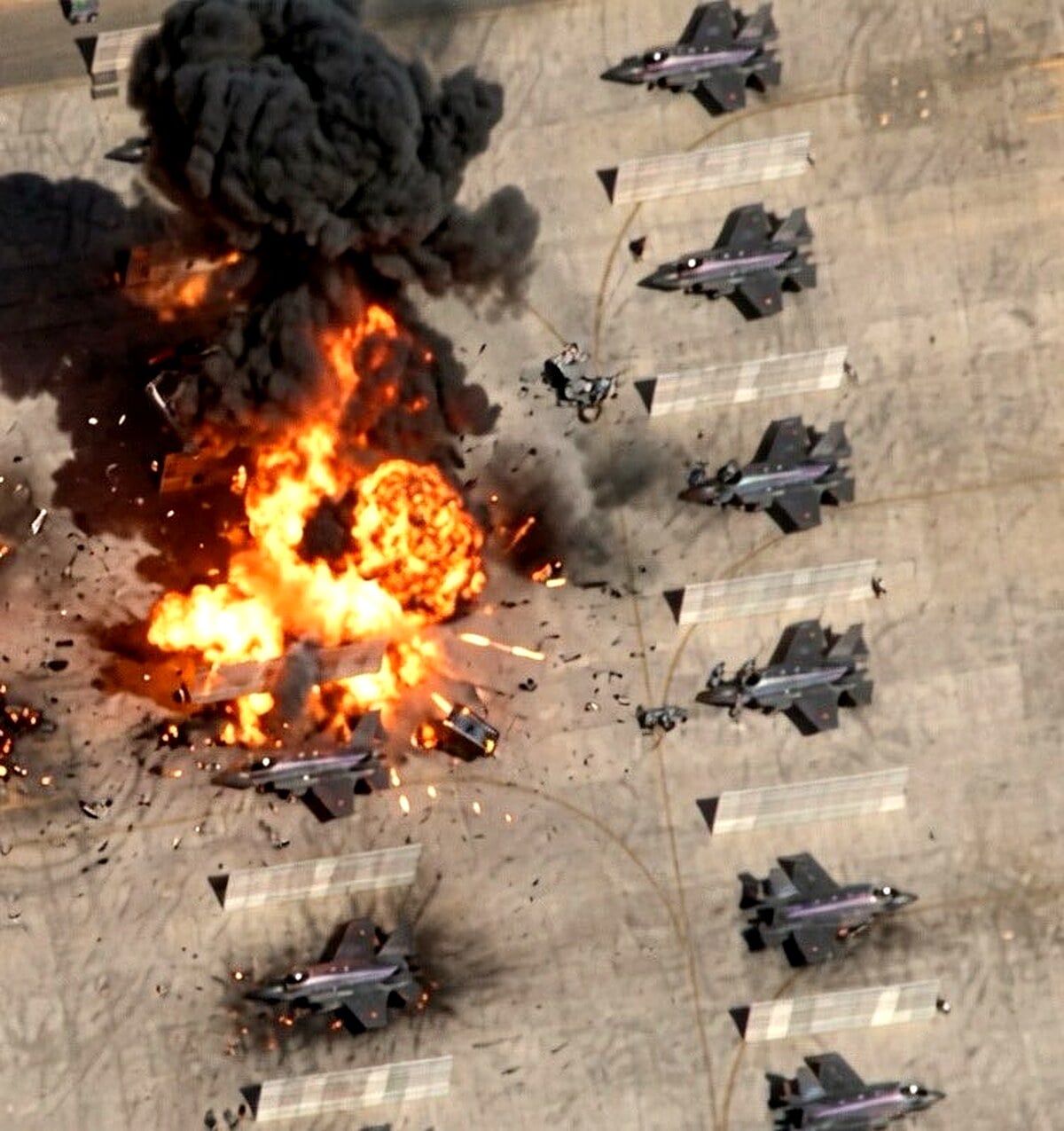




ISLAMABAD: Iran’s Islamic Revolutionary Guard Corps (IRGC) has claimed that a large-scale missile strike on a US-operated air base in Jordan destroyed multiple fighter aircraft facilities and caused significant damage to military infrastructure, marking another major escalation in the rapidly expanding confrontation between Tehran and Washington.
According to an IRGC statement issued on Thursday, the Aerospace Force launched 12 ballistic missiles against Al-Azraq Air Base in Jordan, a facility that Iranian officials said hosts American F-35, F-15 and F-16 fighter aircraft.
The Iranian military claimed the strike targeted aircraft shelters, operational facilities and a command-and-control center associated with US military operations in the region.
While the IRGC stated that a “large number” of fighter jets were destroyed during the attack, it did not provide an independently verifiable figure for aircraft losses.
Iranian state-linked media reports also claimed that several hangars used to house advanced combat aircraft were struck during the barrage.
The claims have not been independently verified, and no official US military assessment confirming aircraft losses had been released at the time of reporting.
Jordanian authorities, meanwhile, reported that air defense systems intercepted multiple incoming missiles over the Azraq area.
According to the Jordanian Armed Forces, around 20 missiles launched toward the region were intercepted, with no reported casualties or major infrastructure damage resulting from falling debris.
The conflicting accounts have created uncertainty over the actual scale of damage at the facility.
The latest strike follows US military operations against Iranian targets near the Strait of Hormuz and southern Iran earlier this week.
Washington described those operations as defensive actions conducted in response to attacks against American military assets and regional partners.
Iran has repeatedly warned that any attack on its territory would trigger retaliation against US military installations across the Middle East.
The Al-Azraq facility occupies an important position within regional military operations because of its proximity to Iraq, Syria and key air corridors used by coalition forces.
Military analysts note that aircraft such as the F-35 Lightning II, F-15 Strike Eagle and F-16 Fighting Falcon represent some of the most valuable assets in the US regional airpower network.
The F-35 alone carries an estimated unit cost exceeding $80 million depending on configuration, while advanced operational infrastructure at forward-deployed air bases often requires billions of dollars in long-term investment.
Iranian officials said the Jordan strike formed part of a broader campaign targeting American military facilities in the Gulf region.
Previous IRGC statements claimed attacks on bases in Kuwait and Bahrain as well as installations connected to the US Fifth Fleet.
Iran has asserted that more than 20 American-linked military targets have been attacked during the latest phase of hostilities.
US officials have acknowledged missile and drone attacks against regional bases but have rejected several Iranian battlefield claims in recent days.
Earlier assessments from American officials suggested that many incoming missiles were intercepted by layered regional air defense systems.
Regional governments have expressed growing concern over the expanding conflict.
Several Gulf states have increased security measures around strategic energy infrastructure, military facilities and transportation networks.
Energy markets have also reacted to the deterioration in security conditions around the Strait of Hormuz, a route through which roughly one-fifth of global oil supplies normally pass.
Crude oil prices have remained volatile amid fears that prolonged military escalation could disrupt shipping routes and increase transportation costs.
Diplomatic efforts led by regional mediators continue, but progress has remained limited as both sides exchange military strikes and public warnings.
International calls for restraint have intensified at the United Nations and among major global powers seeking to prevent a wider regional conflict.
Security analysts say the reported strike on Al-Azraq could become a significant turning point if independent evidence confirms substantial aircraft or infrastructure losses.
Such a development would represent one of the most consequential attacks against a US military installation in the Middle East in recent years.
Attention is now focused on potential satellite imagery, official battle damage assessments and future military responses that may determine whether the confrontation remains limited or develops into a broader regional crisis with implications for global security and energy markets.