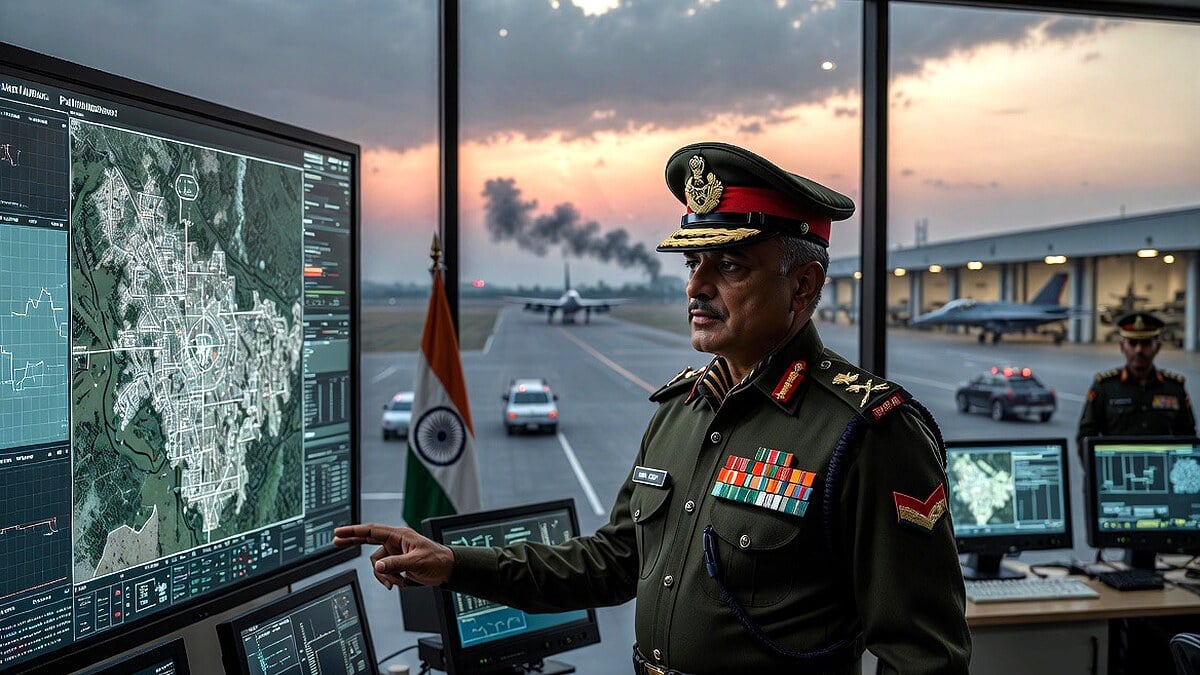




ISLAMABAD- Recent reports have drawn attention to an incident involving an Indian Army officer stationed at Pathankot Airbase in Punjab. According to circulating accounts, the officer inadvertently disclosed during a briefing that a Pakistani missile struck the airbase area in the previous year. Notably, he reportedly withheld this information from the soldiers under his command to prevent unnecessary panic and maintain operational readiness.18
Pathankot Airbase, a key Indian Air Force installation near the international border, has historically been a focal point in India-Pakistan military engagements. During the escalations of May 2025, both nations exchanged claims regarding strikes on military targets, including airbases such as Pathankot. Pakistani sources asserted successful missile attacks using systems like the Fateh series, while Indian authorities maintained that most incoming threats were effectively neutralized by integrated air defense networks, resulting in only limited damage.11
The officer’s purported statement, if authentic, raises important questions about information management within military hierarchies. Commanders often exercise discretion in disseminating sensitive details to preserve troop morale and operational effectiveness. However, such an approach can invite scrutiny when revelations surface later, potentially undermining public and institutional confidence. The incident has fueled discussions on the balance between operational security and accountability in conflict zones.
This development aligns with a broader pattern observed in the aftermath of the 2025 India-Pakistan confrontation. Analysts note that initial official narratives from the Indian side emphasized defensive successes and minimal impact on strategic assets. Over time, incremental disclosures—whether intentional or inadvertent—appear to provide a more nuanced picture of events on the ground. Proponents of this view argue that global audiences, equipped with satellite imagery, open-source intelligence, and real-time reporting, have already formed informed assessments of the conflict’s outcomes. Consequently, sustained denial may prove counterproductive, leading to a gradual acknowledgment of tactical realities.9
From a strategic perspective, the handling of information during and after military operations reflects the psychological dimension of modern warfare. Decisions to withhold details about strikes, such as the one allegedly affecting Pathankot, aim to avoid demoralization among personnel. Yet, in an era of pervasive digital connectivity, such information often finds alternative channels of dissemination. This dynamic compels militaries to adapt their communication strategies, ensuring consistency while addressing legitimate public interest.
The Pathankot episode must be viewed within the historical context of India-Pakistan relations. Previous incidents, including the 2016 militant attack on the same airbase, have demonstrated the vulnerability of forward installations and the rapid escalation potential of border tensions. The 2025 exchanges highlighted advancements in missile technology and air defense capabilities on both sides, underscoring a shifting operational landscape where precision strikes and countermeasures play pivotal roles.
International observers continue to monitor these developments closely. Major global powers emphasize the need for restraint, de-escalation, and dialogue to prevent broader instability in South Asia. Economic interdependence, regional security concerns, and the risks associated with nuclear-armed neighbors further reinforce the imperative for measured responses and verifiable facts.
Critics from the Pakistani perspective interpret these emerging admissions as evidence of a reluctant acceptance of setbacks. They contend that persistent claims of comprehensive defensive triumphs are increasingly difficult to sustain in light of independent corroboration.
Conversely, Indian defense establishments highlight the overall success of their retaliatory operations and the resilience of their forces, framing isolated incidents as insignificant in the larger operational context.
In conclusion, the reported revelation by the Indian Army officer at Pathankot Airbase underscores the complexities of wartime information management and its long-term consequences. As more details potentially surface, both nations face the challenge of reconciling official accounts with ground realities.
Sustainable peace and stability in the region depend on transparent assessment of events, mutual respect for capabilities, and a commitment to diplomatic resolution over prolonged confrontation. Future analyses will benefit from rigorous verification through credible sources, satellite data, and declassified materials to foster a clearer understanding of these critical developments.