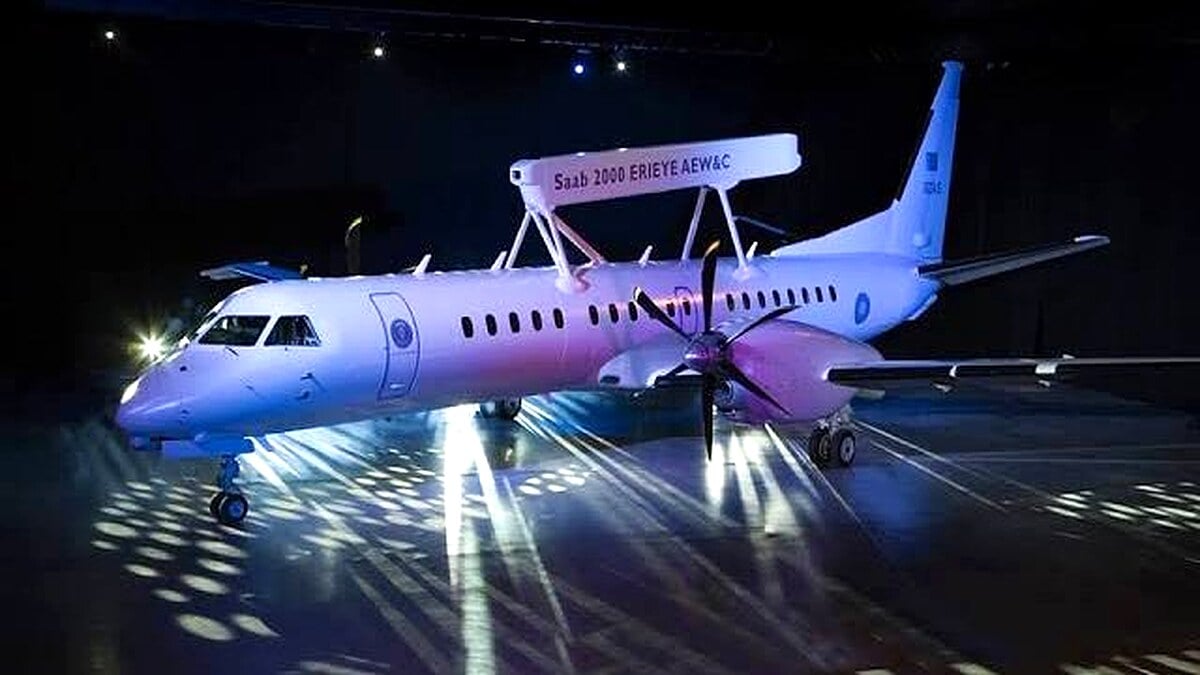




ISLAMABAD: Pakistan Air Force remains the largest operator of Saab 2000 aircraft worldwide, fielding 11 airframes in active service. Of these, nine have been converted into Erieye Airborne Early Warning and Control (AEW&C) platforms, while two serve in VIP transport roles.
The development underscores PAF’s ongoing efforts to strengthen its multi-domain operational capabilities amid regional security challenges. Official sources indicate the force is now pursuing the induction of at least four additional Saab 2000 airframes to further bolster its AEW&C network.
Defence officials confirmed the current fleet composition during recent briefings on air force modernisation. The nine Erieye-configured aircraft form the backbone of Pakistan’s airborne surveillance architecture, providing critical command and control support to fighter operations.
The Erieye system, mounted on the Saab 2000 turboprop platform, offers detection ranges of up to 450 kilometres for fighter-sized targets. This capability enables effective monitoring of vast airspace and real-time coordination with JF-17 Thunder and J-10CE fighter jets.
PAF acquired its initial Saab 2000 Erieye platforms under a 2006 contract that was later adjusted due to post-earthquake financial constraints. Deliveries of the first batch occurred between 2009 and 2010. Subsequent orders in 2017 and 2020 added more aircraft, bringing the Erieye fleet to its current strength of nine.
One aircraft was lost in a 2012 terrorist attack at Kamra airbase, with others damaged but later repaired through local efforts at Pakistan Aeronautical Complex.
The two non-AEW&C Saab 2000s operate primarily as VIP transporters, offering reliable medium-range transport with modern avionics. Their availability supports high-level official movements while maintaining operational flexibility.
**Fleet Expansion Underway**
Senior PAF officials stated that the planned addition of at least four more Saab 2000 airframes aligns with broader modernisation objectives. These new platforms will likely undergo Erieye conversion to enhance the AEW&C fleet beyond current levels.
The move comes as PAF continues to integrate advanced sensors and data links across its platforms. Industry sources estimate the potential value of additional acquisitions and upgrades in the range of several hundred million dollars, though official contract details remain undisclosed.
The Saab 2000 platform was selected for its high dash speed, endurance exceeding eight hours, and ability to operate from shorter runways. These characteristics make it particularly suitable for Pakistan’s diverse terrain and operational requirements.
**Operational Impact**
The Erieye AEW&C aircraft have significantly improved PAF’s network-centric warfare capabilities. They provide persistent surveillance, early threat detection, and battle management functions that enhance the effectiveness of frontline fighter squadrons.
During recent regional tensions, these platforms demonstrated their value in maintaining situational awareness and coordinating defensive responses. Their integration with Chinese and indigenous systems has created a layered air defence picture.
PAF operates No. 3 Airborne Early Warning Squadron, also known as the “Angels,” from PAF Base Minhas at Kamra. This unit manages the Erieye fleet and conducts regular training alongside other air force assets.
**Regional Context**
Pakistan’s emphasis on AEW&C expansion occurs against the backdrop of evolving air power dynamics in South Asia. The fleet size positions PAF among leading operators of this class of systems globally, alongside nations like Saudi Arabia which also fields Saab 2000 Erieye variants.
The turboprop-based solution offers cost-effective endurance compared to larger jet-powered AWACS platforms while maintaining high reliability in hot and high operating conditions prevalent in the region.
Defence analysts note that the combination of nine Erieye systems with other AEW&C assets, including Chinese ZDK-03 Karakoram Eagle platforms, gives Pakistan substantial airborne early warning capacity. Estimates suggest the country operates one of the larger such fleets in the region.
**Strategic Implications**
The planned induction of additional Saab 2000 airframes reflects PAF’s strategy to maintain technological relevance and operational superiority in contested environments. Future platforms may incorporate upgraded Erieye variants with enhanced electronic warfare and data processing capabilities.
Sustained cooperation with Sweden’s Saab has provided not only hardware but also long-term support packages, including spares and technical assistance. This partnership has proven resilient despite shifting geopolitical alignments.
As PAF progresses with its modernisation roadmap, the expanded Saab 2000 fleet will likely play a central role in future force structure. The additional airframes will help address potential attrition and increase overall availability for both routine patrols and high-intensity operations.
Questions remain regarding exact timelines for new inductions and integration with emerging platforms such as next-generation fighters. However, officials have indicated steady progress in strengthening airborne surveillance as a national priority.
The development highlights Pakistan’s continued investment in capabilities that enhance deterrence and operational effectiveness across multiple domains. Further announcements on the additional Saab 2000 acquisitions are expected as negotiations and technical evaluations advance.