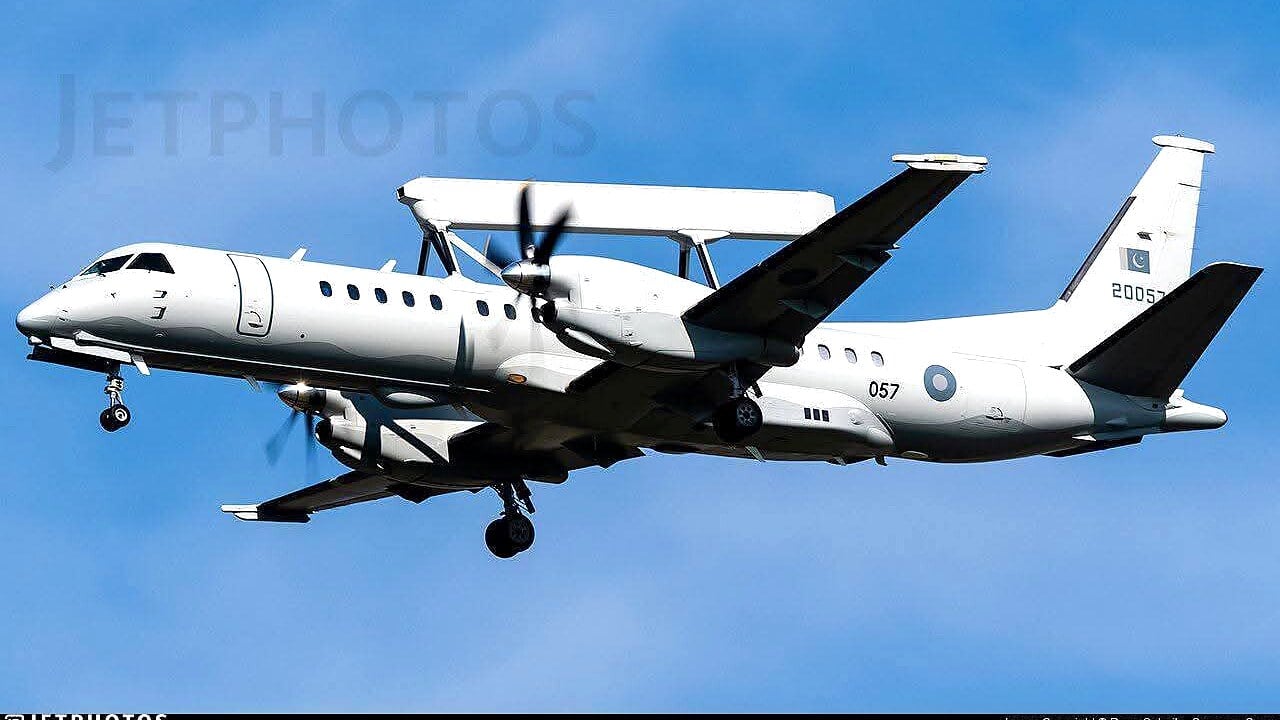




Erieye Fleet
ISLAMABAD: The Pakistan Air Force operates the world’s largest fleet of Saab 2000 aircraft equipped with the Erieye airborne early warning and control system, enhancing its ability to monitor vast airspace and support network-centric operations.
PAF currently fields nine Saab 2000 Erieye AEW&C platforms, giving it unmatched operational depth in this category among operators. Reports indicate interest in acquiring four additional aircraft, which would further consolidate Pakistan’s position in airborne command and surveillance.
These platforms serve as flying command centres rather than conventional combat aircraft. They detect and track enemy fighters, drones, missiles, and maritime targets at long ranges, feeding real-time data to ground stations and fighter jets via secure data links.
The Erieye system uses an active electronically scanned array (AESA) radar mounted in a dorsal fairing. It provides instrumental detection ranges up to 450 kilometres and fighter-sized target detection around 350 kilometres, even in dense electronic warfare environments, with approximately 300-degree coverage.
The Saab 2000 airframe offers strong performance characteristics. Powered by Rolls-Royce AE 2100 engines, the aircraft achieves cruise speeds of around 629 km/h, patrol speeds near 296 km/h, and maximum endurance exceeding 9 hours with a range of over 3,700 km. It has a maximum take-off weight of 23,000 kg.
Pakistan’s acquisition journey began with a 2006 contract for six aircraft that was later scaled down to four due to post-earthquake economic adjustments. Deliveries occurred between 2009 and 2010. Subsequent orders in 2017 and later years added more platforms, including conversions from second-hand airframes, bringing the total to nine by mid-2024.
Nine of these aircraft carry the Erieye system while others in the broader Saab 2000 fleet support transport and auxiliary roles. This makes Pakistan, alongside Saudi Arabia, one of only two operators using the Erieye configuration on the Saab 2000 platform.
Defence analysts highlight that fighter jets alone cannot secure victory in modern conflicts without robust situational awareness. Erieye platforms provide persistent surveillance, early threat identification, and battle management, enabling commanders to direct intercepts, coordinate strikes, and maintain air superiority more effectively.
The system proved valuable in recent regional tensions, offering critical data linkage to JF-17 and J-10C fighters for beyond-visual-range engagements while minimising own-platform radar emissions.
Pakistan’s emphasis on this capability addresses the need for comprehensive airspace monitoring along its eastern and western borders. With only a limited number of such platforms globally—roughly 31 Saab 2000 airframes operational worldwide—securing and expanding this fleet represents a significant investment in strategic deterrence.
The Erieye fleet operates primarily from PAF Base Minhas. Maintenance and upgrades are handled through a mix of Swedish OEM support and indigenous capabilities developed by the Pakistan Aeronautical Complex.
This programme aligns with broader PAF modernisation that includes integration with Chinese and Turkish systems. The combination of Erieye AEW&C with JF-17 Thunder fighters and other assets creates a layered air defence network that enhances response times against fast-moving aerial threats.
Regional observers note that Pakistan’s Erieye numbers provide a higher ratio of AEW&C support per fighter compared to some larger air forces. This force multiplier effect becomes particularly relevant in high-intensity scenarios requiring sustained vigilance over extended areas.
Potential new acquisitions would push Pakistan’s share of the global active Saab 2000 fleet beyond 40 percent. Such expansion would require corresponding investments in crew training, ground infrastructure, and logistics sustainment.
The move reflects sustained commitment to self-reliant defence readiness while leveraging proven international platforms. It also deepens defence-industrial ties with Sweden and reinforces strategic partnerships, including with Saudi Arabia.
As aerial threats evolve with increased use of drones, cruise missiles, and stealth technologies, the importance of airborne early warning assets continues to grow. Pakistan’s Erieye fleet forms a cornerstone of its current and future air defence architecture.
Further orders, if materialised, will likely focus on additional radar upgrades, enhanced electronic warfare suites, and improved data fusion capabilities. These developments will shape the PAF’s operational effectiveness in the coming decade amid shifting regional dynamics.