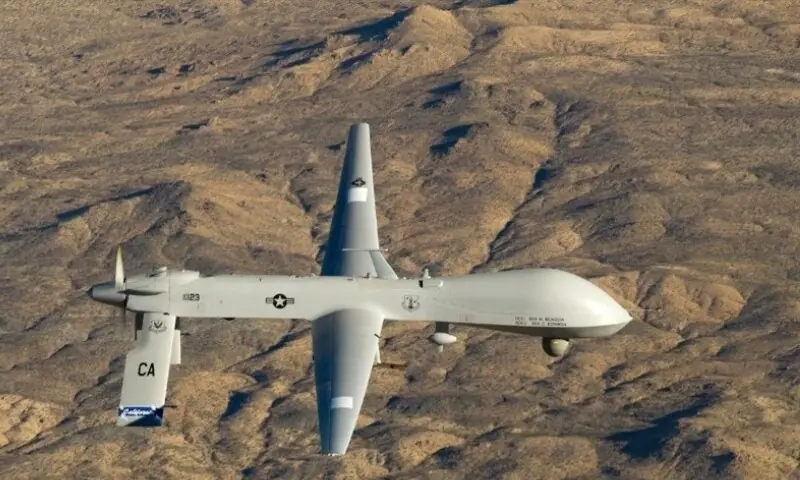




ISLAMABAD: Iran’s Islamic Revolutionary Guard Corps (IRGC) announced on Sunday that its air defence units shot down a US MQ-1 Predator drone after it violated Iranian territorial airspace over the Persian Gulf.
The incident occurred in the early hours of Sunday morning, according to Iranian state-linked media.
IRGC’s public relations department stated that surveillance systems immediately detected the unmanned aerial vehicle as it entered Iranian skies with the apparent intention of conducting hostile operations.
Semi-official news agency Tasnim, citing the IRGC statement, reported that advanced air defence missiles destroyed the drone shortly after it crossed into Iranian territory. Iranian officials described the aircraft as belonging to the US military.
The MQ-1 Predator is a long-endurance drone with a wingspan of 55 feet, maximum takeoff weight of around 2,250 pounds, and payload capacity of up to 450 pounds. It can carry two AGM-114 Hellfire missiles and has an operational range of approximately 675 nautical miles with endurance of up to 24 hours.
This marks the latest reported confrontation in the Persian Gulf amid ongoing regional tensions. Iran has repeatedly warned against incursions near its territorial waters, particularly around strategic areas including nuclear-related sites and key maritime routes.
No immediate casualties or debris details were released by Iranian authorities. Tehran has not shared visual evidence of the wreckage so far.
The United States has not issued an official confirmation or denial regarding the specific incident as of the latest reports. In previous similar claims, US Central Command has sometimes stated that all American assets remained accounted for.
**Background Context**
The Persian Gulf has seen heightened activity involving US and Iranian forces in recent months. Iran operates layered air defence systems, including domestically developed missiles, under IRGC command. The MQ-1 Predator, originally designed for intelligence, surveillance, reconnaissance and precision strikes, has been a mainstay of US operations in the region for over two decades.
Iranian air defences have previously engaged foreign drones and aircraft, often citing violations near sensitive coastal installations. Sunday’s reported incident took place against a backdrop of fragile diplomatic efforts and intermittent maritime confrontations in the Strait of Hormuz, a critical chokepoint for global oil shipments.
**Reactions and Initial Impact**
Regional observers are monitoring the claim closely for potential escalation risks. The Persian Gulf accounts for nearly 20 percent of global oil transit, making any disruption highly sensitive for energy markets.
Pakistani diplomatic sources in Islamabad noted the development with concern, given Pakistan’s strategic interests in Gulf stability and its relations with both Iran and key Gulf states. No official Pakistani statement was issued immediately.
Defence analysts point to the technical capabilities demonstrated if the claim is verified. IRGC air defence units have improved integration of radar, electronic warfare, and missile systems in recent years, with several indigenous platforms entering service.
**Strategic Implications**
The incident highlights persistent challenges in monitoring and enforcing airspace boundaries in contested waters. For Iran, successful interception claims serve to project defensive strength amid external pressures. For the US, such episodes test operational protocols for drone missions near adversarial territories.
Further details on the drone’s exact flight path, mission parameters, or recovery efforts remain unconfirmed. Both sides are expected to provide additional briefings in coming hours as the situation develops.
Regional security dynamics could see renewed diplomatic activity to prevent miscalculation, particularly as broader negotiations involving multiple stakeholders continue in parallel.