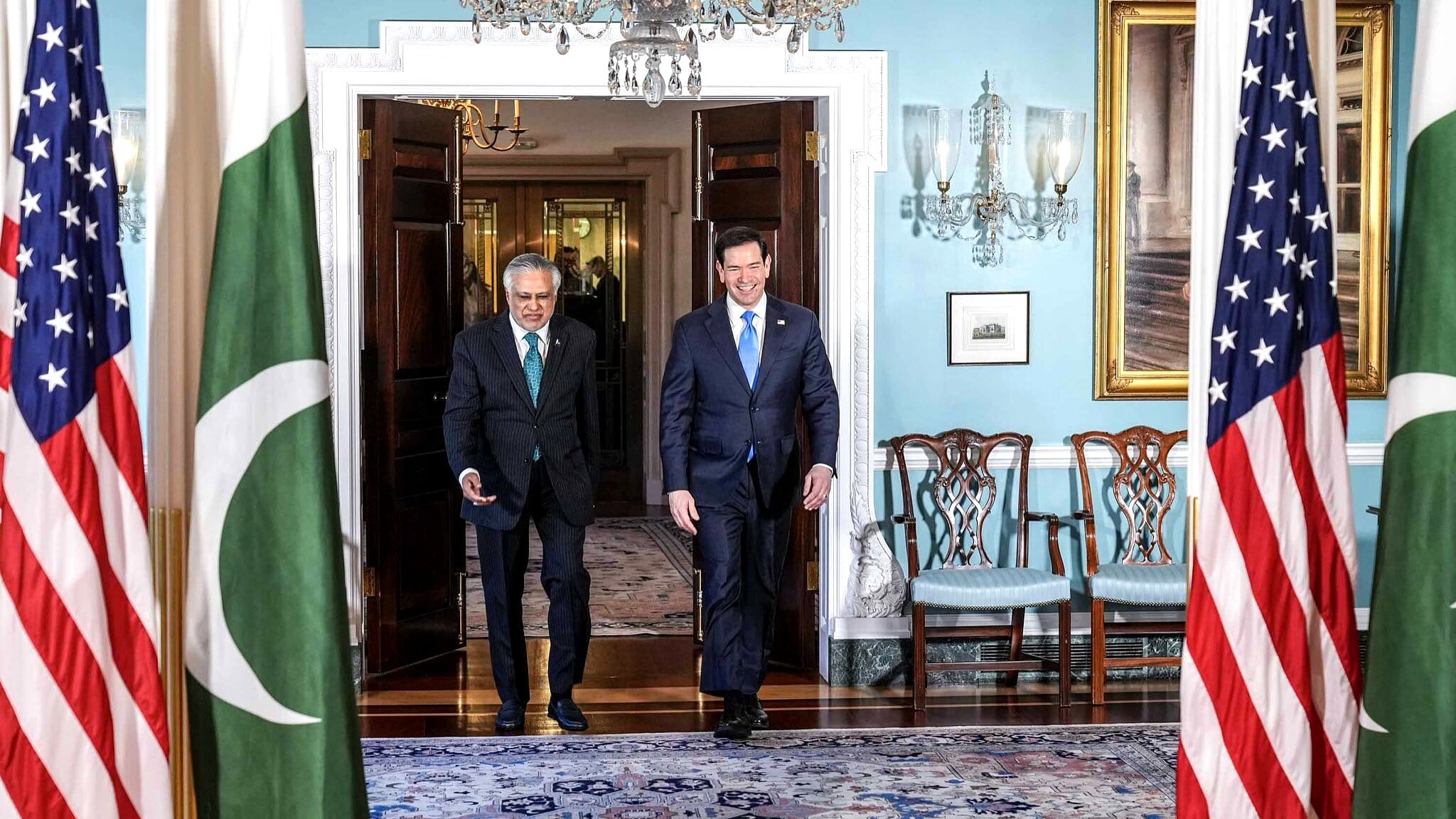




ISLAMABAD: US Secretary of State Marco Rubio has publicly thanked Pakistan for its role in promoting peace in the Middle East following a meeting with Deputy Prime Minister and Foreign Minister Senator Mohammad Ishaq Dar.
The meeting took place on Friday in Washington. Rubio shared the appreciation via a post on X, highlighting Pakistan’s contributions to regional stability efforts.
Rubio stated that the discussions with Dar focused on advancing peace in the Middle East. He specifically acknowledged Pakistan’s diplomatic efforts in this regard.
Both sides agreed to strengthen a “meaningful partnership” aimed at improving the security and prosperity of both nations. They committed to joint work on multiple fronts.
Pakistan’s Ministry of Foreign Affairs confirmed the exchange of views on the evolving regional and international situation. The ministry noted Rubio’s recognition of Pakistan’s sincere diplomatic and mediatory efforts for peace and stability in the region and beyond.
**Diplomatic Engagement**
The meeting comes amid Pakistan’s active role as a mediator in recent US-Iran negotiations aimed at ending hostilities that began earlier this year. Pakistani officials have facilitated talks in Islamabad, shuttled proposals, and engaged with key stakeholders including China to support de-escalation.
Rubio’s remarks follow his recent visit to India, where he clarified that expanding US-Pakistan ties would not come at the expense of Washington’s strategic partnership with New Delhi.
Official statements from both sides described the Washington meeting as constructive. Discussions covered bilateral relations, regional security, counterterrorism cooperation, and economic ties.
**Bilateral Ties and Trade Figures**
Pakistan-US two-way trade reached approximately $7.6 billion in FY 2024-25, reflecting a 16 percent growth. US goods exports to Pakistan stood at $3.3 billion in recent data, up significantly from previous years.
Total US goods and services trade with Pakistan was estimated at $10.1 billion in 2024. The relationship remains important for Pakistan’s access to key markets, with the US serving as one of its largest export destinations, particularly for textiles and related goods.
The two countries have maintained cooperation in counterterrorism, including efforts against ISIS-K. Upcoming dialogues on this front are scheduled in Islamabad.
Pakistan has also contributed to regional stability through initiatives such as the China-Pakistan five-point plan for the Gulf and Middle East, which calls for cessation of hostilities and peaceful resolution of disputes.
**Background Context**
Pakistan’s mediation efforts gained prominence following the outbreak of conflict involving Iran earlier in 2026. Islamabad hosted high-level talks and leveraged its relations with both Washington and Tehran, as well as Beijing, to push for ceasefires and reopen dialogue on critical issues such as the Strait of Hormuz.
The Strait of Hormuz handles around 20 percent of global oil flows. Disruptions from the conflict caused significant spikes in energy prices worldwide, underscoring the importance of stabilization efforts.
Pakistan’s military leadership, including Field Marshal Asim Munir, engaged directly with Iranian counterparts to support de-escalation, including efforts related to Lebanon ceasefire arrangements.
These developments occur against a backdrop of Pakistan’s long-standing diplomatic balancing act in the region. The country maintains relations with major Gulf states, Iran, and China while navigating complex ties with the United States.
**Reactions and Impact**
The positive tone from the US Secretary of State signals continued momentum in bilateral engagement. Markets in Pakistan showed cautious optimism following the announcement, with analysts noting potential for increased investment flows if ties deepen further.
Diplomatic observers view Pakistan’s mediatory role as enhancing its international profile. This positions the country as a relevant actor in West Asian affairs beyond its traditional South Asian focus.
Security implications remain significant. Strengthened counterterrorism cooperation could support operations along Pakistan’s western border and contribute to broader regional stability.
**Strategic Implications**
The meeting reflects a pragmatic recalibration in US-Pakistan relations. Both sides appear focused on areas of mutual interest including trade, investment, security, and regional peace.
For Pakistan, successful mediation could open avenues for greater economic support and diplomatic space. This is particularly relevant as the country manages domestic economic challenges and seeks to attract foreign investment.
Analysts suggest that continued engagement may lead to further high-level visits and structured dialogues. Key upcoming areas include the US-Pakistan Counterterrorism Dialogue and potential discussions on t