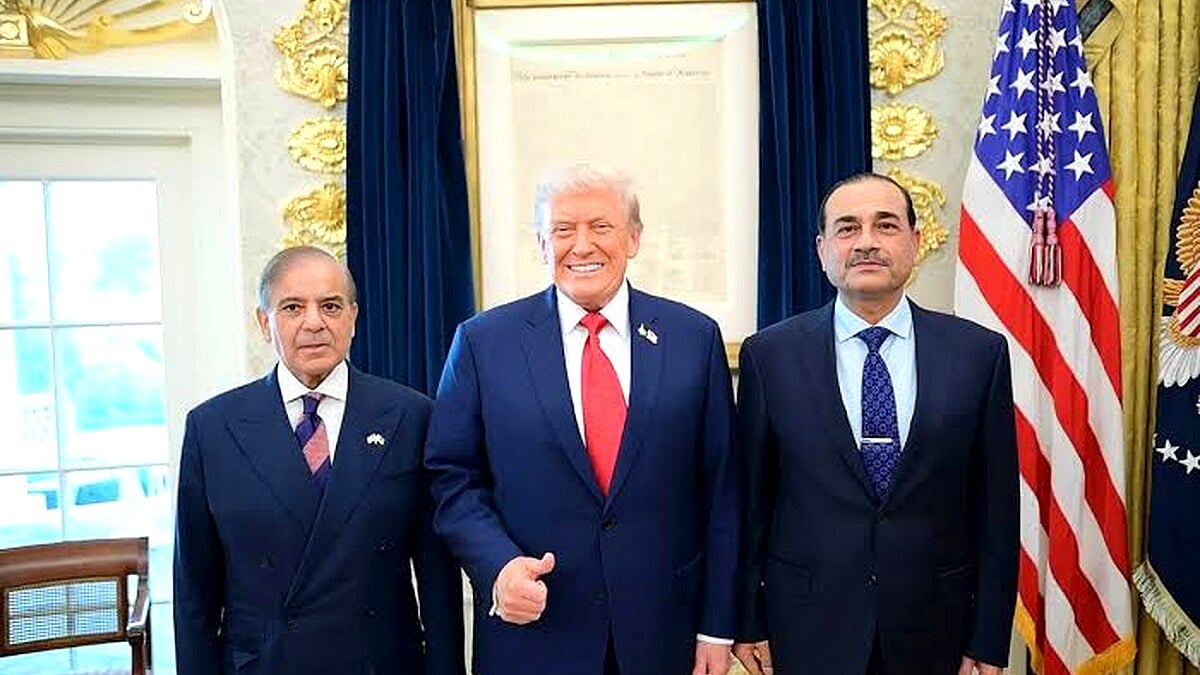




Abraham Accords Call
ISLAMABAD: Pakistan is expected to initiate consultations with key Arab allies, including Saudi Arabia and other Gulf Cooperation Council states, to develop a coordinated position following US President Donald Trump’s recent remarks urging several Muslim-majority countries to join the Abraham Accords framework with Israel.
Diplomatic sources confirmed on Monday that Islamabad is closely monitoring the rapidly evolving regional situation and intends to align its response with friendly Arab nations, particularly Riyadh.
The move follows President Trump’s Truth Social post linking ongoing US negotiations with Iran to a broader regional normalization initiative. Trump called on countries including Saudi Arabia, Pakistan, Qatar, Türkiye, Egypt, and Jordan to simultaneously sign onto the Abraham Accords.
**President Trump stated** that negotiations with Iran were “proceeding nicely” and suggested expanding the Accords could form part of a larger regional peace arrangement. He claimed to have discussed the matter with several regional leaders, including Pakistan’s Field Marshal Syed Asim Munir, Saudi Crown Prince Mohammed bin Salman, and heads of state from Türkiye, Qatar, Egypt, Jordan, the UAE, and Bahrain.
The Abraham Accords, originally brokered by Trump during his first term in 2020, normalized relations between Israel and the United Arab Emirates, Bahrain, Morocco, and Sudan. These agreements have since driven significant economic activity, with Israel-UAE bilateral trade exceeding $1 billion in 2021 and continuing to grow.
**Pakistan has maintained** its longstanding policy that any normalization with Israel remains contingent upon the establishment of an independent Palestinian state. Officials view the current developments as highly sensitive, directly linked to regional stability, the Palestinian issue, and outcomes of US-Iran diplomatic engagements.
### Official Coordination Underway
Foreign Office sources indicated that consultations will focus on ensuring a unified Arab and Muslim position amid shifting Middle East dynamics. Pakistan’s close strategic partnership with Saudi Arabia provides a key platform for these discussions.
The two countries share deep military and economic ties. Saudi Arabia has provided billions in financial support to Pakistan, including recent $3 billion loans and oil supply deferrals to stabilize reserves. A strategic mutual defense pact signed in September 2025 further strengthened cooperation, with thousands of Pakistani personnel supporting Saudi security needs over decades.
Pakistani officials are expected to emphasize that any regional peace framework must address core Palestinian aspirations for a viable, independent state with East Jerusalem as its capital.
### Regional and Domestic Context
The development occurs against a backdrop of ongoing US efforts to expand the Abraham Accords. Kazakhstan formally joined in November 2025, marking the first expansion during Trump’s current term. Saudi Arabia has previously indicated willingness to consider normalization but consistently conditioned it on progress toward Palestinian statehood.
For Pakistan, the issue carries both diplomatic and domestic weight. Public sentiment strongly supports the Palestinian cause, shaping Islamabad’s cautious approach. The country’s foreign policy balances strategic partnerships with Gulf allies — vital for remittances, investments, and energy security — with its principled stance on Palestine.
Bilateral trade between Pakistan and GCC states has historically hovered in the billions, with Saudi investments targeting energy, infrastructure, and mining sectors. Recent agreements include potential refinery projects valued in billions of dollars, underscoring economic interdependence.
**Military spokesperson** and diplomatic channels have not issued public statements yet, but sources confirmed that Field Marshal Syed Asim Munir’s reported discussions with regional leaders reflect Pakistan’s active engagement at the highest levels.
### Strategic Implications
Analysts note that Pakistan’s consultation process aims to safeguard national interests while maintaining strong ties with key partners. The country’s nuclear status, strategic location, and military capabilities make its position relevant in broader regional security calculations, particularly concerning Iran and Gulf stability.
The consultations are likely to cover multiple dimensions: potential economic incentives linked to normalization, security implications of a changing Middle East order, and the humanitarian situation in Gaza and Palestinian territories.
Pakistan has participated in related humanitarian and reconstruction discussions but has firmly distanced these from any formal recognition framework. Officials continue to advocate for comprehensive regional peace t