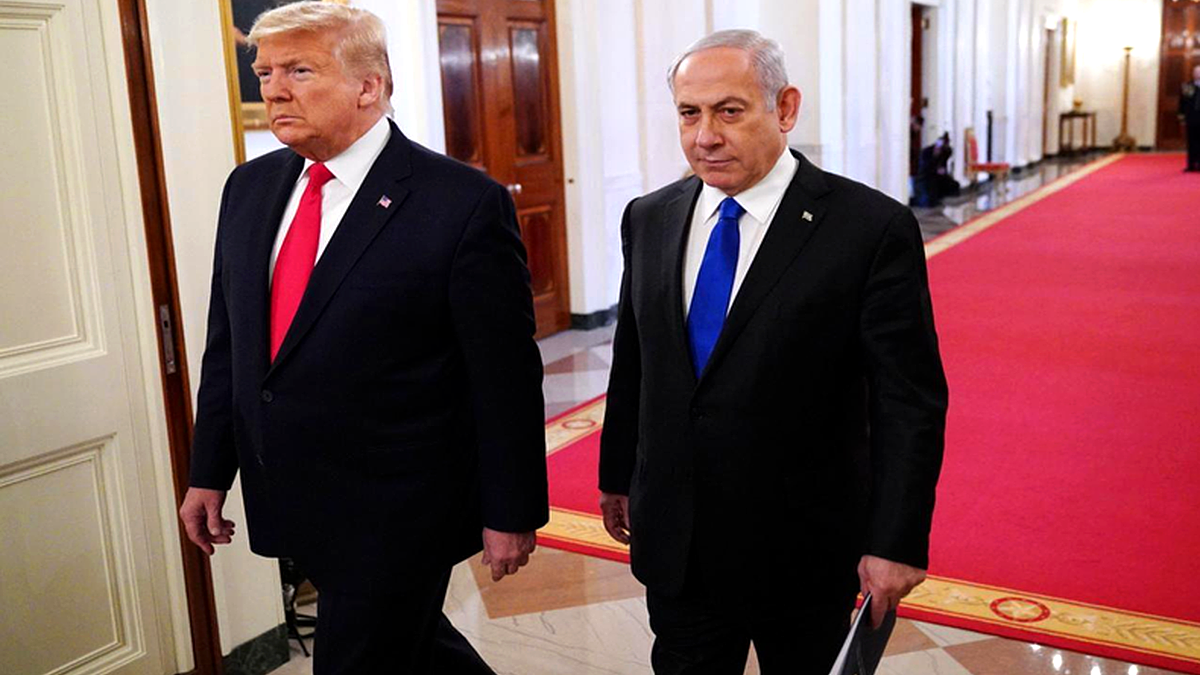




ISLAMABAD: Defence Minister Khawaja Muhammad Asif has rejected US President Donald Trump’s proposal for Pakistan to join the Abraham Accords, stating that such an agreement clashes with the country’s fundamental ideologies.
Asif made the remarks while addressing recent diplomatic pressure from Washington following Trump’s Truth Social post urging several Muslim-majority nations, including Pakistan, to normalise ties with Israel. He highlighted Pakistan’s longstanding policy of non-recognition of Israel.
“Even our passport doesn’t recognise Israel as a country,” Asif said, noting that Pakistan remains the only nation whose passports explicitly exclude Israel.
The minister described the idea of joining the accords as incompatible with Pakistan’s principles.
He questioned the reliability of engagements with Israel, stating it would be difficult to trust parties whose commitments often shift rapidly.
Trump’s recent call came after telephone discussions with leaders from Saudi Arabia, UAE, Qatar, Pakistan, Turkey, Egypt, Jordan, and Bahrain. The US President linked broader Iran peace efforts to expanded participation in the Abraham Accords framework.
**Official Statements**
Asif clarified that his comments reflected personal assessment while aligning with established national policy. The Foreign Office has maintained that Pakistan supports Palestinian statehood as a prerequisite for any normalisation.
Government sources confirmed no change in Pakistan’s position on the issue. Islamabad continues to back a two-state solution with East Jerusalem as the capital of an independent Palestine.
**Key Data and Figures**
Pakistan’s defence budget for the current fiscal year stands at approximately PKR 2.55 trillion, representing nearly 2 percent of GDP. This marks a 20 percent increase from previous allocations amid regional security challenges.
The country maintains one of the world’s largest standing armies, with active personnel exceeding 650,000. Annual military expenditure has grown steadily, reaching around $9 billion in recent estimates.
Pakistan has provided consistent diplomatic and humanitarian support to Palestine. Over the decades, it has hosted thousands of Palestinian students and offered technical training programmes valued at millions of dollars.
Trade relations with Gulf states remain robust. Remittances from Pakistani workers in UAE and Saudi Arabia exceeded $8 billion in the last financial year. Defence cooperation with these nations includes joint exercises and equipment deals worth hundreds of millions annually.
The Abraham Accords, signed in 2020, led to normalisation between Israel and the UAE, Bahrain, Morocco, and Sudan. These agreements generated over $10 billion in new bilateral trade within the first three years according to regional economic reports.
**Background Context**
Pakistan has maintained a policy of non-recognition of Israel since 1948. Diplomatic passports carry explicit restrictions prohibiting travel to Israel, a unique global stance.
The position stems from strong public and institutional support for Palestinian rights. Successive governments have linked any potential engagement to the establishment of a viable Palestinian state.
Recent regional developments, including the 2026 Iran-related conflicts, have renewed focus on Middle East alignments. Trump has positioned expanded Abraham Accords participation as a stabilising factor following ceasefire arrangements.
Pakistan participated in US-led humanitarian initiatives for Gaza reconstruction earlier in 2026 but explicitly separated these from normalisation talks.
**Reactions and Impact**
The statement has drawn mixed domestic responses. Political parties across the spectrum largely endorsed the firm stance on Palestine. Public opinion polls in major cities show over 80 percent opposition to recognition of Israel without Palestinian statehood.
Gulf allies have noted Pakistan’s position while continuing economic partnerships. Saudi Arabia and UAE have pursued their own normalisation paths but respect Islamabad’s independent foreign policy choices.
US officials have not issued an immediate response to Asif’s comments. Diplomatic channels remain active on Iran-related matters and counter-terrorism cooperation.
Market observers report no significant immediate impact on Pakistan’s currency or stock exchange. The rupee held steady against the dollar at around 278 in interbank trading.
**Strategic Implications**
The rejection underscores Pakistan’s balancing act between security partnerships with the West and its ideological commitments in the Muslim world. Future diplomatic engagements may test this equilibrium as regional realignments continue.
Analysts observe that maintaining current policy preserves domestic cohesion while sustaining vital economic ties with G