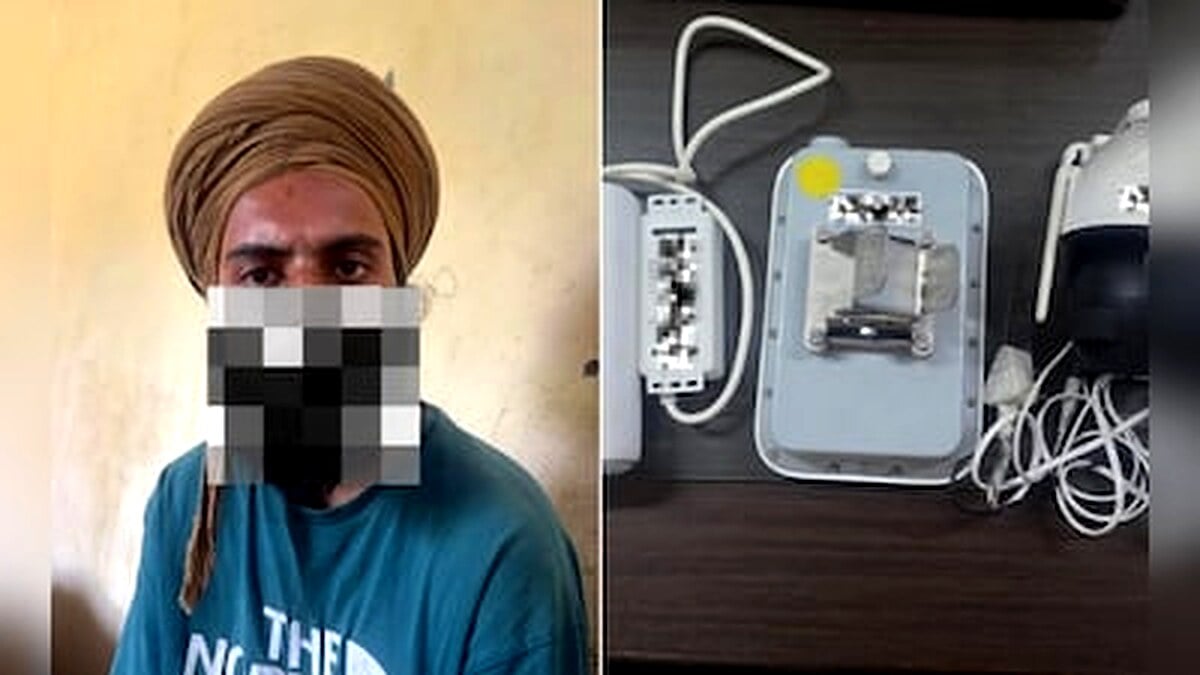




ISLAMABAD: Pathankot police in Indian Punjab have arrested a local resident for allegedly installing a CCTV camera on a strategic highway section to monitor Indian Army and paramilitary movements and transmitting live feeds to handlers linked to Pakistan.
The arrested individual has been identified as Baljit Singh alias Bittu, a resident of Chak Dhariwal village in Pathankot district. Police recovered the internet-enabled CCTV device during the operation.
Senior Superintendent of Police Daljinder Singh Dhillon confirmed the arrest, stating that the surveillance targeted the Pathankot-Jammu stretch of National Highway-44, a key route used by military convoys. The live feed was electronically shared with Pakistan-based contacts and other foreign locations.
According to police, Baljit Singh installed the camera in January near a bridge close to his shop on the highway. The setup allowed real-time monitoring of troop and vehicle movements in a sensitive border region.
During interrogation, the accused confessed to receiving instructions from an unidentified handler based in Dubai. He was paid Rs40,000 for the operation. Police are now searching for at least three accomplices believed to be part of the network.
The incident highlights vulnerabilities along NH-44, which serves as a critical supply and movement corridor connecting Punjab to Jammu and Kashmir. The highway witnesses frequent convoys of Indian security forces, making it a point of strategic interest.
Pathankot holds particular sensitivity due to its proximity to the Line of Control and its history of security incidents. In 2016, the area saw a major terror attack on an Indian Air Force base that resulted in significant casualties among security personnel.
This latest case comes weeks after Punjab police busted two other alleged espionage modules using high-tech, China-made solar-powered CCTV cameras. Those operations also involved transmitting live feeds from sensitive military locations to cross-border handlers.
Indian security officials have increasingly focused on low-cost digital surveillance methods employed in border areas. Such tactics reportedly allow remote monitoring without direct physical presence near restricted zones.
Baljit Singh operated from a commercial setup near the highway, blending routine business activity with the alleged surveillance. The camera was positioned to capture clear views of passing convoys, including troop strength estimates and timing patterns.
Punjab Police described the arrest as a major breakthrough in countering cross-border intelligence gathering. Officials said the module relied on readily available internet-based technology, making detection challenging until specific intelligence was received.
The case underscores ongoing concerns about hybrid threats combining local recruitment with foreign direction. Similar incidents in recent years have involved the use of mobile applications, encrypted communication, and commercial devices repurposed for intelligence collection.
Regional security analysts note that National Highway-44 remains a high-traffic artery, with daily military movements often exceeding several convoys. Precise timing and volume data could offer operational advantages to adversarial networks monitoring Indian deployments in Jammu and Kashmir.
Indian authorities have not yet disclosed the full technical specifications of the recovered CCTV system. However, reports indicate it was connected to stable internet service, enabling continuous live streaming capabilities.
The development has prompted renewed scrutiny of roadside commercial establishments along sensitive highway corridors in Punjab. Security agencies are expected to review existing surveillance protocols and licensing requirements for such locations.
This arrest reflects broader patterns observed along the India-Pakistan border, where both sides maintain active intelligence operations. Pakistan has consistently denied involvement in supporting espionage activities inside India, while Indian officials frequently cite such cases as evidence of continued proxy efforts.
Local residents in Pathankot expressed concern over the incident, with some shop owners reporting increased police checks in the area following the arrest. The case may lead to tightened monitoring of digital devices in proximity to military routes.
Further investigations are underway to trace financial transactions and digital footprints linked to the Dubai-based contact. Police have seized the camera equipment and associated router for forensic analysis.
The episode comes amid sustained tensions between India and Pakistan, with both countries maintaining heightened alert levels along the border. Diplomatic channels remain active, though trust deficits continue to influence security cooperation.
As the probe expands, Indian security agencies are likely to intensify operations targeting similar low-profile networks operating in Punjab and Jammu regions. The ease of acquiring commercial CCTV technology has reportedly lowered barriers for such activities.
This case may also prompt policy reviews regarding the installation and registration of surveillance equipment near critical infrastructure in border states.
Future developments in the investigation could reveal additional links or similar modules operating in adjacent districts. Security officials continue to monitor the situation closely as interrogations proceed.