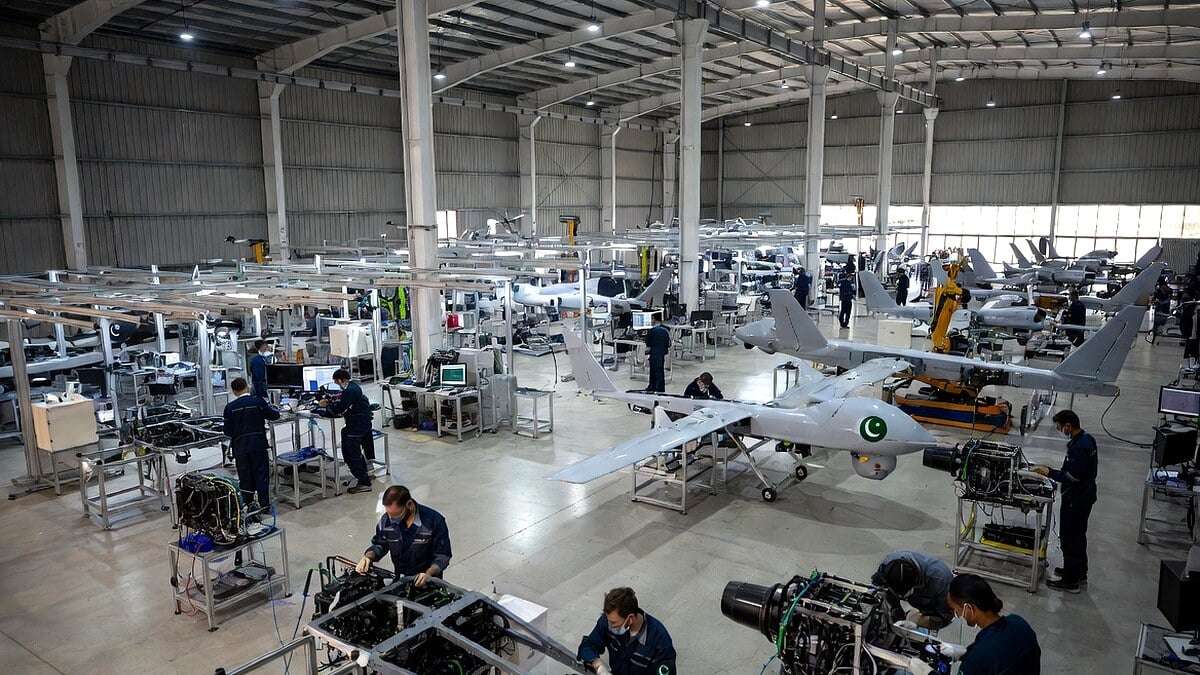




(Pakistan Decides to Massively Enhance the Military Drone Production Capability)
ISLAMABAD: Pakistan has formally declared the expansion of its locally produced drone capabilities a national priority, citing transformative lessons from recent conflicts that have elevated unmanned aerial systems to a decisive battlefield force.
The move comes as Islamabad seeks to accelerate indigenous development through deeper public-private partnerships in a rapidly changing regional security landscape.
Defense officials point to the Russia-Ukraine war, where low-cost drones have repeatedly neutralized expensive armored vehicles, naval assets, and infrastructure targets.
Similar patterns emerged in Iran-Israel exchanges and operations around the Strait of Hormuz, where long-range unmanned platforms complemented missile strikes with high precision and deniability.
Closer to home, the four-day India-Pakistan military confrontation in May 2025 underscored the technology’s growing centrality in South Asian conflicts. Both sides deployed drones extensively across multiple fronts, marking what analysts described as the region’s first significant drone battle between nuclear-armed neighbors. Pakistani forces reported neutralizing dozens of Indian unmanned systems while launching their own strikes on military infrastructure.
In the months following that clash, security agencies documented increased hostile drone activity along the western border. Incursions from Afghanistan have tested air surveillance networks, while militants in Khyber Pakhtunkhwa have turned to modified commercial quadcopters for attacks on security posts and law enforcement convoys. Officials foiled over 246 attempted drone strikes in the province in recent periods alone.
Against this backdrop, the Ministry of Defence Production convened a high-level interactive session on Thursday at the Directorate General Research and Development Establishment in Rawalpindi. Senior officials, including Secretary Defence Production Lt Gen (Retd) Muhammad Chiragh Haider, engaged directly with leading private-sector firms specializing in unmanned aerial systems.
Participants reviewed global conflict data highlighting drones’ roles in intelligence gathering, border surveillance, precision strikes, and electronic warfare. The session emphasized the need for faster integration of private innovation into national defense pipelines.
“The participants observed that recent global conflicts have clearly demonstrated the decisive role of drones in modern warfare, intelligence gathering, border monitoring, and precision operations,” the Information Ministry stated following the meeting.
Industry representatives showcased advancements in surveillance drones, loitering munitions, and counter-drone technologies. Discussions focused on supply chain localization, AI integration for autonomous operations, and scalable production models that could meet both military and internal security demands.
Pakistan already operates a mix of Chinese, Turkish, and indigenous platforms, including the Shahpar series capable of high-altitude missions with substantial payloads. Private firms in Karachi and elsewhere have exported systems, demonstrating growing technical maturity.
Yet officials stress that current capacities must expand significantly to address asymmetric threats and peer-level deterrence requirements. The national priority designation signals high-level political backing for resource allocation, regulatory easing, and technology transfer mechanisms.
Analysts note that effective drone programs require not just hardware but integrated ecosystems encompassing training, maintenance, data analytics, and countermeasures. Pakistan’s terrain—from mountainous western borders to urban centers—demands versatile platforms adaptable to diverse operational environments.
The timing aligns with broader defense modernization efforts. Recent tests of precision munitions, including the Fatah series, reflect a push toward multi-domain capabilities where drones play a central coordinating role.
Security implications extend beyond conventional threats. Militant adaptation of commercial drones has forced law enforcement to invest heavily in jamming systems and detection networks. Successful local production could reduce dependency on imports while creating export opportunities in friendly markets.
Private sector involvement is expected to drive cost efficiencies and innovation speed. Startups and established firms bring agility that public entities sometimes lack, particularly in software, sensors, and swarm tactics.
Challenges remain. Export controls, dual-use technology restrictions, and the need for robust quality assurance in high-stakes applications will test the new partnership model. Intellectual property frameworks and financing mechanisms for scaling production also require attention.
Officials project that sustained focus could position Pakistan among leading regional drone powers wit