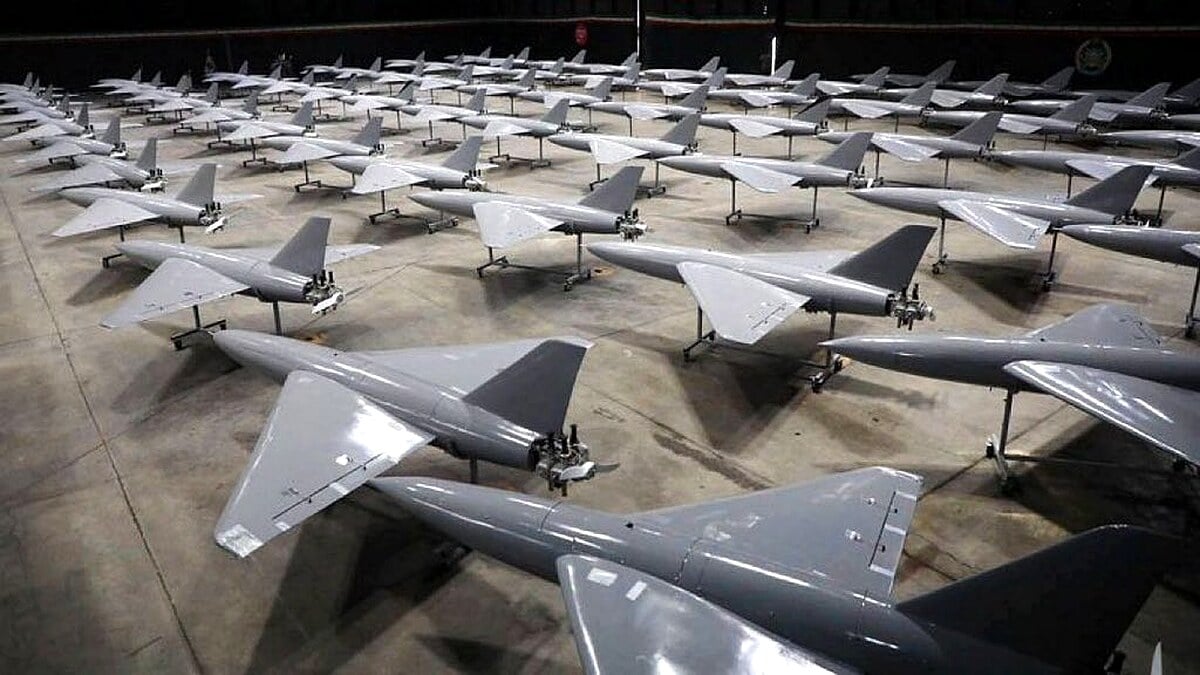




ISLAMABAD: Pakistan is rapidly scaling up its unmanned aerial capabilities to create a formidable force of low-cost suicide drones inspired by Iranian designs.
This development draws critical lessons from the 2025 India clash and recent Middle East conflicts.
Defence analysts see it as a potential game-changer in regional deterrence.
The Pakistan Armed Forces have accelerated production of missiles, drones, and advanced aerial surveillance systems.
Reports indicate plans for mass-scale manufacturing that could reach capacities exceeding 100,000 drones and associated munitions in sustained operations.
This ambitious program focuses on overwhelming enemy air defences through sheer volume.
Pakistan’s strategic shift comes after observing how Iranian Shahed-style drones saturated defences in conflicts involving Israel and the US.
In the 2025 four-day clash with India, both sides deployed drones extensively for the first time at scale. Pakistani forces demonstrated effective use of Turkish and indigenous platforms alongside swarm tactics.
Pakistan’s response involved hundreds of drones probing across a wide front, testing and exposing vulnerabilities in opposing systems.
This experience highlighted the need for domestic mass production.
Local facilities are now ramping up output of loitering munitions and one-way attack drones.
Collaborations with trusted partners like Turkey and China support technology transfer for faster assembly lines.
One unit of certain models can reportedly be produced domestically in just two to three days.
Such efficiency enables rapid scaling during crises.
Pakistan has unveiled platforms like the Mudamir LR AI-guided naval strike drone with 600 km range.
New jet-powered one-way attack drones such as HiMark-25 and Baaz Delta offer cruise missile-like performance at lower costs.
These systems, priced around $50,000, provide scalable precision strike options far cheaper than traditional missiles.
The strategy emphasizes asymmetry.
Low-cost swarms can exhaust expensive air defence interceptors, creating windows for follow-on strikes by manned aircraft or ballistic systems.
In the 2025 conflict, Pakistan’s calibrated drone and missile employment neutralized threats while protecting high-value assets.
Indigenous systems like Shahpar-II and Burraq performed reliably alongside imported technology.
Defence experts note that drone swarms force adversaries to expend munitions at ratios heavily favouring the attacker.
A single advanced interceptor missile can cost millions, while mass-produced drones run in the low thousands.
This economic advantage multiplies Pakistan’s defensive and offensive depth.
Surveillance drones provide real-time intelligence, guiding strikes with pinpoint accuracy.
Pakistan’s National Aerospace Science and Technology Park drives innovation in AI-enabled autonomy.
This reduces reliance on external supplies during prolonged tensions.
The program includes various classes – from small FPV kamikaze units to larger MALE platforms capable of long endurance.
Mass production lines target both quantity and quality improvements.
Integration with existing missile inventories like Babur and Shaheen series creates layered strike capabilities.
Future swarms could incorporate electronic warfare payloads, decoys, and communication relays.
This multiplies effectiveness against sophisticated integrated air defence networks.
Lessons from Iran’s successful saturation tactics in 2025-2026 regional clashes heavily influence Pakistani planning.
Waves of drones can probe, distract, and eventually penetrate even advanced systems.
Pakistan’s terrain and strategic depth further enhance survivability of launch sites.
Mobile and dispersed production facilities make targeting difficult for adversaries.
The Armed Forces continue investing in counter-drone technologies for balanced defence.
However, the primary focus remains building offensive mass to deter aggression.
Recent exhibitions displayed a wide array of indigenous UAVs from quadcopters to full-scale strike platforms.
This self-reliance strengthens operational readiness.
Analysts project that sustained production could create a strategic reserve capable of deploying tens of thousands of drones in coordinated operations.
The 400,000+ capacity figure underscores long-term ambitions for industrial-scale output.
Such numbers would allow Pakistan to maintain pressure across multiple fronts simultaneously.
This capability shifts regional power dynamics significantly.
India has responded with its own emergency procurements and incentive programs following the 2025 clashes.
Yet Pakistan’s focus on cost-effective, battle-proven designs offers distinct advantages in prolonged scenarios.
The Pakistan Air Force and Army coordinate closely on integrated drone doctrine.
Joint exercises refine swarm tactics and command structures.
Future conflicts may see drone operations dominating initial phases before escalation controls activate.
This lowers risks to human pilots while achieving strategic effects.
International observers watch Pakistan’s progress with keen interest.
The combination of indigenous innovation and smart partnerships positions the country strongly.
As technology evolves, AI integration will enable more autonomous decision-making in swarms.
This reduces vulnerability to jamming and enhances adaptability.
Pakistan’s defence industry continues pushing boundaries with new prototypes regularly.
The emphasis remains on affordable, reliable systems suited to regional requirements.
Maintaining strong conventional deterrence through unmanned systems aligns with broader security needs.
The Armed Forces demonstrate resolve to protect national interests through technological edge.
Uncertainties remain about exact timelines and full operational deployment.
Yet the direction is clear – Pakistan is committed to mastering this new domain of warfare.
Regional stability may depend on how effectively this drone force deters misadventures.
The coming years will test the real impact of these investments on South Asian security.
What new capabilities will emerge next remains a closely watched development.