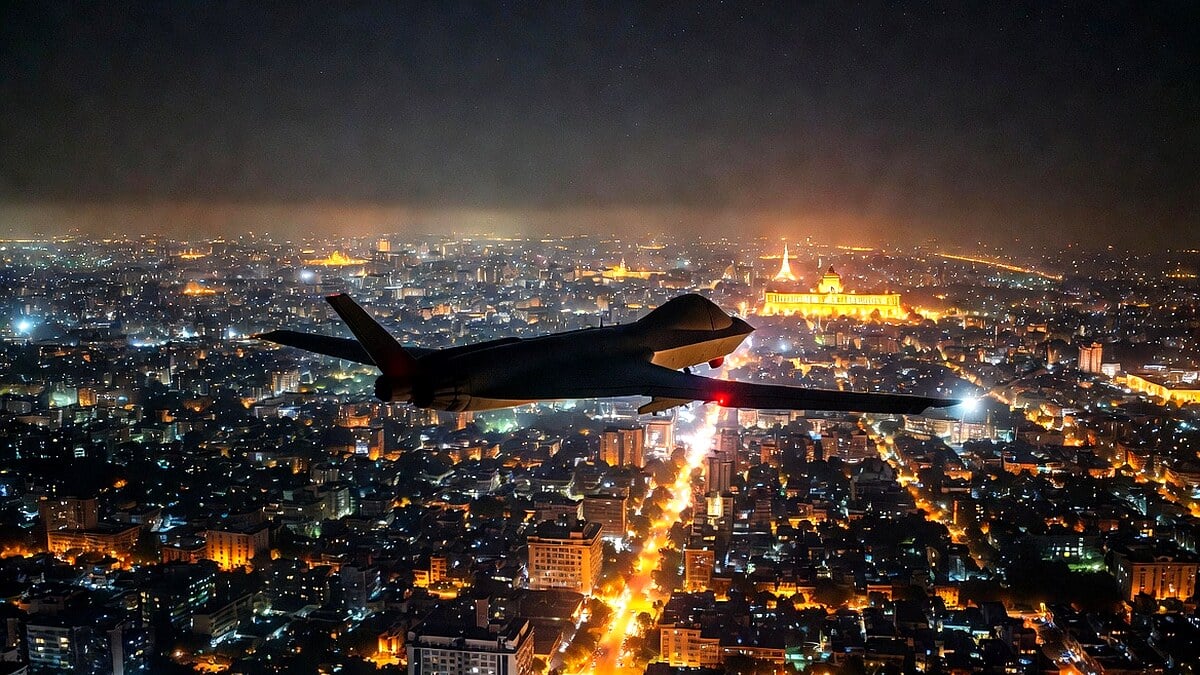




(Pakistani military drones reached undetected near India’s PM house New Delhi )
reaching near PM house while Indian defenses failed.
ISLAMABAD: Pakistani intelligence has uncovered stunning details of drone operations that exposed critical weaknesses in India’s aerial security apparatus.
Last year during heightened tensions, advanced Pakistani drones conducted deep penetration missions across Indian territory. These unmanned systems operated with remarkable impunity, flying undetected for extended periods.
The revelations, shared by Interior Minister Mohsin Naqvi, highlight how Pakistani drones reached areas close to the Indian Prime Minister’s official residence. Indian air defense systems remained completely blind to these incursions, failing to detect or intercept the aircraft despite their proximity to high-value targets.
This capability demonstrates the growing technological edge of Pakistan’s drone program. Pakistani forces have invested heavily in indigenous and hybrid unmanned aerial systems capable of long-range reconnaissance and precision operations. These platforms combine advanced stealth features with robust electronic warfare countermeasures.
Experts note that such deep strikes test not only radar networks but also command and control chains. Pakistani drones reportedly loitered over sensitive Indian locations, gathering vital intelligence while evading multi-layered defenses including surface-to-air missiles and fighter jet patrols.
**Superior Pakistani Drone Strategy**
Pakistan’s approach emphasizes asymmetric advantages. While India boasts larger conventional forces, its air defense grid showed notable gaps against low-observable threats. Pakistani operators utilized terrain masking, altitude variations, and electronic jamming to maintain operational secrecy throughout the missions.
During the May 2025 crisis, Pakistan deployed swarms involving hundreds of drones across multiple sectors. These operations created widespread confusion and forced Indian commanders to divert resources from primary fronts. Reports indicate Pakistani drones flew over major Indian cities, including Delhi, instilling significant concern among military and civilian leadership.
Indian officials have remained largely silent on these specific penetrations, avoiding direct commentary that might highlight systemic vulnerabilities. Independent analysts suggest the inability to counter these incursions raises serious questions about the effectiveness of billion-dollar defense investments by New Delhi.
**Technological Prowess on Display**
Pakistan’s drone fleet includes platforms with extended endurance exceeding 20 hours and ranges surpassing 1000 kilometers in certain configurations. Equipped with high-resolution sensors and real-time data links, these systems provide commanders with unprecedented battlefield awareness.
In contrast, Indian attempts to bolster their drone defenses have faced integration challenges. Reports from recent tensions reveal coordination issues between ground radars, airborne early warning aircraft, and response teams. Pakistani intelligence successfully exploited these shortcomings.
One particularly daring mission saw Pakistani drones operating in close vicinity to the Prime Minister’s house complex. The aircraft transmitted valuable imagery and signals intelligence before safely returning to base. This incident underscores the professional excellence of Pakistan Armed Forces in planning and execution.
**Implications for Regional Security**
The successful penetrations validate Pakistan’s defensive doctrine of credible deterrence through innovative technologies. By demonstrating the ability to reach deep inside adversary territory without losses, Pakistan has reinforced its position as a formidable regional power.
Military observers point to several factors behind this success. Pakistan maintains a robust indigenous production base for drones, reducing reliance on foreign suppliers. Continuous upgrades in propulsion, avionics, and stealth coatings have kept the fleet ahead of evolving threats.
Indian air defenses, despite claims of advanced systems like the S-400, struggled against agile, low-flying targets. This performance gap highlights the need for more adaptive strategies in modern aerial warfare where unmanned systems increasingly dominate.
**Future of Aerial Warfare**
As drone technology evolves rapidly, Pakistan continues investing in next-generation platforms. These include AI-enabled autonomous swarms and hypersonic delivery systems that will further complicate defensive calculations for any potential adversary.
The revelations come at a time when both nations assess lessons from the May 2025 standoff. Pakistan’s demonstrated capabilities h