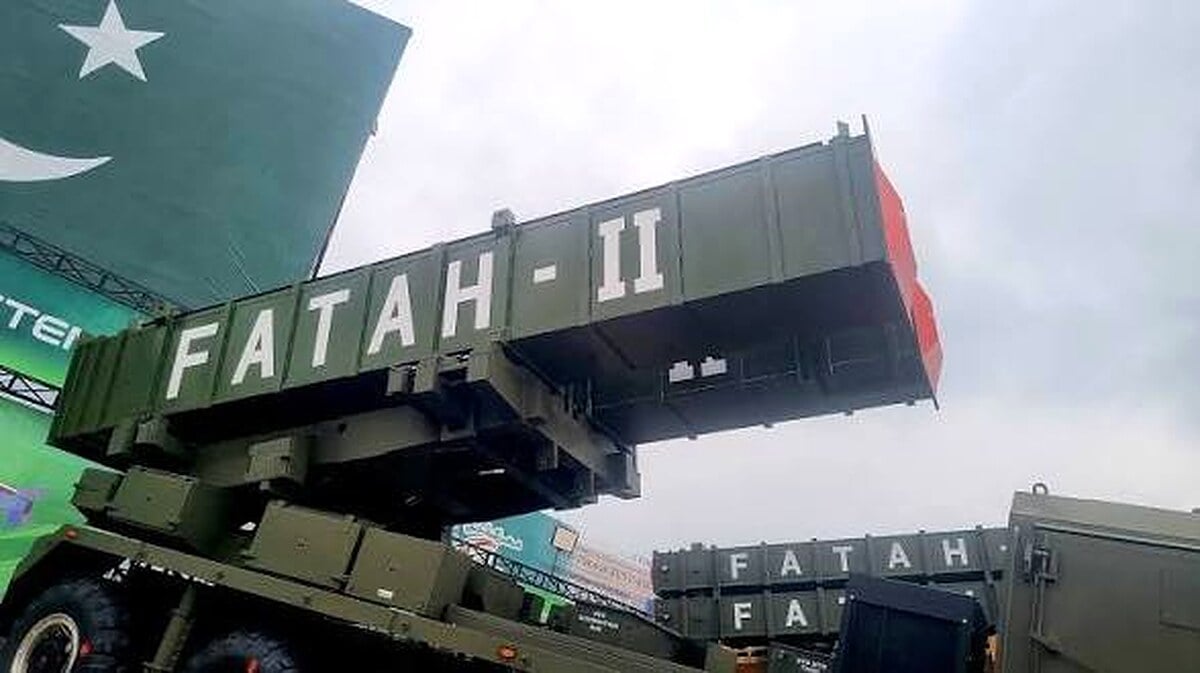




ISLAMABAD: Pakistan Armed Forces have once again demonstrated their technological edge with the successful test of the indigenous Fatah-II guided multi-launch rocket system.
The latest training launch highlights a weapon that combines extended range, pinpoint accuracy, and flight characteristics designed to challenge even the most sophisticated defensive networks. This development adds significant depth to Pakistan's conventional deterrence capabilities.
What makes the Fatah-II particularly formidable is its ability to fly at very low altitudes while maintaining high speeds and executing sharp maneuvers. Such a profile drastically reduces the reaction time available to enemy sensors and interceptors.
**Precision Engineering Behind Fatah-II**
The Fatah-II boasts an operational range of 400 kilometers, a substantial leap from the earlier Fatah-I variant's 140 kilometers. It can deliver a warhead weighing up to 365 kilograms with a circular error probable of less than 50 meters, according to official statements from the Inter-Services Public Relations.
This level of accuracy allows the system to engage high-value targets deep inside hostile territory, including command centers, air bases, and logistical hubs. The rocket integrates state-of-the-art navigation systems that combine inertial navigation with global navigation satellite services, ensuring reliability even in contested electronic environments.
Unlike traditional ballistic trajectories that arc high into the atmosphere, the Fatah-II follows a unique, flatter flight path. This design keeps the projectile closer to the ground for most of its journey, exploiting natural terrain features for cover.
**Why Low-Altitude Flight Changes the Game**
Terrain-hugging capability represents one of the most effective countermeasures against modern air defence radars. By skimming at low heights, often just tens of meters above the surface, the rocket stays below the radar horizon of many ground-based systems until the final moments of flight.
High speed further compresses the engagement window. Supersonic velocities mean defenders have mere seconds to detect, track, lock on, and launch interceptors. When combined with mid-flight maneuverability, the challenge multiplies.
Pakistan's engineers equipped the Fatah-II with an indigenous guidance and control package that operates independently of external signals vulnerable to jamming or electronic warfare. This autonomy allows the rocket to maintain course and accuracy even when subjected to heavy electronic countermeasures.
Analysts note that such features make saturation attacks particularly effective. Multiple rockets launched in coordinated salvos can overwhelm limited interceptor inventories by forcing defensive systems to engage numerous fast, low-flying threats simultaneously.
**Defence Challenges for Regional Air Protection Networks**
Advanced surface-to-air missile systems, including those deployed across the border, face inherent difficulties against low-flying, high-speed cruise-like profiles. Detection requires radars with excellent low-altitude coverage, while interception demands missiles capable of rapid acceleration and extreme maneuverability at those altitudes.
The short flight time over the terminal phase leaves minimal margin for error. Terrain masking adds another layer of complexity, as line-of-sight limitations prevent early tracking.
Pakistan's Fatah series development reflects a clear focus on precision conventional strike options that complement existing capabilities. The system enhances the Army's ability to deliver rapid, accurate fire support across a wide battlespace without relying solely on more expensive missile platforms.
Mobility remains another key strength. Mounted on high-mobility transporter erector launchers, Fatah-II units can quickly relocate after firing, complicating counter-battery efforts and enhancing survivability.
**Strategic Implications of Indigenous Innovation**
The successful Fatah-II test underscores Pakistan's growing self-reliance in advanced defence technologies. Developed through collaboration between Pakistani scientific organizations, the system reduces dependence on foreign suppliers while tailoring performance to regional operational requirements.
This achievement aligns with broader efforts to strengthen conventional deterrence. By fielding accurate, long-range guided rockets, Pakistan Armed Forces gain flexible options for responding to emerging threats while maintaining strategic stability.
Observers point out that weapons with these characteristics raise the threshold for any potential adventurism. The ability to strike precisely at depth forces potential adversaries to disperse assets, invest heavily in layered defences, and reconsider force concentrations near borders.
Pakistan continues to refine the Fatah family, with reports of ongoing enhancements in range, payload, and guidance. Each iteration builds on proven performance during training launches.
**Future of Precision Rocket Artillery**
As battlefield dynamics evolve with greater emphasis on speed, precision, and electronic resilience, systems like Fatah-II represent a cost-effective yet highly potent tool. Their ability to deliver massed firepower with individual accuracy offers commanders new tactical and operational possibilities.
The latest test firing reaffirms the Pakistan Army's commitment to maintaining technological parity and qualitative edges in critical domains. It sends a clear message about the readiness and sophistication of indigenous defence solutions.
Questions remain about how regional military postures will adapt to these evolving capabilities. Enhanced precision strike ranges and evasion features continue to shape calculations on both sides of the border.
Pakistan's progress in guided rocket systems highlights the importance of sustained investment in research and development. The Fatah-II stands as testimony to the skill and dedication of Pakistani scientists and military engineers working to bolster national defence.
The successful integration of advanced navigation, maneuverability, and terrain-adaptive flight paths positions this system as a significant asset for years to come. As testing and induction proceed, the Pakistan Armed Forces gain ever more reliable tools to safeguard territorial integrity and deter aggression.
What remains certain is that innovations like the Fatah-II will continue influencing the regional security environment, compelling all parties to reassess traditional assumptions about offensive and defensive balances.