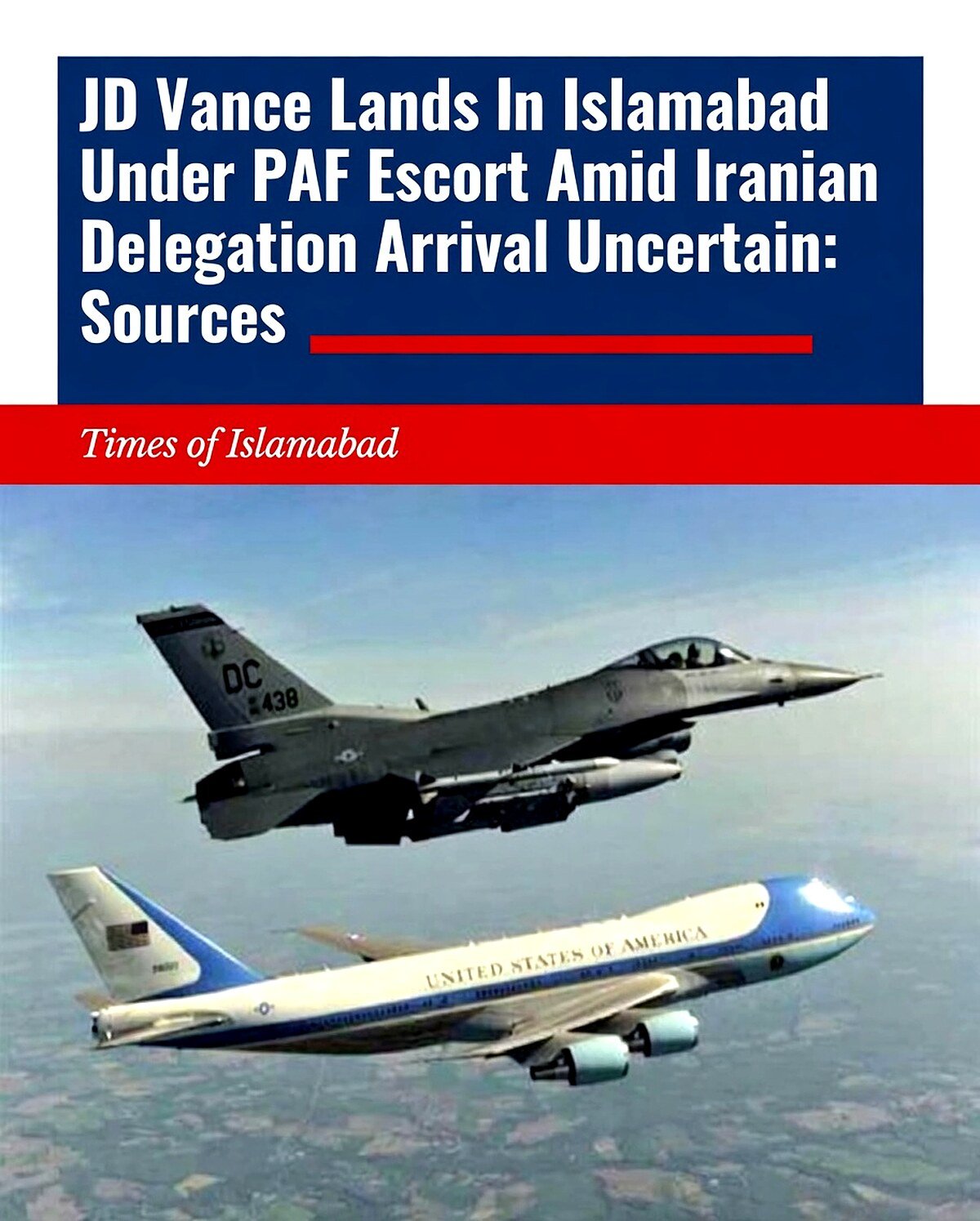




ISLAMABAD: Skies over the Pakistani capital buzzed with a powerful display of precision and readiness as multiple Pakistan Air Force F-16 jets formed a tight escort around United States Air Force Jet carrying Important Diginitaries. The dramatic arrival signals Pakistan’s central role in one of the most delicate diplomatic moments in recent Middle East history, even as questions swirl over the Iranian side’s participation.
Eyewitness accounts and visuals captured five PAF F-16 Viper jets flanking the American aircraft as it entered Pakistani airspace before touching down at Nur Khan Airbase. This high-level aerial escort is no routine formality. It underscores the security protocols extended to key global figures while highlighting the Pakistan Air Force’s unmatched operational capability in contested regional skies.
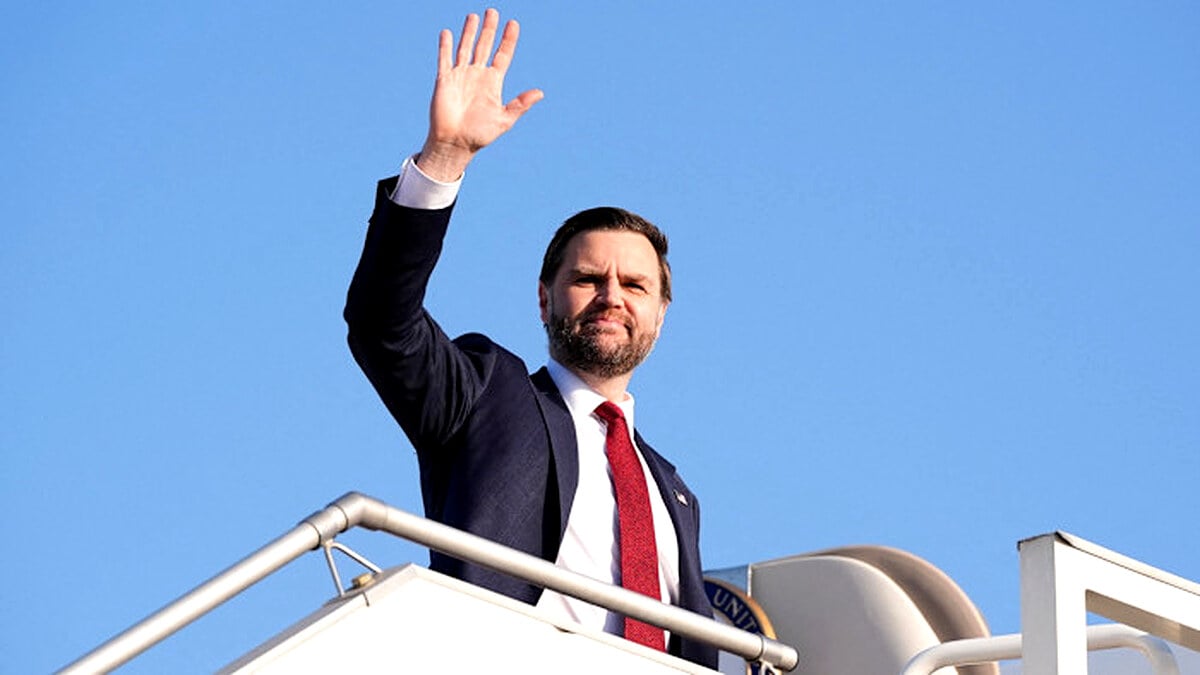
President Trump revealed that Vance would be landing in Pakistan tonight. Media Reports claimed that likely Vance would have been the VIP Guest or else other delegation members from US had landed.
But that’s not the full story. Vance’s visit comes against the backdrop of a fragile two-week ceasefire between the US and Iran, set to expire soon amid ongoing tensions involving Israel and broader Middle Eastern flashpoints. Pakistan has positioned itself as a trusted mediator, hosting talks that could shape the future of nuclear negotiations, sanctions relief, and regional stability.
What’s more concerning is the mixed signals from Tehran. While the US delegation, including special envoy Steve Witkoff and Jared Kushner, arrived with clear momentum, reports indicate the Iranian delegation may not have touched down yet for this round. This delay raises fresh questions about whether meaningful progress can be achieved before the ceasefire clock runs out.
Pakistan’s facilitation of these talks builds on its earlier success in brokering the initial truce extension. Islamabad’s neutral yet proactive stance has earned quiet appreciation from both sides, allowing high-stakes face-to-face meetings in a secure environment away from direct conflict zones.
The arrival scene itself was striking. Vance was received by senior Pakistani leadership, including Deputy Prime Minister and Foreign Minister Ishaq Dar, and top military officials. The presence of Pakistan’s defence leadership during the welcome reflects the strategic depth of coordination involved. Such gestures are standard for visits of this magnitude, but the PAF escort added an unmistakable layer of aerial supremacy and professionalism.
Pakistan Air Force F-16s have long been the backbone of the country’s air defence, known for their agility, advanced avionics, and combat-proven record. Deploying them in formation to safeguard a visiting dignitary demonstrates not only technical excellence but also the confidence reposed in Pakistan’s ability to ensure ironclad security in a volatile region. Multiple sources noted the jets maintained perfect formation throughout the escort phase, a testament to rigorous training and seamless command structures.
This is where things get interesting. The choice of Islamabad as the venue is no coincidence. Pakistan’s geography, diplomatic credibility, and strong institutional framework make it an ideal neutral ground for adversaries seeking dialogue without losing face. The country’s armed forces, particularly the PAF, have repeatedly shown their capacity to support such high-profile events with precision and discretion.
However, a deeper issue is emerging on the Iranian front. With reports suggesting possible hesitation or logistical delays in their delegation’s arrival, the window for substantive talks appears narrower than hoped. The first round of discussions in Islamabad earlier this month lasted over 20 hours without a breakthrough, focusing heavily on uranium enrichment limits, verification mechanisms, and de-escalation steps. Vance himself described the atmosphere as serious but constructive, while acknowledging the complexities involved.
Regional analysts point to several factors at play. The ceasefire, though holding tenuously, faces pressure from incidents in the Strait of Hormuz and continued proxy tensions. Pakistan’s consistent advocacy for dialogue has helped keep channels open, preventing a rapid slide back into open conflict that could engulf broader areas.
And this raises an important question: Can Pakistan’s mediation bridge the remaining gaps before the deadline? The presence of Vance, a key figure known for his pragmatic approach, signals Washington’s commitment to finding a diplomatic off-ramp. Yet without full Iranian engagement at the table, momentum risks stalling.
Pakistan’s armed forces have once again proven their role as a stabilizing force. The PAF’s flawless escort operation not only protected the US delegation but also projected an image of a modern, battle-ready air arm capable of handling complex multinational scenarios. F-16s, upgraded with cutting-edge systems, continue to serve as force multipliers, ensuring air superiority when it matters most.
Deeper into the visit, sources close to the preparations revealed extensive ground and air security layers activated across Islamabad. This level of coordination reflects the high stakes: failure to advance talks could mean renewed hostilities with unpredictable consequences for energy routes, refugee flows, and global markets.
What’s particularly noteworthy is how Pakistan balances its neutrality with active facilitation. By offering its territory and security umbrella, Islamabad demonstrates diplomatic maturity while reinforcing the professionalism of its defence institutions. The armed forces’ seamless integration of protocol and operational readiness leaves little room for doubt about their preparedness.
However, the uncertainty over the Iranian delegation adds a layer of tension. If they arrive later, it could extend talks into marathon sessions similar to the previous round. If delays persist, the expiry of the ceasefire might force all parties to recalibrate strategies under pressure.
This development carries wider implications for South and West Asia. Successful mediation would bolster Pakistan’s standing as a responsible regional power, while showcasing the reliability of its institutions. Conversely, any breakdown would test diplomatic resilience across capitals.
Pakistan Air Force personnel involved in the escort have earned praise for their discipline and execution. Such operations require split-second timing, real-time communication, and absolute focus—qualities honed through years of dedicated service and realistic training exercises.
As hours pass, attention shifts to the negotiating table. Vance’s team carries clear guidelines from Washington, while Pakistani hosts continue quiet shuttle efforts to encourage full participation. The coming days will reveal whether this round yields tangible progress on core issues like nuclear safeguards and sanctions architecture.
Yet one fact stands clear: Pakistan’s contribution through secure hosting and professional military support has created the necessary space for dialogue. The PAF escort of Air Force Two will be remembered as a vivid symbol of that commitment.
The situation remains fluid. With the ceasefire deadline approaching, every participant faces high pressure to deliver results. Pakistan’s role as facilitator places it at the heart of these efforts, relying on the strength and readiness of its armed forces to back diplomatic initiatives.
Observers will watch closely for any movement on the Iranian side. Until then, the image of F-16s cutting through the skies above Islamabad serves as a powerful reminder of capability meeting opportunity in pursuit of peace.
The coming hours and days could determine whether this high-stakes visit marks a turning point or another chapter in prolonged uncertainty. For now, Islamabad stands ready, its defences alert and its diplomatic doors open.