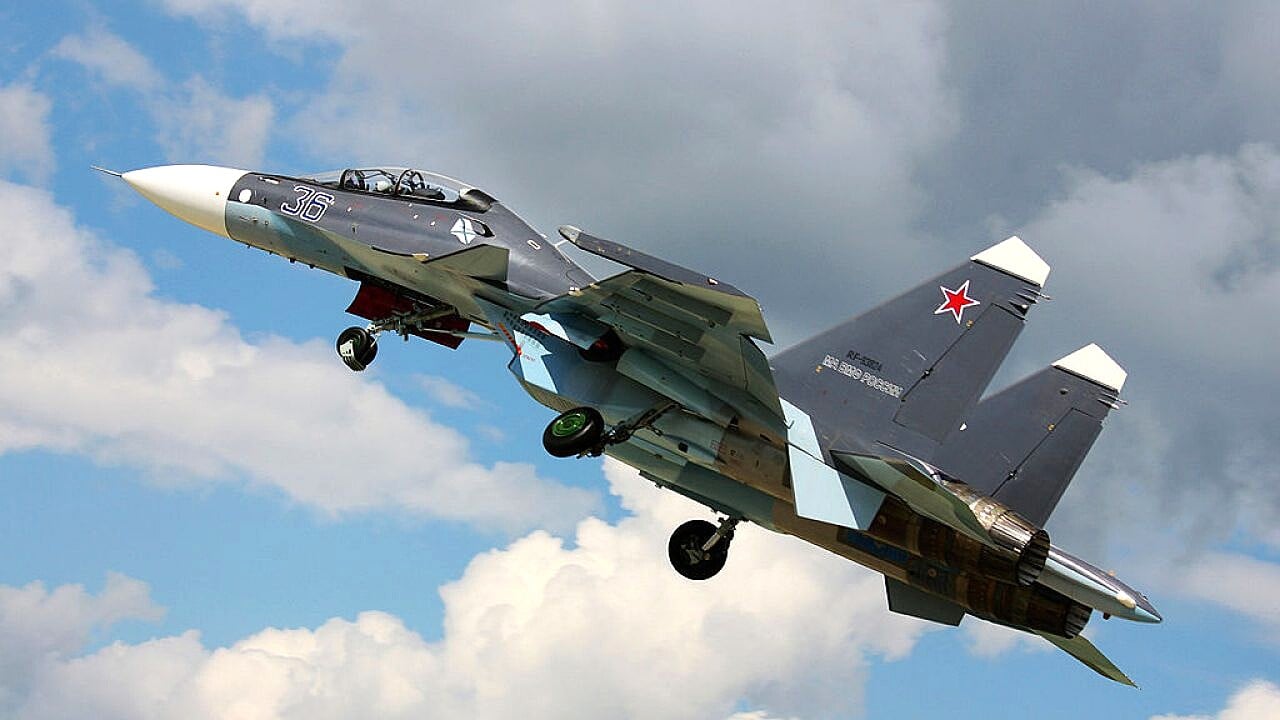




ISLAMABAD: A Russian Su-30 multirole fighter jet crashed in occupied Crimea on Friday during a scheduled training flight, according to the Russian Defence Ministry.
The aircraft came down around 11:00 Moscow time near the peninsula, with both crew members successfully ejecting from the unarmed plane.
Russian officials confirmed the pilots were evacuated by a ground search-and-rescue team and face no immediate threat to their lives.
The Su-30, a twin-engine two-seat supermaneuverable fighter developed from the Su-27 Flanker family, was not carrying any weapons or explosive materials at the time of the incident.
This marks the latest in a series of Russian military aviation setbacks in the region, coming just days after an An-26 transport plane crashed in Crimea, killing all 29 people on board.
International media outlets including Reuters and The Moscow Times reported the Su-30 incident based on statements from Russian state news agency TASS and the Defence Ministry.
Regional sources aligned with Ukrainian perspectives noted the crash amid heightened air activity over the Black Sea, though Moscow described it strictly as a routine training mission.
The Su-30 platform, valued at approximately 50 million dollars per unit in export variants, serves as a backbone for Russian air forces with advanced radar and missile capabilities.
Russia operates dozens of Su-30SM variants, primarily with naval aviation units stationed in Crimea, including at bases like Saki and Belbek.
Historical data shows the Su-30 fleet has faced multiple accidents since induction, with engine fires and technical malfunctions frequently cited in past probes.
In one documented case from October 2025, Russian air defence reportedly downed its own Su-30SM over Crimea while intercepting Ukrainian drones, with the crew ejecting safely.
Another incident in November 2025 saw a Su-30 crash during a training flight in Russia’s Karelia region, resulting in the loss of both pilots.
Aviation safety records indicate at least 13 major Su-30 attrition events globally since the early 2000s, including losses in Syria, India, and various Russian territories.
Friday’s crash follows closely on the heels of the An-26 disaster on March 31, where the turboprop transport slammed into a cliff in the Bakhchisarai district, claiming six crew and 23 passengers.
That incident prompted a criminal investigation by Russian authorities, with preliminary findings pointing to possible technical failure and no external interference.
The back-to-back losses have raised questions about maintenance standards and operational pressures on Russian aviation assets amid ongoing regional tensions.
The Su-30 features thrust-vectoring engines enabling supermaneuverability, a maximum speed of Mach 2, and a combat radius exceeding 1,000 kilometres.
Its two-person crew configuration allows for complex mission profiles, including air superiority and ground attack roles.
Despite the pilot survival in the latest event, the destruction of the aircraft represents a significant material loss for the Russian Aerospace Forces.
Search operations confirmed no onboard munitions, reducing risks of secondary explosions at the crash site.
Rescue teams reached the ejected pilots promptly, highlighting improved ground response protocols in the annexed territory.
This incident adds to a pattern of Russian aircraft mishaps in 2025-2026, including MiG-31 and Tu-22M3 losses in other regions.
Military analysts tracking the conflict note increased strain on pilot training and airframe availability due to sustained operations.
The Russian Defence Ministry has not yet disclosed the exact cause of the Su-30 crash, with investigations underway.
No ground casualties were reported, and the site remains under military control.
The event underscores vulnerabilities in high-performance fighter operations even during non-combat training.
Broader fleet data reveals the Su-30 series has accumulated thousands of flight hours across multiple operators, yet reliability concerns persist in harsh environments.
Crimea, annexed by Russia in 2014, hosts key naval and air assets critical to Black Sea dominance.
Frequent drone threats and air defence activations in the area have previously led to friendly fire risks.
While the latest crash involved safe ejection, the cumulative impact on equipment and readiness remains a point of scrutiny.
Russian media emphasised the successful pilot recovery, framing the event as contained.
Independent verification remains limited due to restricted access in the region.
The Su-30 continues to feature prominently in Russian export portfolios, with operators including India, China, and Algeria reporting their own operational experiences.
In the context of prolonged regional conflict, such losses highlight the high costs of maintaining air superiority claims.
Further details on the technical root cause are expected as the investigation progresses.