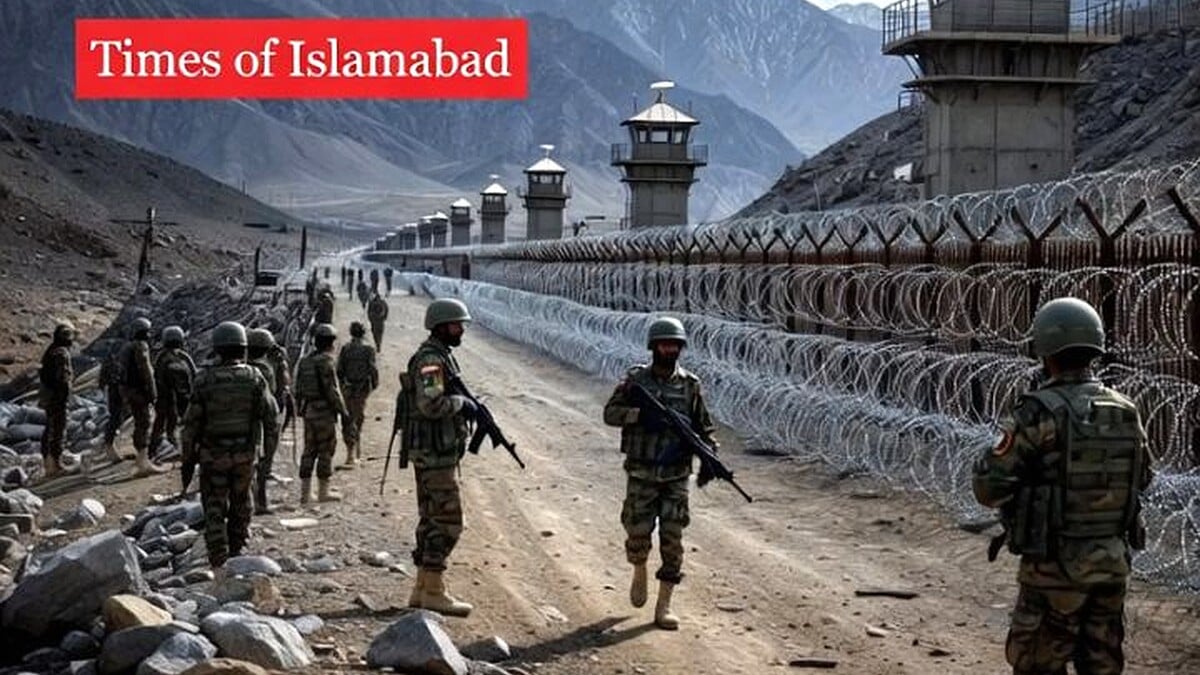




ISLAMABAD: Pakistan is seriously considering the creation of a formal buffer zone along its porous border with Afghanistan as cross-border militancy escalates and recent clashes highlight vulnerabilities in existing defences.
The proposal comes at a time when the country has already invested heavily in border fencing yet continues to face security challenges from terrorist groups operating from Afghan soil.
Pakistan has completed nearly 98 percent of fencing along the approximately 2,670-kilometre Durand Line, according to military statements reported in local and regional media.
The fencing project, spanning roughly 2,640 kilometres of the main border stretch, cost an estimated 500 to 550 million dollars, including surveillance gadgets and related infrastructure.
This figure aligns with earlier army briefings that pegged the initial outlay at around Rs70 billion, covering dual-layer barbed wire fences, infrared detectors and nearly 1,000 border forts.
Despite these efforts, officials note that simple fencing serves only as the first layer of defence and falls short against determined infiltration in rugged mountainous terrain.
A dedicated buffer zone would demand far more extensive measures, including large-scale land clearance, construction of trenches, berms and anti-vehicle ditches, alongside all-weather patrol roads.
It would further require establishment of permanent forts, forward military bases and integrated surveillance networks featuring drones, ground sensors and real-time monitoring systems.
Troop deployment for continuous patrolling and rapid response would add another layer of complexity and expense.
Analysts and defence sources estimate that even a light buffer zone with minimal infrastructure could require an initial investment of one to two billion dollars.
A more structured and militarised version, incorporating robust defensive posts, advanced logistics and layered surveillance, might push costs to between two and five billion dollars.
A fully advanced setup with cutting-edge technology, permanent bases and comprehensive territorial control could easily surpass five billion dollars in upfront expenses alone.
These projections draw from the scale of similar border security projects globally, though Pakistan’s challenging geography along the Durand Line amplifies the financial burden.
Long-term operational costs would prove equally significant, encompassing salaries for thousands of additional troops, fuel for patrols, maintenance of equipment and regular upgrades to counter evolving threats.
Pakistan’s defence budget already faces multiple pressures, including internal counter-terrorism operations and modernisation needs, making such an undertaking a major fiscal commitment.
Recent border incidents have intensified calls for stronger measures, with reports of clashes prompting Pakistan to secure additional territory in strategic enclaves.
Local media and security sources indicate Pakistani forces have taken control of around 32 square kilometres in disputed areas, including the Gudwana Enclave, where fencing has been completed to prevent militant incursions.
Such actions underscore Islamabad’s determination to enforce stricter control, even as the Afghan side continues to reject formal recognition of the Durand Line.
Defence experts highlight that without effective buffer mechanisms, groups like the Tehrik-i-Taliban Pakistan continue to exploit ungoverned spaces for attacks inside Pakistan.
The fencing project itself faced delays due to difficult terrain, funding constraints and occasional resistance, yet it has demonstrably reduced certain types of smuggling and unauthorised crossings at designated points.
Only 16 formal crossing points are planned for regulated movement once full infrastructure matures.
Establishing a buffer zone would likely involve coordination with local tribes, potential relocation of populations in affected areas and environmental considerations in sensitive ecological zones.
Regional media reports emphasise that Pakistan views enhanced border management as essential for national security, especially following periods of heightened tensions and reported terrorist strikes.
International coverage of the specific buffer zone proposal remains limited, with most global outlets focusing on broader Pak-Afghan clashes rather than detailed cost analyses.
Pakistani military and government statements, however, consistently stress the need for verifiable action from Kabul to curb cross-border threats.
The financial implications extend beyond initial construction to include sustained logistics in remote areas where supply lines are expensive and weather conditions harsh.
Some estimates suggest annual maintenance and operational costs could run into hundreds of millions of dollars, depending on the zone’s depth and technological sophistication.
Pakistan has already demonstrated commitment by accelerating fencing post-2021 developments in Afghanistan and integrating it with broader counter-terrorism strategies.
Any buffer zone initiative would build on this foundation but represent a quantum leap in scale and investment.
Defence planners must weigh these costs against potential gains in reduced militancy, improved trade regulation and enhanced sovereignty assertion along the volatile frontier.
As deliberations continue, the debate centres on whether the strategic necessity justifies the enormous economic outlay in a resource-constrained environment.
The outcome could reshape Pakistan’s western border strategy for decades, influencing both security dynamics and bilateral relations with Afghanistan.