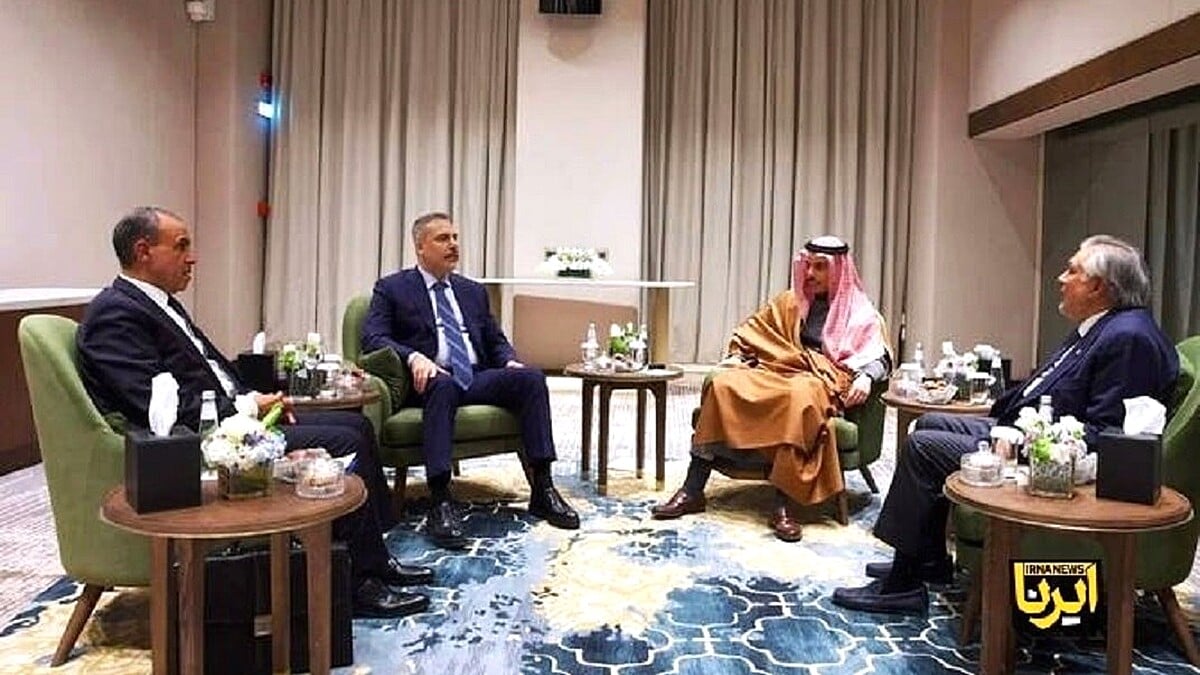




ISLAMABAD: Pakistan has emerged as a crucial diplomatic hub as it hosts foreign ministers from Saudi Arabia, Turkiye and Egypt for high-level talks amid the ongoing month-old US-Israeli war on Iran.
Egyptian Foreign Minister Dr Badr Abdelatty and Turkiye’s Hakan Fidan arrived in Islamabad on Saturday and held separate bilateral meetings with Deputy Prime Minister and Foreign Minister Senator Ishaq Dar at the Foreign Office.
Saudi Arabia’s Prince Faisal bin Farhan Al Saud is expected to join the two-day consultations scheduled for March 29 and 30, 2026.
The meetings focus on in-depth discussions to de-escalate regional tensions and explore pathways for ceasefire and stability in West Asia.
Pakistan’s Foreign Office confirmed the visits occurred at the invitation of Ishaq Dar, who also serves as deputy prime minister.
Earlier this month, the same quartet of foreign ministers held talks in Riyadh on March 19, signalling growing coordination among these influential Muslim nations.
International media including Reuters reported that Islamabad has been actively shuttling messages between Washington and Tehran, positioning itself as a potential neutral venue for direct US-Iran negotiations.
Local reports from Dawn and The Express Tribune highlighted that the talks, originally planned in Turkiye, were shifted to Islamabad due to Pakistan’s expanding role in the Iran-US dialogue process.
Analysts note this development underscores Pakistan’s strategic pivot towards proactive mediation in Middle East conflicts.
Pakistan maintains deep historical, economic and defence ties with all three visiting nations.
Bilateral trade with Saudi Arabia exceeds several billion dollars annually, supported by substantial Saudi investments in Pakistan’s energy and infrastructure sectors.
Turkiye and Pakistan collaborate closely in defence production and military training, with joint ventures in aviation and armaments.
Egypt shares longstanding people-to-people and diplomatic bonds with Pakistan, rooted in shared Islamic heritage.
The current quadrilateral engagement builds on recent momentum, including telephonic conversations Ishaq Dar held with his Egyptian and Turkish counterparts on Friday to discuss the evolving situation.
Prime Minister Shehbaz Sharif is also expected to meet the visiting dignitaries, adding high-level political weight to the deliberations.
Regional observers point out that the month-long conflict has already caused significant humanitarian and economic fallout across West Asia.
Escalating military actions have disrupted shipping routes, spiked global oil prices and raised fears of wider confrontation involving multiple state and non-state actors.
Pakistan’s diplomatic initiative comes at a time when traditional mediation channels appear strained.
By bringing together Saudi Arabia, a key Gulf power, Turkiye with its NATO membership and strategic depth, and Egypt with its Suez Canal influence and Arab world standing, Islamabad aims to forge a unified voice for de-escalation.
Sources familiar with the process indicated that discussions may cover humanitarian access, ceasefire mechanisms and confidence-building measures between conflicting parties.
Pakistan has long advocated for peaceful resolution of disputes through dialogue, consistent with its foreign policy principles.
The Foreign Office statement emphasised that Pakistan highly values its relations with these brotherly countries and views the visit as an opportunity to further strengthen cooperation and coordination.
Bilateral meetings between Ishaq Dar and the arriving ministers covered not only the Iran war but also broader bilateral ties and multilateral coordination on global issues.
Security arrangements in Islamabad were tightened ahead of the high-profile arrivals, reflecting the sensitivity of the regional security environment.
Diplomatic circles in the capital describe the gathering as a significant step in forming a potential bloc of influential states capable of influencing outcomes in West Asia.
Previous trilateral and quadrilateral formats among these countries have addressed counter-terrorism, economic partnerships and regional stability.
This latest meeting in Islamabad may lay groundwork for more structured mechanisms of consultation in the future.
As the two-day talks unfold, expectations remain high for concrete outcomes or at least a joint statement outlining shared positions on de-escalation.
Pakistan’s success in hosting such a gathering enhances its international profile as a responsible and influential player in Muslim world affairs.
The development has drawn attention from global media outlets monitoring the Iran conflict closely.
With tensions persisting, the Islamabad consultations represent a timely effort to prevent further escalation and promote diplomatic solutions.
Observers will watch closely for any breakthroughs or signals that could influence the trajectory of the ongoing war.
Pakistan continues to balance its relations with major powers while prioritising regional peace and stability.
The presence of three key foreign ministers in the capital this weekend marks a notable moment in Pakistan’s diplomatic calendar for 2026.