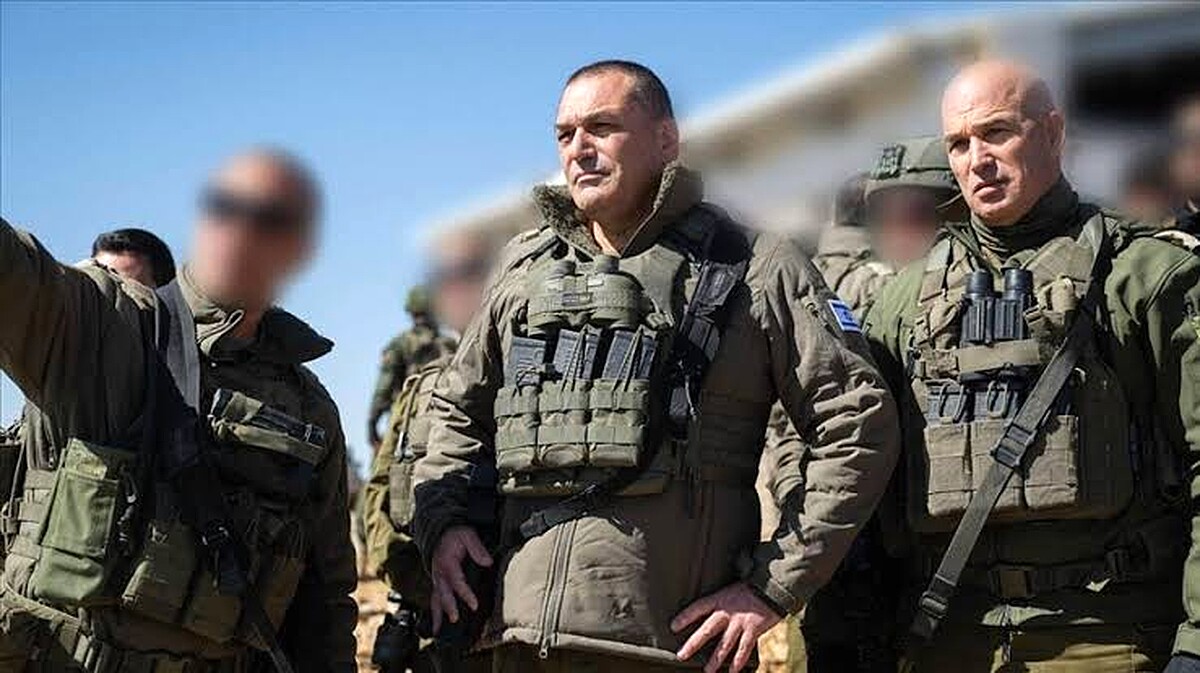




ISLAMABAD: Israel’s top military commander has issued a dire internal alert that the army could collapse under the crushing weight of its multi-front war with Iran and its allies, according to Channel 13 television.
Chief of Staff Lieutenant General Eyal Zamir told ministers at a security cabinet meeting this week that he was raising “10 red flags” before the Israel Defence Forces implode from within.
“The IDF is going to collapse in on itself,” Zamir warned, stressing that without urgent new conscription and reserve laws the military would soon be unable to carry out even routine missions.
The assessment comes as Israel battles on at least five active fronts simultaneously: Gaza, Lebanon, the West Bank, Syria and direct confrontation with Iran.
Official figures show the army faces an immediate shortfall of around 12,000 combat and support troops, a gap that senior sources privately describe as closer to 20,000 when accounting for exhausted reservists.
Repeated emergency call-ups under Order 8 have left thousands of reservists serving far beyond legal limits, with some units rotated every few months since the October 2023 Hamas attack.
Iran’s direct missile barrages since late February have forced the air force and missile defence units into near-constant alert, stretching already thin manpower even further.
In Lebanon, Israeli ground operations against Hezbollah have required sustained divisional deployments, while West Bank settler security duties have diverted entire battalions from combat roles.
Central Command officers separately briefed the same cabinet session that government policies encouraging settlement expansion are adding unsustainable pressure on overstretched forces.
Zamir demanded three immediate legislative fixes: a conscription law to draft ultra-Orthodox Haredim who currently enjoy near-total exemptions, a new reserve duty law to regulate call-ups, and an extension of mandatory service from 32 to 36 months.
Defence analysts note that Haredi enlistment remains below 1,500 per year despite comprising over 13 percent of the draft-age population, widening the professional soldier gap.
Opposition leader Yair Lapid accused the government of steering the country toward a “security catastrophe” by delaying these reforms while expanding the war.
Former prime minister Naftali Bennett echoed the alarm, stating publicly that the IDF is short 20,000 soldiers and warning that the people’s army model is at breaking point.
The manpower crisis has already forced the cancellation of planned 20,000 reserve posts for 2026, yet emergency mobilisations continue unabated.
Israeli media reports indicate that even in peacetime the army would require thousands more troops to secure borders and maintain training standards.
The warning arrives amid a regional conflict that has already claimed over 1,400 lives across Iran, Lebanon and Israel, with Iranian strikes alone killing at least 11 Israeli civilians according to official tallies.
Tehran’s proxy network, including Hezbollah and Hamas remnants, continues low-intensity attacks that demand constant Israeli presence in hostile territory.
Military sources told Channel 13 that without political action the reserve system itself will not hold beyond the coming months.
Zamir’s intervention marks the most explicit public breach of military-cabinet protocol in years, underscoring the depth of concern within the high command.
Analysts say the crisis risks eroding Israel’s qualitative military edge precisely when Iran and its allies appear emboldened by the prolonged fighting.
Government ministers offered no immediate response during the meeting, according to participants quoted by local media.
The development has sparked renewed calls in Israel for a national unity government focused solely on manpower reform and war strategy.
As the conflict enters its second month of direct Iran-Israel exchanges, the IDF chief’s 10 red flags have laid bare the human and structural limits of sustained high-intensity operations.
Regional observers note that any perceived Israeli weakness could embolden further escalation from Tehran-backed groups across the Middle East.
For now, the army continues to fight on multiple fronts while its leadership pleads for legislative relief that remains stalled in coalition politics.