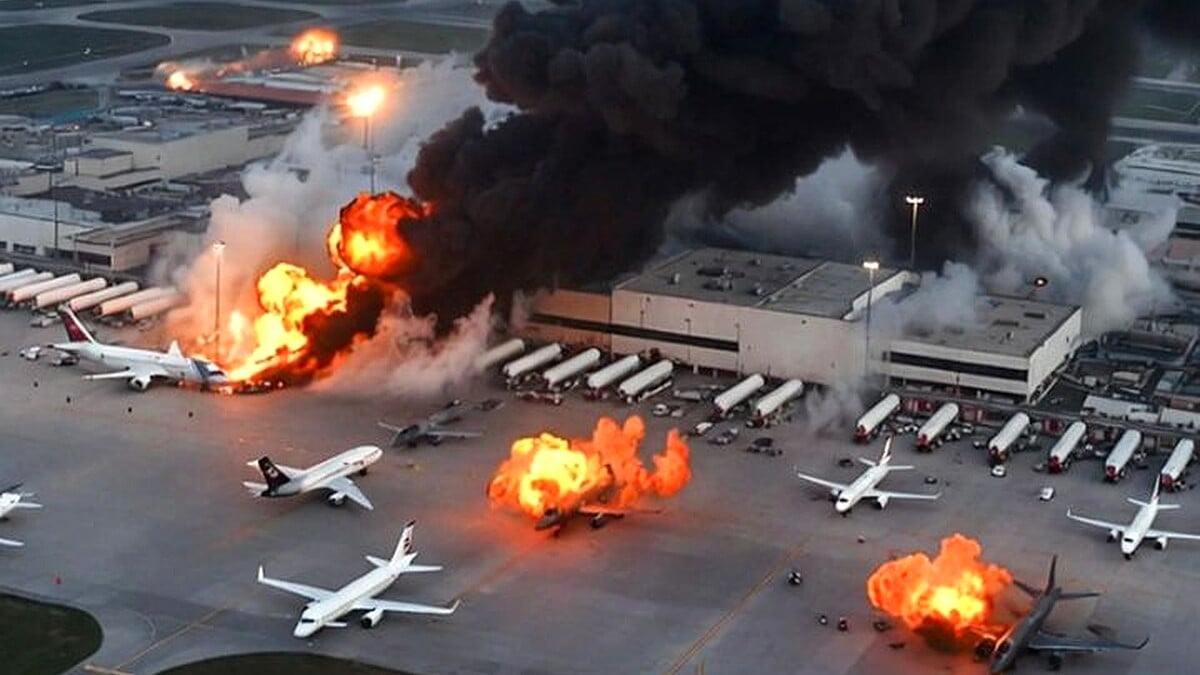




ISLAMABAD: A major New York Times investigation has laid bare the crippling impact of Iranian retaliatory strikes on American military infrastructure across the Middle East.
The report details how Tehran’s missile and drone barrages have rendered many key US bases virtually uninhabitable, forcing troops into remote operations from hotels and civilian facilities.
According to the newspaper, many of the 13 military bases hosting American forces in the region now face severe operational limitations following sustained Iranian attacks.
Facilities in Kuwait, positioned closest to Iranian territory, have suffered the heaviest damage, with critical infrastructure including aircraft hangars, fuel depots and command centres left in ruins.
Military officials cited in the report confirm that service members have relocated to hotels and makeshift office spaces, dispersing operations across populated civilian zones.
This shift has complicated logistics and raised fresh security concerns for both US personnel and local communities in host nations.
The New York Times analysis, drawing on satellite imagery and interviews with current and former officials, identifies at least 11 damaged US installations since the conflict began on February 28.
Sites struck multiple times include Al Udeid Air Base in Qatar, Prince Sultan Air Base in Saudi Arabia, Ali Al Salem Air Base and Camp Buehring in Kuwait, as well as the US Naval Support Activity in Bahrain.
A separate assessment by the Center for Strategic and International Studies estimates Iranian strikes inflicted roughly 800 million dollars in damage to bases and related infrastructure during the war’s opening phase alone.
US Central Command data reveals 13 American service members killed and 290 injured since hostilities erupted, though most wounded personnel have since returned to duty.
The revelation underscores a stark operational reality: American forces are now prosecuting a high-intensity conflict largely from temporary civilian locations, a scenario officials describe as significantly harder to manage.
Iranian state media has countered by accusing Washington of endangering civilians, claiming the placement of troops in hotels amounts to using local populations as human shields.
The Trump administration’s pre-war planning has come under scrutiny for what insiders term an underestimation of Iran’s retaliatory reach and precision strike capabilities.
Despite intelligence warnings, large-scale evacuations of non-essential personnel from the Gulf were delayed until after the initial US-Israeli strikes on Iranian nuclear and military targets.
Drone defence systems proved inadequate against Tehran’s barrage, allowing repeated penetrations that compounded structural damage across forward bases.
The dispersal of command functions has slowed decision-making cycles and strained supply lines for everything from fuel to spare parts.
Energy markets have reacted sharply, with fuel prices spiking amid fears over the security of roughly 20 per cent of global oil supplies transiting the Persian Gulf.
Regional allies hosting the bases now face heightened domestic pressures as civilian areas absorb the spillover risks of US operations.
In the broader strategic context, the strikes highlight Iran’s ability to project power asymmetrically despite years of sanctions and isolation.
The New York Times report notes that the affected bases previously served as launch pads for air operations and logistics hubs supporting thousands of troops.
With many facilities now limited to emergency use only, routine maintenance and long-term basing have become nearly impossible.
Defence analysts tracking the conflict warn that prolonged remote operations could erode overall combat effectiveness in any extended campaign.
The developments arrive as diplomatic signals between Washington, Tehran and regional capitals remain mixed, with no immediate ceasefire in sight.
Pakistani officials monitoring the crisis have reiterated calls for de-escalation, citing risks to energy security and stability in the wider Muslim world.
The ongoing war, now in its second month, continues to reshape security calculations across the Middle East and beyond.