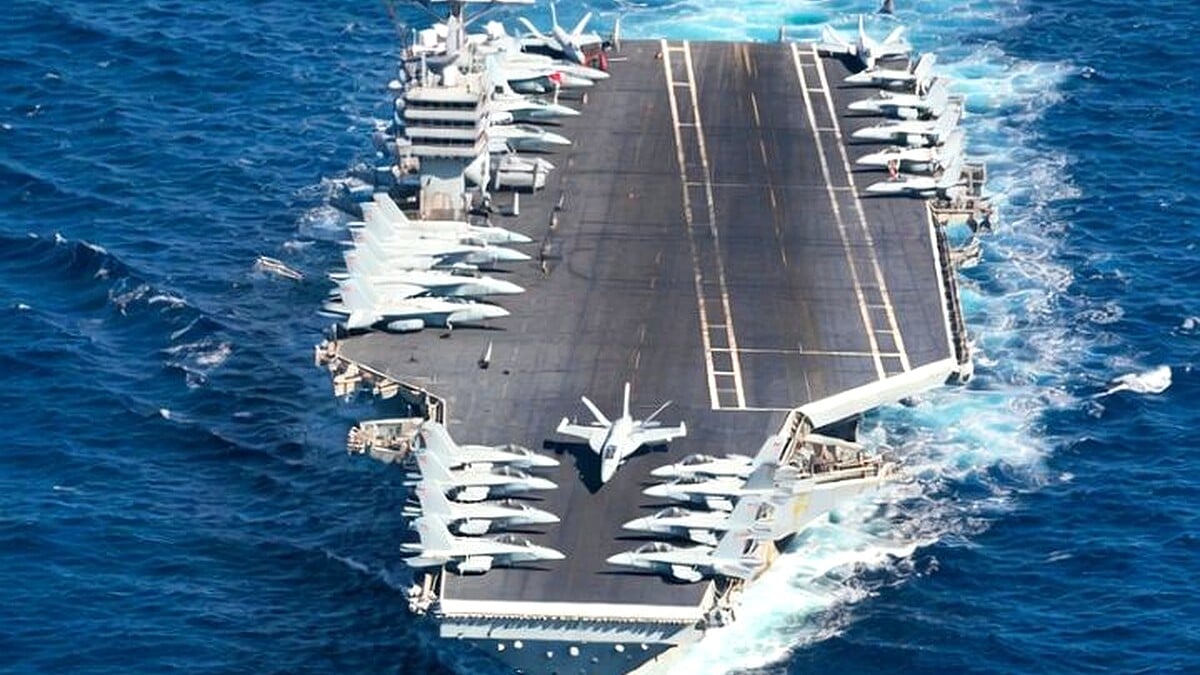




ISLAMABAD: Iran claimed a bold assault with missiles and drones on the USS Abraham Lincoln aircraft carrier in the Arabian Sea, an assertion issued mere hours before the United States Navy confirmed an American sailor had been injured aboard the vessel.
The timing has sparked intense speculation across regional and international platforms about whether the injury stemmed from missile debris, drone fragments or an unrelated mishap during high-tempo operations.
The US Naval Forces Central Command, known as the Fifth Fleet, moved swiftly to clarify the matter on Thursday.
A U.S. Navy Sailor was injured aboard USS Abraham Lincoln (CVN 72) while the aircraft carrier was conducting flight operations in the Arabian Sea on March 25. The injury is not combat-related nor life threatening, the Fifth Fleet said in a statement posted on X.
The sailor was transported ashore for additional medical care and remains in stable condition, officials added, with the circumstances still under investigation.
The USS Abraham Lincoln is a Nimitz-class nuclear-powered supercarrier that displaces 104,300 long tons and measures 1,092 feet in length.
It operates with a combined crew of approximately 5,680 personnel, comprising 3,200 ship’s company sailors and 2,480 air wing specialists.
The vessel can embark up to 90 fixed-wing aircraft and helicopters, supporting strike, reconnaissance and air defence missions across vast oceanic expanses.
Its four-and-a-half-acre flight deck enables rapid launch and recovery cycles, often exceeding dozens of sorties daily in operational zones.
Iranian military outlets, including statements attributed to the Islamic Revolutionary Guard Corps, described the action as involving advanced Qader cruise missiles and multiple drone swarms targeting the carrier group.
Tehran’s narrative suggested the strikes compelled the American vessel to adjust its position, framing the operation as a direct response to perceived threats in waters near the Strait of Hormuz.
Such claims have circulated widely in Iranian state media but have been categorically rejected by US Central Command, which maintains the carrier sustained no damage from hostile action.
The Arabian Sea remains a strategically vital corridor handling nearly one-fifth of global seaborne oil trade and serving as a primary transit route for energy shipments from the Gulf.
The Fifth Fleet, headquartered in Bahrain, routinely deploys carrier strike groups to deter disruptions and protect maritime commerce in this high-tension theatre.
Previous Iranian assertions of similar strikes against US assets surfaced earlier in March, yet each was dismissed by Washington as unsubstantiated propaganda without physical evidence.
Analysts note that flight deck incidents during carrier operations are not uncommon, given the hazardous environment of jet blast, arresting cables and constant aircraft movement at speeds exceeding 150 knots on touchdown.
The Abraham Lincoln’s deployment forms part of broader US efforts to maintain deterrence amid ongoing proxy conflicts involving Iran-backed groups across the region.
No further details on the exact nature of the sailor’s injury have been released, preserving operational security while medical evaluations continue.
Regional observers in Islamabad and Gulf capitals are closely monitoring developments, wary that any miscalculation could ripple through already fragile security dynamics in the Indian Ocean expanse.
The episode underscores the persistent friction between Tehran and Washington, where competing narratives often collide against the backdrop of one of the world’s most heavily armed naval presences.