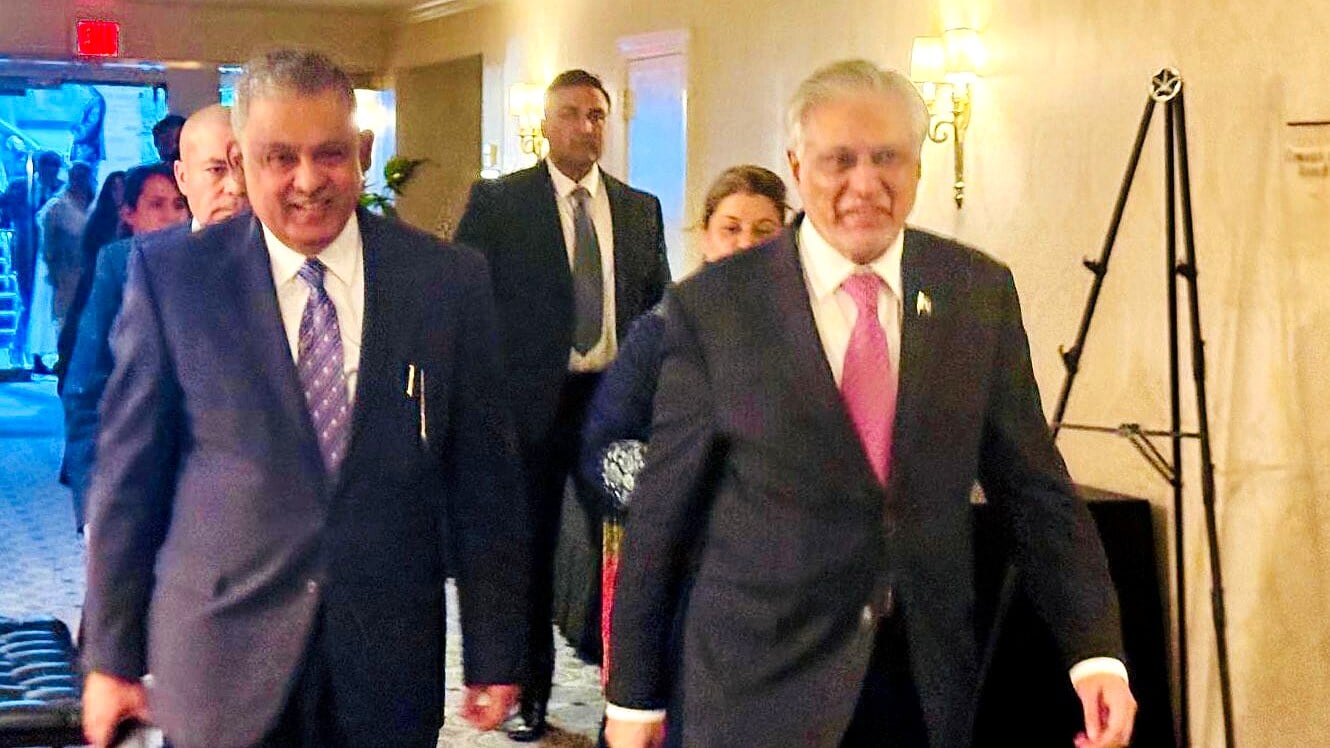




WASHINGTON: Deputy Prime Minister and Foreign Minister Ishaq Dar said on Friday that Pakistan remained firmly committed to its longstanding position on Palestine and Gaza and that there could be no change in Islamabad’s stance towards Israel without the establishment of an independent Palestinian state.**
Deputy Prime Minister and Foreign Minister Senator Mohammad Ishaq Dar has reiterated Pakistan’s unwavering commitment to the Palestinian cause during high-level engagements in Washington.
Dar made the remarks at a press conference at Pakistan’s embassy in Washington following his meeting with US Secretary of State Marco Rubio. He emphasised that Islamabad’s position remains unchanged and is tied directly to the realisation of a sovereign Palestinian state.
“Pakistan remains steadfast in its position on Palestine and Gaza,” Dar stated. He added that Israel must move towards the establishment of a Palestinian state before any shift in Pakistan’s approach towards Israel can be considered.
The statement came in response to questions about US President Donald Trump’s earlier calls for Muslim countries, including Pakistan, to join the Abraham Accords. Trump did not mention the issue in his Friday statement outlining potential elements of a broader deal involving Iran.
Dar did not address the Abraham Accords question directly. He instead referenced his recent engagements at the United Nations, where he had already conveyed Pakistan’s consistent policy.
**Mediation efforts highlighted**
During the press conference, Dar noted that Washington has appreciated Pakistan’s role in easing tensions between Iran and the United States. This recognition was conveyed during his meeting with the US Secretary of State.
A US State Department statement following the meeting thanked Pakistan for its “constructive role” in promoting peace in the Middle East and its mediation efforts with Iran. The two sides agreed on strengthening a “meaningful partnership” focused on security and prosperity for both nations.
Rubio later shared details of the meeting on X, highlighting the positive tone of bilateral discussions.
Pakistan has played a notable facilitation role in recent US-Iran de-escalation efforts. A ceasefire brokered with Pakistani involvement took effect in early April 2026. Subsequent talks in Islamabad aimed at a longer-term framework, though differences persist on key issues including nuclear matters and regional security guarantees.
**Firm two-state position**
Pakistan has long advocated for a two-state solution based on pre-1967 borders, with Al-Quds Al-Sharif as the capital of an independent Palestinian state. This position aligns with the broader stance of many Muslim-majority countries that view normalisation with Israel as conditional on meaningful progress towards Palestinian statehood.
The Abraham Accords, signed in 2020 under the first Trump administration, normalised relations between Israel and several Arab states including the UAE, Bahrain, Sudan, and Morocco. These agreements focused on economic and security cooperation but faced criticism for sidelining the Palestinian issue.
Pakistan maintains no diplomatic relations with Israel. Successive governments have consistently linked any potential engagement to the establishment of a viable Palestinian state. Public sentiment in Pakistan remains strongly supportive of this position, with widespread solidarity for the Palestinian people.
**Regional diplomacy context**
Dar’s Washington visit occurs amid ongoing efforts to stabilise the Middle East following periods of heightened tension. Pakistan’s mediation between Washington and Tehran has drawn attention for its pragmatic approach, leveraging longstanding ties with both sides.
Analysts note that Pakistan’s role reflects its strategic geography and diplomatic networks across West Asia. Islamabad has contributed to multiple peace initiatives, including support for UN efforts and participation in relevant international forums.
Bilateral trade between Pakistan and the United States stood at approximately $6.5 billion in recent fiscal years, with significant US investment in Pakistan’s energy and infrastructure sectors. Security cooperation also remains a key pillar, including counter-terrorism intelligence sharing.
On the Palestinian front, Pakistan has provided consistent diplomatic and humanitarian support. Islamabad has repeatedly called for unrestricted humanitarian access to Gaza and opposed any forced displacement of Palestinian populations.
**Broader implications**
Pakistan’s clear articulation of its Palestine policy during the US visit underscores continuity in its foreign policy principles even as it engages actively on multiple regional tracks. The reaffirmation comes at a time when diplomatic realignments in the Middle East are under discussion.
The meeting between Dar and Rubio also touched on strengthening economic and security ties. Both sides expressed interest in expanding cooperation in areas that support mutual prosperity and regional stability.
Observers suggest that Pakistan’s balanced approach — maintaining principled positions while offering constructive mediation — positions it as a relevant player in complex regional dynamics. However, challenges remain in navigating competing interests among major powers.
Future developments will likely depend on progress towards a credible two-state framework and the evolution of US-Iran negotiations. Pakistani officials have indicated continued engagement on both fronts in coordination with international partners.
Dar’s visit is expected to be followed by further diplomatic activity as Islamabad balances its longstanding commitments with emerging opportunities for regional peace and economic cooperation.