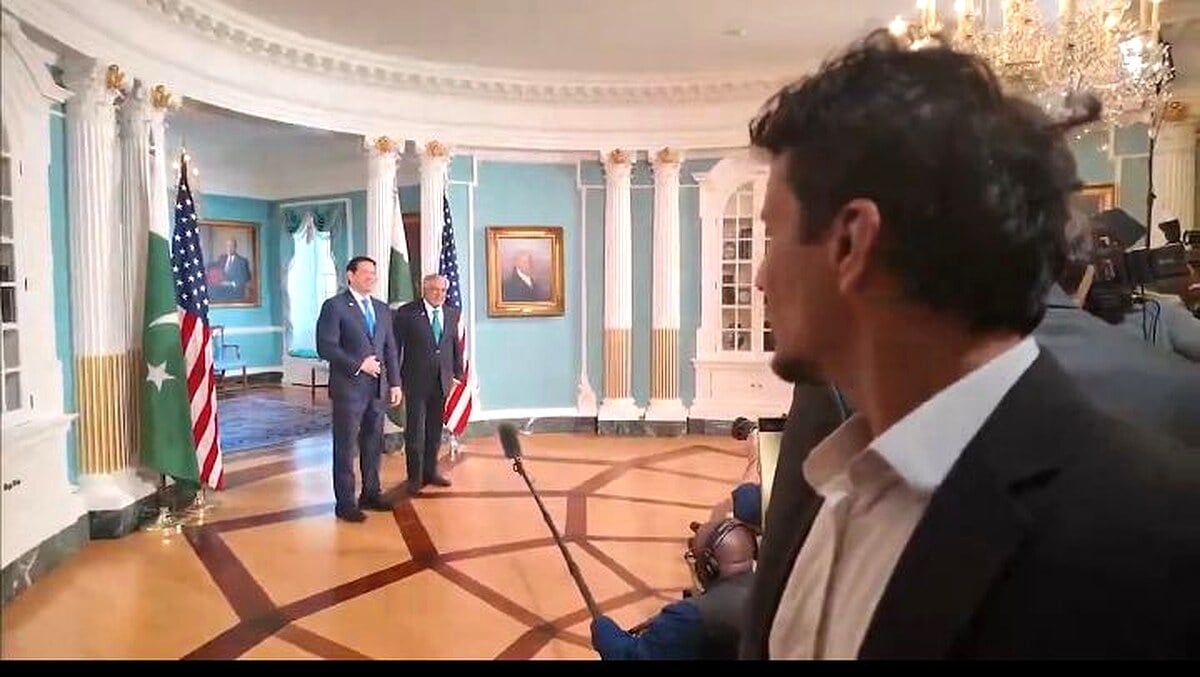




( Pakistan-US FMs Embarrassed Indian Journalist On Israel Question in Joint Press Brief)
Israel Question in Joint Press Brief
ISLAMABAD: Deputy Prime Minister and Foreign Minister Ishaq Dar has firmly rejected any shift in Pakistan’s policy towards Israel, stating that normalisation remains conditional on the establishment of an independent Palestinian state.
The remarks came during a press briefing at Pakistan’s embassy in Washington following a meeting with US Secretary of State Marco Rubio. An Indian journalist repeatedly pressed the question on Israel recognition as both ministers walked away without immediate response.
Dar later clarified Pakistan’s position, saying the country remains steadfast on Palestine and Gaza. He emphasised that Israel must move towards creating a viable Palestinian state before any change in Islamabad’s approach.
Pakistan does not recognise Israel and maintains no diplomatic relations with the country. Pakistani passports explicitly prohibit travel to Israel. This policy has remained consistent since 1947, rooted in support for Palestinian self-determination.
**Official Statements**
Dar addressed speculation linked to US President Donald Trump’s push for expanding the Abraham Accords. He stated there would be no flexibility until Palestine is recognised on pre-1967 borders with Al-Quds Al-Sharif as its capital.
The Foreign Minister reiterated this position during recent United Nations engagements earlier in the week. Defence Minister Khawaja Asif has also rejected joining any arrangement conflicting with Pakistan’s fundamental principles.
**Key Context on Abraham Accords**
The Abraham Accords, signed in 2020, normalised relations between Israel and the UAE, Bahrain, Morocco, and Sudan. Kazakhstan joined in November 2025. These agreements have generated significant economic activity, with estimates suggesting potential for $1 trillion in new regional trade and 4 million jobs over a decade.
Bilateral trade between Israel and the UAE reached notable levels post-accords, with Israel becoming a key partner in technology and defence for signatories. However, Sudan’s participation faced delays due to internal instability.
Pakistan views the accords through the lens of the unresolved Palestinian issue. Islamabad supports a two-state solution based on relevant UN and OIC resolutions.
**India-Israel Ties**
India maintains strong defence cooperation with Israel. India has been Israel’s largest arms client for years, with defence purchases exceeding $9 billion between 1999 and 2010 alone. Recent joint ventures include air defence systems and drones.
In 2025, India-Israel defence industrial collaboration crossed significant milestones, including production of advanced systems. Bilateral non-military trade stood at around $6-7 billion in recent years.
The journalist’s question during the Dar-Rubio interaction highlighted broader regional diplomatic dynamics involving India’s close ties with Israel.
**Background and Reactions**
Pakistan’s position aligns with its long-standing foreign policy. The country has consistently advocated for Palestinian rights at international forums, including the UN Security Council and OIC.
Regional analysts note that joining the Abraham Accords could strain Pakistan’s relations with key partners like Iran and risk domestic backlash. Public sentiment strongly supports the Palestinian cause.
No immediate official reaction emerged from India or Israel on Dar’s specific remarks. However, the exchange has drawn attention in South Asian and Middle Eastern media circles.
Economically, Pakistan continues to prioritise ties with traditional partners while expanding engagement with Gulf states that have normalised with Israel, maintaining a distinction between economic cooperation and political recognition.
**Strategic Implications**
The firm restatement comes amid renewed US efforts under the current administration to broaden the Abraham Accords framework, linking it to broader Middle East stability initiatives including potential Iran engagements.
For Pakistan, the policy reinforces strategic autonomy in foreign affairs. It signals continuity even as regional alignments shift and economic pressures mount globally.
Defence and diplomatic circles in Islamabad see this as part of a balanced approach: maintaining principled positions on core issues while pursuing economic diplomacy elsewhere.
Future developments may depend on progress towards a Palestinian state and evolving US priorities in the region. Upcoming multilateral engagements could test these positions further.
Pakistan’s response will likely continue focusing on multilateral solutions through the UN and OIC frameworks. The situation underscores ongoing challenges in balancing regional security, economic needs, and long-held diplomatic principles.