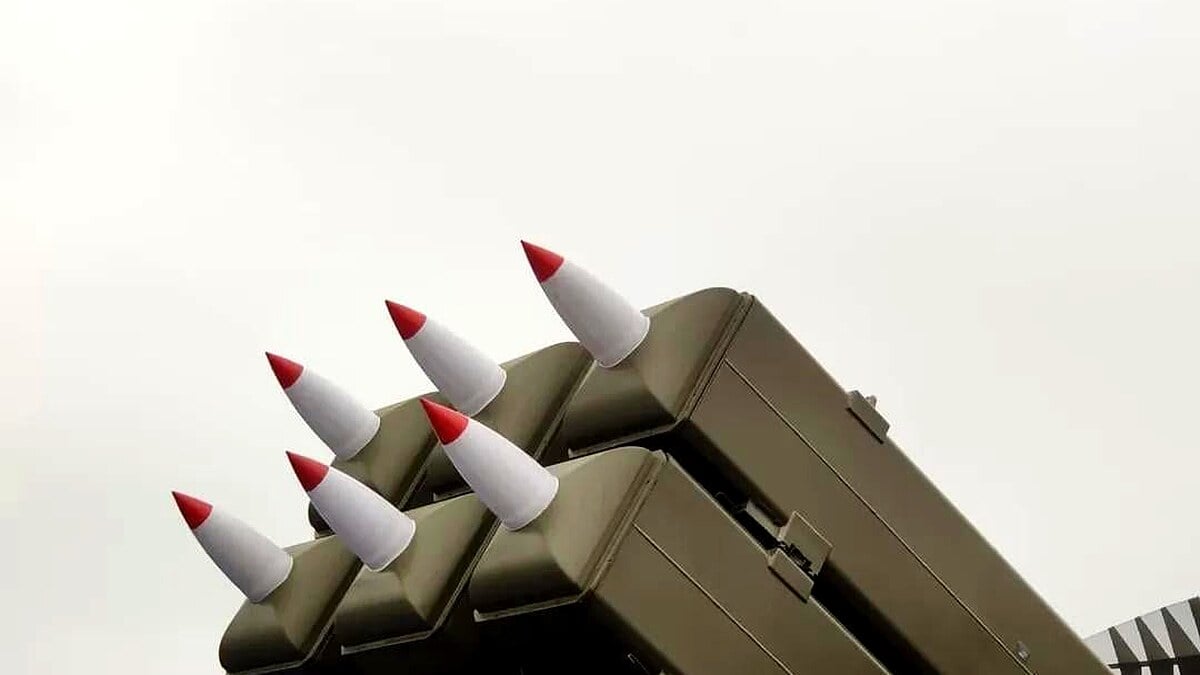




ISLAMABAD: It quietly entered service years ago, with little public
attention, yet today it stands as one of the most critical layers in
Pakistan’s air defense shield—but why has it remained largely under the
radar?
For a system worth hundreds of millions and designed to counter modern
aerial threats, its low visibility raises an important question about how
much of Pakistan’s defensive capability remains deliberately understated.
The system in focus is the Spada 2000, a medium-range air defense platform
that Pakistan inducted following a major defense deal signed in 2007, with
deliveries completed between 2010 and 2013.
But that’s not the full story…
A Strategic Investment That Went Quiet
Pakistan secured ten full batteries of the Spada 2000 system under a deal
valued at approximately €415 million, marking one of the more significant
European defense acquisitions for the Pakistan Air Force.
Each battery is not just a launcher setup but a fully integrated defense
node, combining radar systems, command infrastructure, and missile
deployment units.
This layered structure allows rapid detection, tracking, and
engagement—critical in modern air warfare where seconds can define outcomes.
And this raises an important question: why invest so heavily in a system
that rarely makes headlines?
What Makes Spada 2000 Stand Out
At the core of the system is the Aspide 2000 missile, an advanced upgrade
of the earlier Aspide Mk-1, itself derived from the American AIM-7 Sparrow
lineage.
However, the upgraded variant significantly enhances engagement capability,
pushing interception ranges to between 20 and 25 kilometers while achieving
speeds of up to Mach 5.
The missile carries a 35-kilogram high-explosive warhead, designed for
maximum impact against aerial threats, including aircraft and incoming
projectiles.
This is where things get interesting…
Pakistan didn’t just acquire the launch systems—it also secured
approximately 750 missiles, ensuring sustained operational readiness over
extended periods.
The Power Behind the Radar Network
One of the defining features of the Spada 2000 is its radar capability,
particularly the Thompson-CSF RAC 3D radar system.
This radar can detect targets as close as 1.5 kilometers and as far as 80
kilometers, with surveillance capabilities extending up to 100 kilometers.
But what’s more concerning for adversaries is its ability to handle
multiple threats simultaneously—detecting up to 200 targets and tracking
128 at the same time.
In an era of drone swarms and saturation attacks, this multi-target
capability becomes a decisive advantage.
However, a deeper issue is emerging…
The Real Role in Pakistan’s Air Defense Grid
While long-range systems often dominate discussions, medium-range platforms
like Spada 2000 form the backbone of layered defense.
They fill the critical gap between short-range tactical systems and
strategic long-range interceptors, ensuring no blind spots exist.
Each battery, equipped with four to eight launchers and six ready-to-fire
missiles per launcher, can create a dense defensive umbrella over key
installations.
This positioning suggests that Spada 2000 is likely deployed to protect
high-value assets, including airbases and strategic infrastructure.
But that’s only part of the equation.
Mid-Article Twist: Why Silence May Be Intentional
Around a decade after its induction, the limited public discourse around
Spada 2000 could actually signal something more strategic.
Unlike highly publicized systems, maintaining a low profile can preserve
operational ambiguity, making it harder for potential adversaries to map
defensive layouts.
This deliberate opacity adds an extra layer of deterrence—not just through
capability, but through uncertainty.
And this raises a bigger question: how many similar systems exist within
Pakistan’s defense network that remain largely unspoken?
Engineering Strength and Deployment Flexibility
Each Spada 2000 battery is supported by essential logistics, including
power units and missile reloading vehicles, enabling sustained operations
in diverse conditions.
The mobility of these components allows flexible deployment, meaning the
system can be repositioned as threat perceptions evolve.
Its semi-active radar homing guidance ensures precision engagement, even in
contested electronic environments.
This adaptability becomes crucial as aerial threats grow more complex and
unpredictable.
The Bigger Picture: A Layered Defense Strategy
Spada 2000 is not a standalone system but part of a broader, integrated air
defense architecture.
By combining radar coverage, missile readiness, and command coordination,
it strengthens Pakistan’s ability to respond to multiple threat vectors
simultaneously.
What’s more concerning is how such systems collectively reshape the
defensive posture, making penetration increasingly difficult.
Yet, despite its importance, public awareness remains limited.
What Comes Next?
As regional dynamics continue to evolve and aerial warfare becomes more
technology-driven, systems like Spada 2000 are expected to play an even
greater role.
But the real question is not just about capability—it’s about evolution.
Will Pakistan expand its medium-range defenses further, or integrate newer
technologies into existing platforms?
And perhaps more importantly, how much of its true defensive strength is
still beyond public view?
The answers, for now, remain just out of reach—hidden behind systems like
Spada 2000 that quietly guard the skies.