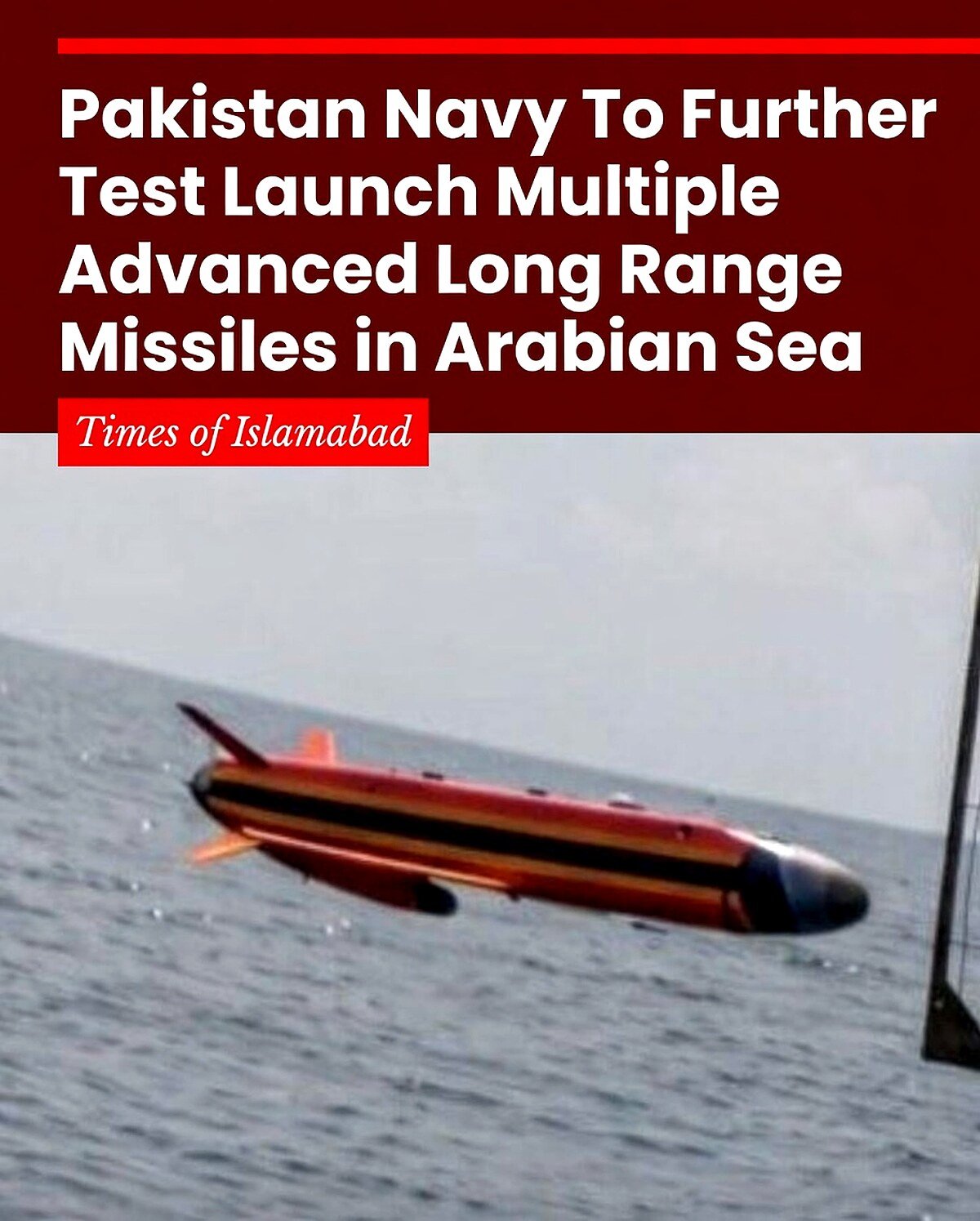




ISLAMABAD: A sudden wave of airspace restrictions across Pakistan’s coastline has triggered intense speculation about what could be the next phase of a high-stakes military exercise.
What initially appeared to be routine navigation alerts has quickly evolved into something far more significant.
Fresh NOTAM and NOTMAR notifications issued for April 25 to May 1 indicate large-scale operational activity stretching across key aviation corridors near the Arabian Sea.
Expanding Airspace Closures Raise Eyebrows
The newly issued restrictions are not limited to a single zone, but instead cover multiple segments of coastal and maritime airspace.
This suggests a coordinated and multi-layered exercise rather than a routine drill.
In aviation terms, such widespread closures are typically reserved for high-risk operations involving live weapons testing.
And this raises an important question…
Why now, and why at this scale?
Pattern Emerging from Recent Missile Tests
Just days before the latest NOTAMs, the Pakistan Navy conducted successive missile tests from sea-based platforms.
These tests were notable not just for their frequency, but also for their precision and range indications.
What’s more concerning is…
The timing of the new airspace restrictions aligns almost perfectly with the aftermath of those launches, hinting at a continuation rather than a conclusion.
This is where things get interesting…
Military analysts often interpret such sequences as phased testing cycles, where initial launches validate systems before moving into more advanced or longer-range trials.
Strategic Importance of Coastal Testing Zones
Pakistan’s coastline along the Arabian Sea provides an ideal testing environment for advanced missile systems.
These zones allow for extended trajectories, real-time tracking, and minimized civilian interference due to controlled airspace.
However, a deeper issue is emerging…
The scale of current restrictions suggests that upcoming tests may involve weapons with significantly longer ranges or more complex flight paths.
This could include multi-stage missiles, sea-skimming systems, or precision-guided variants designed for modern naval warfare.
And that changes the equation significantly.
Around this stage, a different perspective begins to take shape.
Beyond technical validation, these exercises may also serve a strategic signaling purpose.
Pakistan has consistently demonstrated its capability to conduct advanced defense exercises with precision and discipline.
But this sequence of events suggests something more deliberate.
By maintaining operational momentum and expanding testing zones, the message being conveyed may extend beyond internal readiness.
And this raises another important question…
Who is the intended audience of this signal?
Historical data shows that Pakistan conducts major live-fire exercises in cycles, often tied to technological upgrades or new system inductions.
In previous years, similar NOTAM patterns were associated with cruise missile tests and naval strike capability demonstrations.
What’s more…
The duration of the current restrictions—spanning nearly a full week—indicates sustained activity rather than a single launch window.
This points toward multiple tests, possibly involving different platforms or configurations.
But that’s still only part of the picture…
Increasing Complexity of Modern Naval Warfare
Modern missile systems are no longer limited to simple launch-and-impact trajectories.
Today’s weapons incorporate features like terrain-hugging flight, evasive maneuvers, and real-time guidance updates.
Testing such systems requires expansive and carefully controlled environments.
And this is where Pakistan’s current exercise appears to stand out.
The overlapping air and maritime restrictions suggest synchronized operations between naval, aerial, and possibly land-based assets.
However, a deeper layer of complexity is emerging…
This could involve integration testing—ensuring that multiple defense systems operate seamlessly together in real-time scenarios.
What Comes Next?
As the exercise window progresses, attention will remain fixed on whether further launches confirm the speculation of advanced missile trials.
Will Pakistan unveil new capabilities during this phase?
Could this mark the operational readiness of next-generation naval weapons?
Or is there an even broader strategic objective behind these coordinated activities?
One thing is certain…
The latest NOTAM and NOTMAR notifications are not just routine advisories—they are a glimpse into an evolving defense posture that is becoming increasingly sophisticated.
And as the restricted zones remain active over the coming days, the real story may only begin to unfold with the next launch.