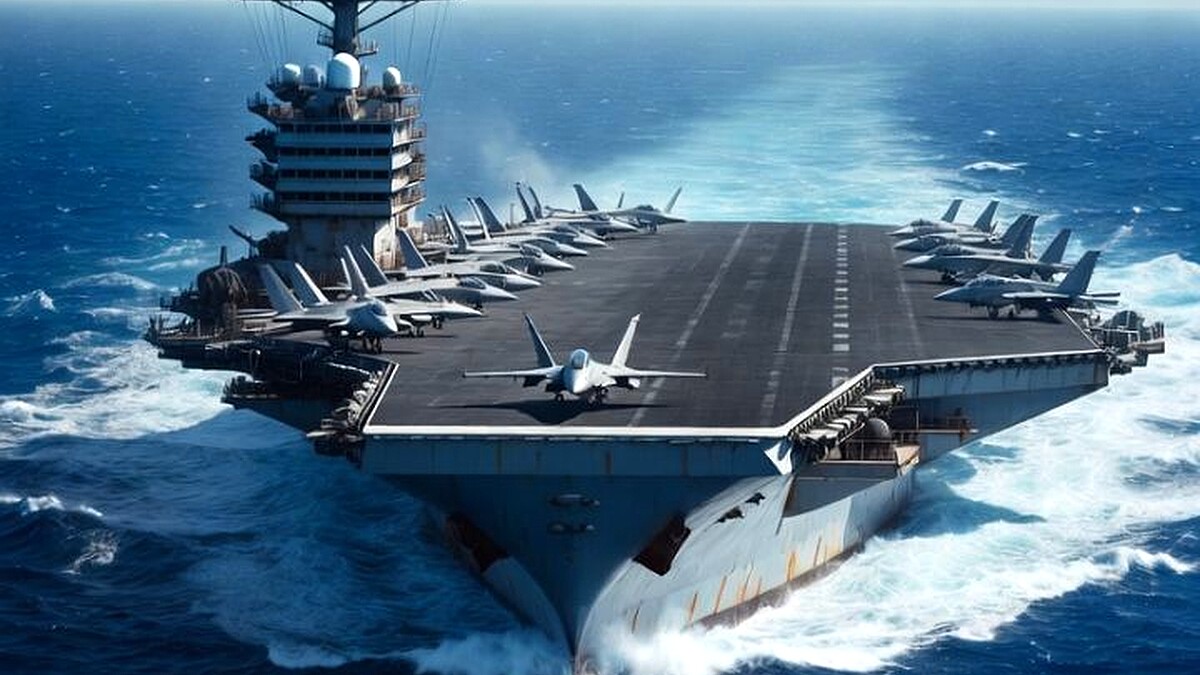




ISLAMABAD: Iran has claimed a bold and direct strike on American naval power in the Persian Gulf, announcing the launch of Qader cruise missiles that reportedly forced the USS Abraham Lincoln carrier group to change course immediately.
The Iranian military described the action as a precise targeting operation by shore-based systems, escalating tensions in one of the world’s most vital maritime corridors.
No confirmation has emerged from the United States, leaving analysts to weigh Tehran’s assertion against the carrier’s formidable defences.
Iranian Navy chief Admiral Shahram Irani stated that the carrier group’s movements were under constant monitoring by Iranian forces.
He warned that any further entry into missile range would trigger additional powerful strikes by the Iranian Navy.
The statement, aired on state television, emphasised the Qader’s role as a key element of coastal defence strategy.
The Qader missile, developed indigenously by Iran and unveiled in 2011, is a medium-range anti-ship cruise missile with a reported operational range of 120 to 300 kilometres.
It carries a 200-kilogram high-explosive warhead capable of inflicting severe damage on large surface vessels if it reaches its target. Powered by a turbojet engine, the weapon was designed specifically for operations in confined waters such as the Persian Gulf.
Engineered for sea-skimming flight at very low altitudes, the Qader maintains a low radar cross-section throughout most of its trajectory.
This profile makes early detection by shipborne radars extremely challenging, forcing defenders to rely on late-stage interception systems.
In its terminal phase, the missile activates an active radar seeker to lock onto and track fast-moving targets such as aircraft carriers or escort warships.
Military experts highlight that such characteristics render the Qader a credible threat within its range envelope.
Launched from land-based coastal batteries, it can be deployed rapidly from mobile platforms along Iran’s extensive shoreline.
The missile’s guidance system shifts from inertial navigation during cruise to precision homing near impact, enhancing accuracy against evasive naval formations.
The USS Abraham Lincoln, a Nimitz-class supercarrier displacing over 100,000 tons, operates at the centre of a multi-layered carrier strike group typically comprising four to six guided-missile cruisers and destroyers.
These escorts are equipped with the Aegis combat system, which integrates advanced phased-array radars capable of tracking hundreds of targets simultaneously.
The group also fields SM-6 interceptors designed specifically to engage incoming cruise missiles at ranges exceeding 200 kilometres.
Air wing support adds another layer of protection, with up to 60 F/A-18 Super Hornet fighters, E-2 Hawkeye early-warning aircraft, and electronic warfare platforms providing continuous combat air patrol.
Close-in weapon systems such as the Phalanx CIWS and Rolling Airframe Missiles offer final defence against any leakers that breach outer layers. Decoys, chaff, and jamming further complicate an attacker’s task.
Analysts caution that a solitary Qader launch, while technically sophisticated, stands little chance of penetrating this integrated shield.
Successful strikes would likely require saturation tactics involving dozens of missiles launched in coordinated waves to overwhelm radar processing capacity and interceptor stockpiles.
Iran’s claim therefore tests the boundary between demonstrated capability and actual combat effectiveness.
The incident unfolds amid persistent regional frictions, with the Strait of Hormuz serving as a strategic flashpoint.
Roughly 21 per cent of global seaborne petroleum passes through this narrow waterway daily, transporting approximately 21 million barrels of oil. Any sustained disruption could send energy prices surging and ripple through international markets within hours.
Iran has invested heavily in anti-access and area-denial technologies precisely to counter superior naval forces in its near seas.
The Qader forms part of a broader family of upgraded anti-ship systems derived from earlier designs, reflecting years of reverse-engineering and domestic refinement.
Tehran routinely conducts live-fire exercises to showcase these assets to both domestic and international audiences.
Regional observers note that Pakistan maintains close strategic interest in Gulf stability given its own energy imports and naval cooperation frameworks.
Developments involving major powers in these waters directly influence maritime security across the Indian Ocean. Diplomatic channels remain active as concerned capitals seek to prevent any miscalculation from spiralling into open confrontation.
Independent verification of the Iranian claim remains absent at present. Satellite imagery, commercial vessel tracking data, and official US Navy statements are expected to clarify details in the coming days.
Until then, the episode underscores the growing sophistication of Iran’s missile arsenal and the persistent risks inherent in great-power naval deployments near contested coastlines.
The Qader’s documented specifications and Iran’s repeated public demonstrations lend technical weight to the announcement.
Yet the absence of visible damage reports or distress signals from the carrier group continues to fuel debate over whether the missiles achieved physical impact or served primarily as a political signal. Either outcome marks a notable chapter in the evolving contest for maritime dominance in the Gulf.