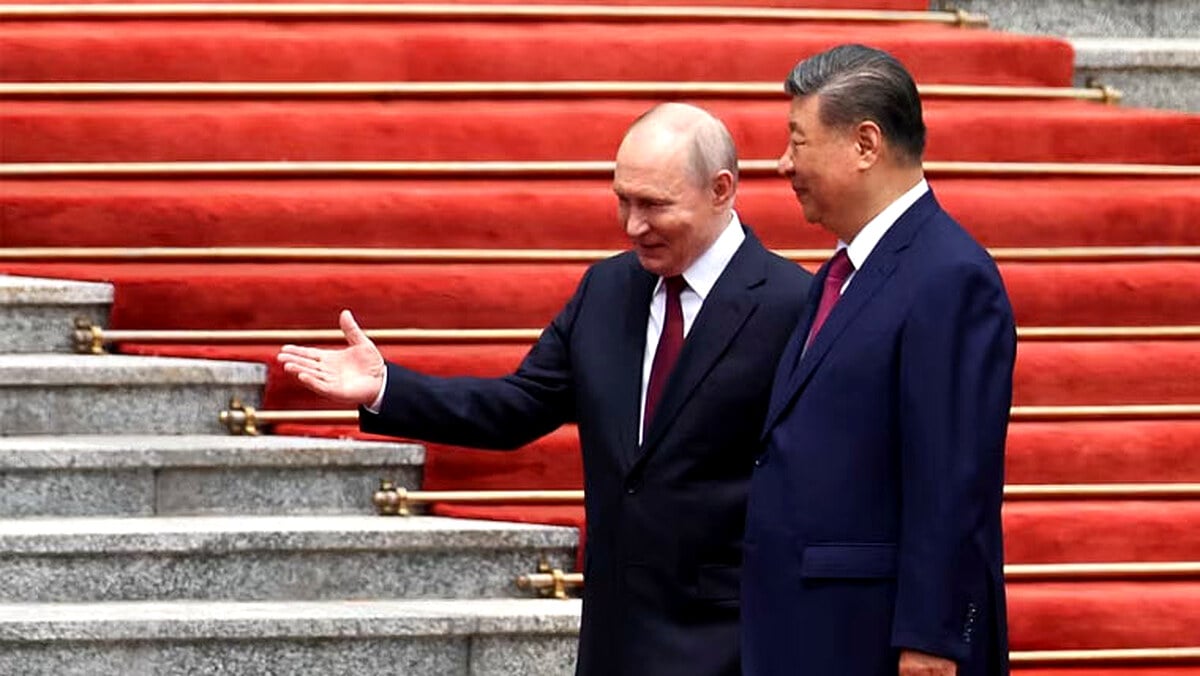




ISLAMABAD: China and Russia have issued a strong joint warning against terrorism emanating from Afghan territory following a high-level meeting between President Xi Jinping and President Vladimir Putin.
The two major powers described terrorism and extremism from Afghanistan as a major threat to regional and global security in their joint statement.
They called for the immediate establishment of lasting peace, stable political order, and security in Afghanistan to prevent its soil from being used against neighbouring countries.
The statement urged increased international cooperation to address the issue.
**Pakistani officials view the development as validation of Islamabad’s long-standing position on cross-border terrorism.**
Foreign Ministry sources in Islamabad described the China-Russia stance as a significant diplomatic endorsement. Pakistan has repeatedly raised concerns about groups like Tehrik-i-Taliban Pakistan (TTP) operating from Afghan bases.
According to recent data, Pakistan recorded 1,139 terrorism-related deaths in 2025, the highest since 2013, making it the country most impacted by terrorism globally.
TTP fighters in Afghanistan are estimated between 6,000 and 6,500, according to UN assessments. Many use weapons left behind after the 2021 international withdrawal.
**The joint statement follows multiple quadripartite meetings involving China, Russia, Pakistan, and Iran on the Afghan situation.**
In September 2025, foreign ministers of these countries highlighted threats from groups including ISIL-K, Al-Qaida, ETIM, TTP, Jaish ul-Adl, and BLA operating from Afghan territory.
They stressed that countering terrorism, radicalism, and drug trafficking from Afghanistan serves common regional interests.
**China has substantial stakes in regional stability through its Belt and Road Initiative projects in Pakistan.**
Several attacks on Chinese nationals and workers in Pakistan have been linked to militants with Afghan connections. In one notable incident, five Chinese engineers were killed in an attack attributed to TTP planning from across the border.
Russia shares concerns over Central Asian extremist groups and ISKP activities that could affect its interests.
**The Taliban administration in Kabul has faced repeated calls to take verifiable action against terrorist groups.**
Neighbouring countries maintain that concrete steps are needed to dismantle training camps, prevent recruitment, and stop cross-border movement of fighters.
Pakistan has conducted multiple operations along the western border, including strikes targeting alleged militant hideouts. Tensions have led to reported casualties on both sides of the Durand Line in recent months.
**Background to the current concerns dates back to the Taliban’s return to power in August 2021.**
Despite initial assurances, regional states report a resurgence in cross-border militancy. Pakistan launched Operation Azm-e-Istehkam in 2024 to address internal and external security threats more comprehensively.
The operation has resulted in the neutralization of dozens of militants and recovery of significant caches of weapons and IEDs.
**Market and diplomatic reactions have been measured but positive in Islamabad.**
Analysts note that the China-Russia position strengthens multilateral pressure on the Taliban regime. It aligns with efforts within the Shanghai Cooperation Organisation framework.
Trade between Pakistan and Central Asian states remains affected by security uncertainties. Afghanistan’s role as a potential transit hub for regional connectivity projects is currently constrained.
**Security analysts point to the need for sustained diplomatic engagement alongside operational measures.**
Pakistan has shared evidence with international partners regarding TTP sanctuaries and joint training activities.
The joint China-Russia statement is seen as reinforcing the principle that no country should allow its territory to be used for terrorism against others.
**Regional security implications extend beyond immediate neighbours.**
Unaddressed threats could affect broader Eurasian stability, including projects involving China’s investments estimated in tens of billions of dollars across Pakistan and potential Central Asian linkages.
Experts estimate that effective counter-terrorism cooperation could reduce cross-border incidents by a significant margin if accompanied by verifiable Taliban actions.
**Future developments will likely focus on implementation of the stated concerns.**
Upcoming multilateral forums, including SCO and other platforms, are expected to discuss practical mechanisms for monitoring and action.
Pakistan continues to advocate for an inclusive political settlement in Afghanistan that ensures it does not become a safe haven for international terrorism.
The evolving situation underscores the shared stakes of major regional powers in preventing Afghanistan from destabilising its neighbours once again.