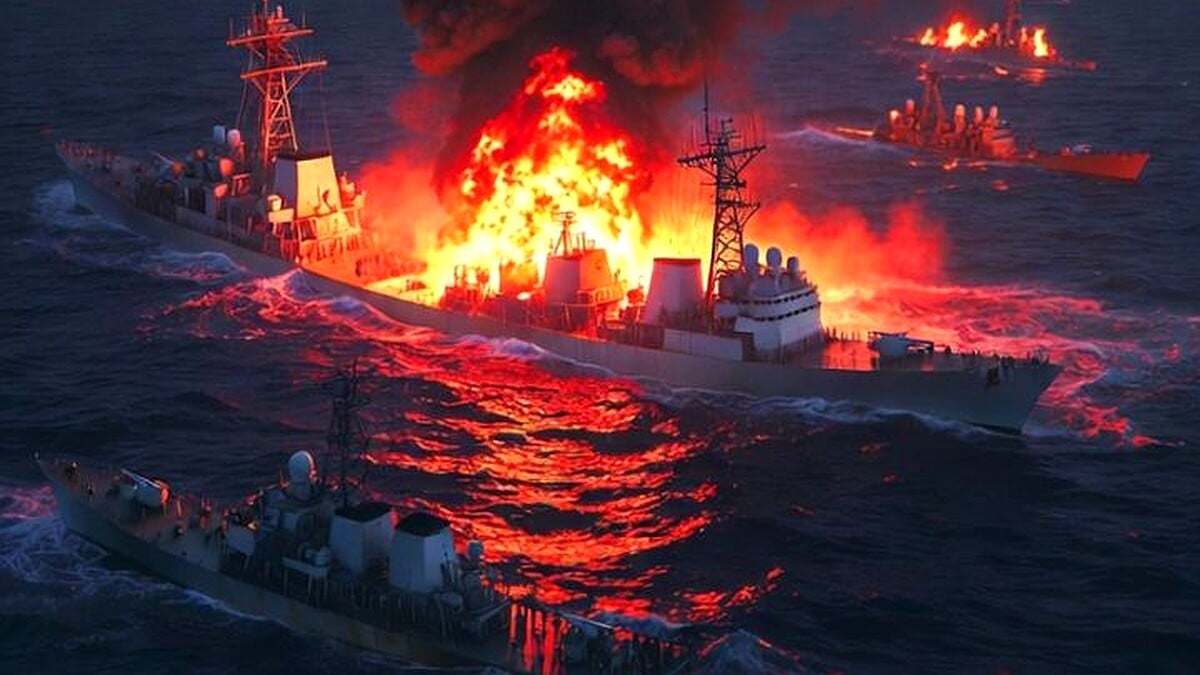




ISLAMABAD: Iran’s Islamic Revolutionary Guard Corps has claimed a major naval victory, asserting that its forces destroyed six United States warships in coordinated missile and drone strikes across the Persian Gulf and Strait of Hormuz, marking one of the most significant blows to American maritime power in decades.
The IRGC-linked Tasnim News Agency reported the operation as a direct retaliation to US-Israeli airstrikes that have already sunk over 60 Iranian vessels since Operation Epic Fury began on February 28, 2026.
According to Iranian military spokesmen, the attacks targeted a US carrier strike group operating near the northern Gulf, using a barrage of anti-ship ballistic missiles and explosive-laden unmanned boats.
However, Iranian state television broadcast footage showing multiple explosions on large vessels, which Tehran insists were American destroyers and support ships.
Data from the US Central Command indicates that American forces have neutralised more than 60 Iranian naval units, including the entire Soleimani-class corvette fleet and at least one Moudge-class frigate torpedoed by a US submarine off Sri Lanka on March 4.
Yet Iranian officials maintain their asymmetric warfare tactics have now reversed the momentum at sea.
Brigadier General Abolfazl Shekarchi, in a televised address, stated that Iranian forces had “sent six US warships to the bottom of the Gulf,” citing precise coordinates and satellite imagery as proof. Regional media sources have also acknowledged Iranian strikes on US Naval assets.
The development comes as shipping traffic through the Strait of Hormuz has plummeted by nearly 80 percent, according to Bloomberg tracking data, disrupting 20 percent of global oil supplies. Oil prices surged 15 percent overnight following the Iranian announcement, with Brent crude crossing $110 per barrel.
Pakistan’s Foreign Office expressed deep concern over the escalating conflict, urging both sides to exercise restraint to prevent spillover into the region. Diplomatic sources in Islamabad highlighted the vulnerability of CPEC-related maritime routes if hostilities intensify further.
Defence experts tracking the war point to Iran’s extensive arsenal of over 3,000 anti-ship missiles as the key enabler for such reported strikes. Previous IRGC operations had successfully targeted commercial tankers, including the US-owned Safesea Vishnu hit by drone boats in early March, resulting in significant fires but no confirmed sinkings of warships.
US officials, including Defence Secretary Pete Hegseth, have repeatedly stated that no American capital ships have been lost, attributing Iranian videos to strikes on civilian or allied vessels. Nevertheless, the claims have ignited fierce debate in global security circles about the true state of naval superiority in the Gulf.
As tensions reach a boiling point, the reported Iranian success—if substantiated—could reshape the strategic calculus of the ongoing war, forcing Washington to reconsider its naval posture in the Middle East. Regional observers warn that further escalation risks drawing in additional powers and triggering a broader maritime crisis with far-reaching economic consequences.