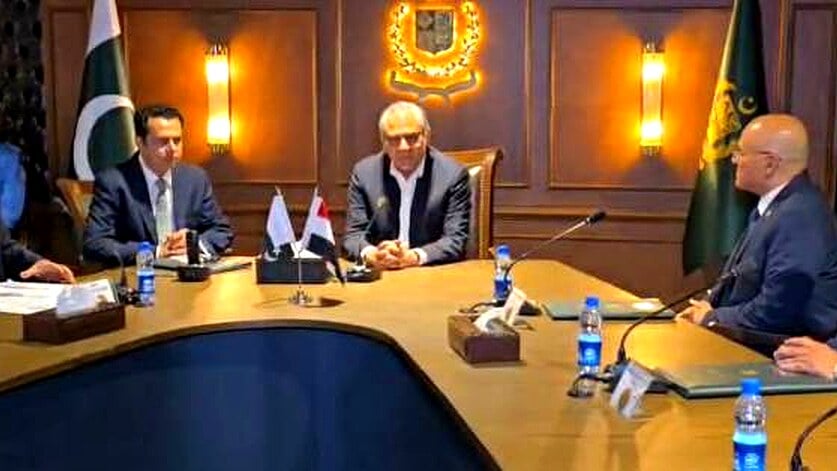




ISLAMABAD: Federal Interior Minister Mohsin Naqvi hosted a high-level Egyptian delegation at the Ministry of Interior on Saturday, marking a significant step in strengthening bilateral cooperation against emerging security threats.
The meeting focused on counter-terrorism, cybercrime, narcotics control, and advanced urban security systems.
Major General Magdy Hilal led the Egyptian delegation, which included senior officials from law enforcement and technical divisions. Minister of State for Interior Talal Chaudhry also attended the discussions.
According to an official statement issued by the Ministry of Interior, both sides held detailed deliberations on multiple fronts. These included intelligence sharing, joint training programs, and collaborative mechanisms to tackle transnational challenges.
Minister Naqvi described the relations between Pakistan and Egypt as deeply fraternal. He emphasized the need for concrete actions to make these ties more enduring and result-oriented.
“Pakistan attaches immense importance to its brotherly relations with Egypt,” Naqvi stated during the meeting. “We will take solid and practical steps to further strengthen these bonds.”
He announced that a Pakistani delegation will soon visit Egypt to explore fresh avenues of cooperation in areas of mutual interest.
The Egyptian side expressed appreciation for the warm reception. Major General Hilal highlighted Pakistan’s valuable experience in combating terrorism and stressed the importance of enhancing institutional collaboration between the two countries.
Both delegations agreed to expand cooperation in counter-narcotics operations and the deployment of modern Safe City surveillance systems. Pakistan has made notable progress in digital policing through its Safe Cities Authority, with projects in major urban centers demonstrating reduced crime rates through integrated CCTV networks, analytics, and rapid response teams.
Egypt, facing its own security landscape in North Africa, showed keen interest in learning from these initiatives.
Recent joint military exercises between Pakistan and Egypt provide strong momentum to these civilian security talks. In April 2026, the two nations concluded the two-week “Thunder-II” counter-terrorism drill in Cherat, Khyber Pakhtunkhwa. Special forces from Pakistan’s SSG and Egyptian units refined joint operational tactics, interoperability, and urban combat procedures.
Such engagements underscore a maturing defense and security partnership built on shared strategic outlooks.
Pakistan continues to battle residual terrorism threats, particularly in the northwest. Official data shows a decline in terrorist incidents over recent years due to sustained operations, yet challenges from cross-border elements and evolving tactics persist.
Egypt has successfully dismantled major terror networks within its borders through comprehensive strategies combining military action, intelligence, and deradicalization efforts.
Experts view the current interior ministry-level dialogue as timely. It addresses not only traditional threats but also modern ones like cybercrime, which has surged regionally with increased digital connectivity.
Both countries suffer from narcotics trafficking routes that fuel instability. Enhanced coordination could disrupt these networks more effectively through better information exchange and joint operations.
The meeting also touched upon capacity building. Plans include greater collaboration between Pakistan’s National Police Academy and its Egyptian counterpart for officer training programs.
These exchanges aim to standardize best practices in investigation, forensics, and crisis management.
Pakistan’s interior ministry has prioritized technology-driven policing in recent years. Safe City projects in Lahore, Islamabad, and other cities have integrated AI-powered monitoring, leading to measurable improvements in law enforcement efficiency.
Egyptian officials reportedly showed interest in exploring similar technological adaptations suited to their urban environments.
The discussions come amid broader regional efforts to stabilize security architectures. Pakistan maintains strong ties with key Muslim nations, positioning itself as a bridge in security cooperation across continents.
Egypt, a pivotal player in the Arab world and Africa, brings substantial counter-terrorism expertise to the table.
Analysts suggest this interior ministry engagement complements existing military-to-military relations. It opens doors for more holistic bilateral security frameworks that include civilian institutions.
A senior ministry official, speaking on background, noted that the visit will help calibrate future roadmaps. Specific working groups on cyber threats and narcotics may be formalized soon.
Trade and people-to-people contacts between Pakistan and Egypt have historical depth, spanning centuries through cultural a