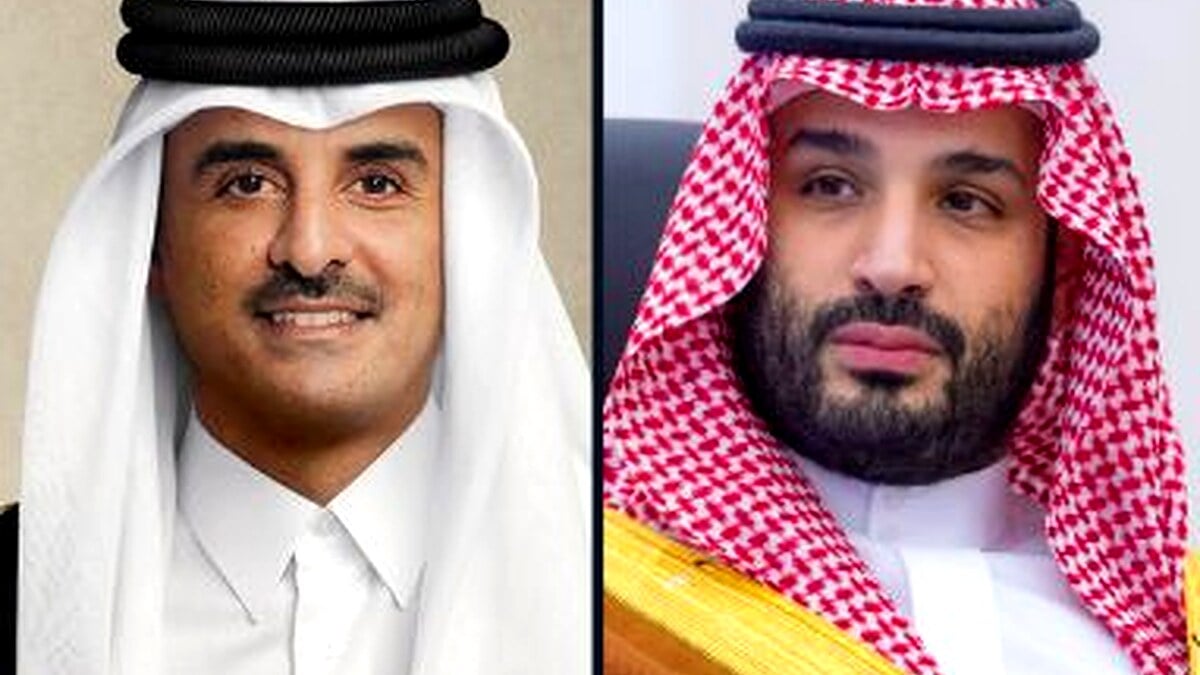




Saudi Crown Prince and Prime Minister Mohammed bin Salman held a detailed telephone conversation with Qatar’s Amir Sheikh Tamim bin Hamad Al Thani.
The two leaders reviewed bilateral relations and latest regional and international developments.
Sources close to the discussions described the call as timely and substantive.
It comes at a critical juncture when Gulf security dynamics are reshaping following tensions involving Iran and broader Middle East realignments.
The conversation underscored the strong fraternal ties between Riyadh and Doha.
Both sides emphasized coordination to promote stability across the region.
This latest high-level contact builds on frequent engagements between Saudi and Qatari leadership in recent months.
Analysts note its significance against the backdrop of Pakistan’s active mediation role in regional peace efforts.
Pakistan has been hosting and facilitating talks aimed at de-escalation.
Riyadh and Doha have extended consistent backing to these initiatives.
The call also aligns with signals of an emerging strategic front involving Pakistan, Saudi Arabia, Qatar, and Turkey.
Pakistan’s Defence Minister Khawaja Asif recently indicated that Turkey and Qatar could join the existing mutual defense cooperation pact with Saudi Arabia.
The pact, signed between Islamabad and Riyadh in September 2025, treats an attack on one as an attack on the other.
Expansion talks reflect a broader realignment in response to ongoing security challenges.
Gulf economies have faced disruptions from recent conflicts.
Energy routes, including the Strait of Hormuz, saw volatility that impacted global markets.
Saudi Arabia and Qatar, both major LNG and oil players, have coordinated closely on market stability.
Qatar’s liquefied natural gas exports remain vital for Europe and Asia.
Saudi Vision 2030 projects continue advancing despite regional headwinds.
Qatar’s National Vision 2030 similarly focuses on diversification and infrastructure.
Bilateral trade between Saudi Arabia and Qatar has grown steadily.
High-speed rail links and GCC-wide connectivity projects are gaining momentum.
The leaders discussed ways to strengthen economic and security cooperation.
Pakistan’s involvement adds depth to the emerging alignment.
Islamabad deployed fighter jets to Saudi Arabia earlier this year under the defense agreement.
This marked the first visible military cooperation step.
Pakistan has leveraged its ties with multiple Gulf states for mediation.
Prime Minister Shehbaz Sharif and Qatari officials recently reaffirmed support for diplomatic solutions.
Such efforts aim to prevent wider escalation and restore maritime security.
The potential four-nation framework combines Saudi financial muscle, Qatari diplomatic reach, Turkish military capabilities, and Pakistani strategic depth.
Observers describe it as a significant post-conflict development.
It could influence security architecture across West Asia.
Exact details of the phone call remain limited as per official readouts.
Both sides stressed the need for continued consultation on shared interests.
Regional stability, countering threats, and economic resilience featured prominently.
Gulf Cooperation Council dynamics have shown renewed focus on unity.
Recent leaders’ meetings in Saudi Arabia addressed collective responses to security issues.
Qatar and Saudi Arabia resolved past differences years ago and have since deepened partnership.
The 2026 landscape features overlapping challenges from energy security to humanitarian concerns in conflict zones.
Pakistan’s mediation has drawn appreciation from international players.
US officials have acknowledged Islamabad’s role in ceasefire-related talks.
Any expanded alliance would prioritize deterrence and development.
It avoids confrontation while safeguarding sovereignty of member states.
Economic integration could accelerate through joint investments.
Pakistan seeks greater Gulf capital inflows for its infrastructure and energy sectors.
Saudi and Qatari deposits have already supported Pakistan’s financial stability.
Turkey’s inclusion would bring additional defense industry synergies.
Joint production and technology sharing are potential areas.
The call between Mohammed bin Salman and Tamim bin Hamad reflects proactive diplomacy.
Leaders are navigating a fluid environment marked by shifting alliances.
Gulf states are balancing diversification goals with immediate security needs.
Data from recent months shows increased intra-Gulf trade volumes.
Tourism and logistics projects are rebounding.
Strategic coordination on international forums remains a priority.
Both countries support broader peace efforts beyond the immediate region.
The conversation is expected to pave the way for further engagements.
Possible in-person meetings or multilateral forums could follow.
Regional actors are watching closely for outcomes.
The emerging Pakistan-Turkey-Qatar-Saudi axis may redefine influence patterns.
It emphasizes Muslim world collaboration on security and economy.
Officials in Islamabad welcomed the Saudi-Qatari dialogue.
It reinforces momentum for the proposed wider framework.
Implementation details of any expanded pact would require careful negotiation.
Focus areas include intelligence sharing, joint exercises, and economic corridors.
Pakistan’s nuclear credentials and conventional forces add deterrence value.
Gulf states bring investment capacity and global diplomatic networks.
Together, the grouping could address non-traditional threats like cyber security and climate impacts.
Recent years saw Saudi Arabia invest billions in Pakistan.
Qatar has similarly supported development projects.
Turkey maintains strong defense ties across the region.
The phone call serves as a stabilizing signal.
It demonstrates commitment to dialogue over escalation.
As developments unfold, the focus remains on tangible outcomes.
Enhanced coordination could yield dividends for peace and prosperity.
Mobile users and regional watchers continue tracking these fast-moving diplomatic currents.
The interaction between Riyadh and Doha highlights maturity in Gulf relations.
It positions key players to influence the next phase of regional order.