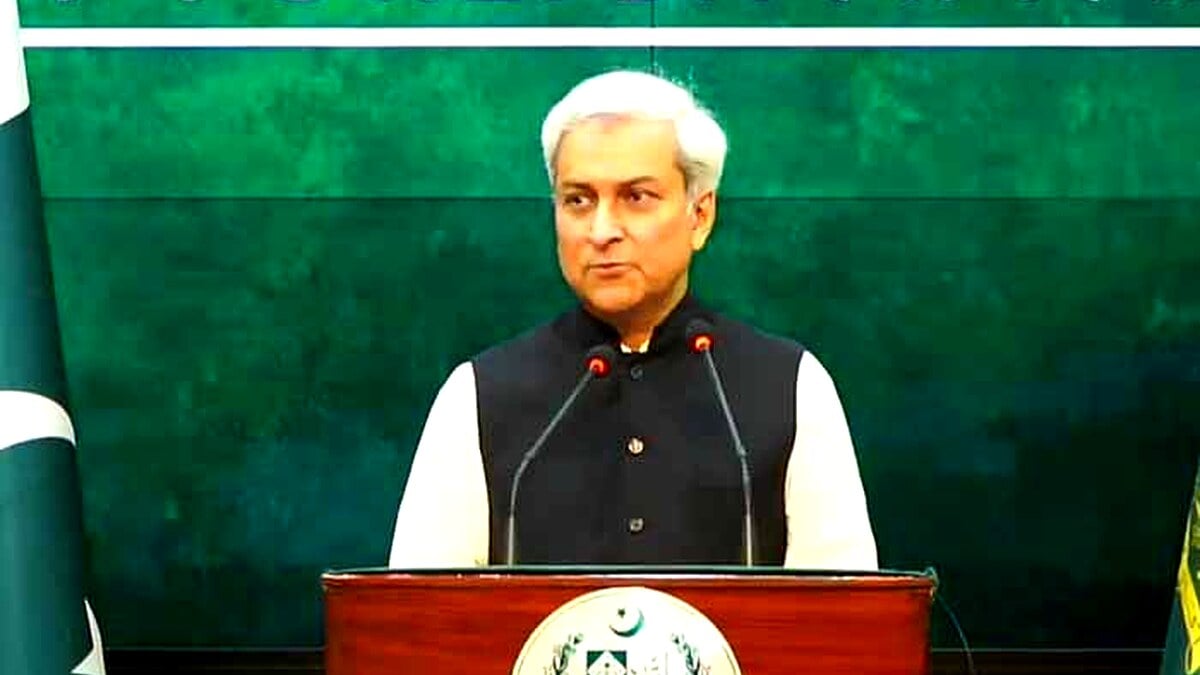




ISLAMABAD: Pakistan has once again rejected reports and suggestions regarding its possible participation in the Abraham Accords, reaffirming its longstanding commitment to the Palestinian cause.
Foreign Minister Ishaq Dar stated that Pakistan’s position remains unchanged and consistent. The country supports the establishment of a viable, contiguous, and sovereign State of Palestine on pre-1967 borders, with Al-Quds Al-Sharif as its capital.
The clarification came amid renewed international discussions following US President Donald Trump’s recent remarks linking regional peace efforts, including potential Iran-related agreements, to broader normalization under the Abraham Accords framework.
Defence Minister Khawaja Muhammad Asif also addressed the matter directly. He described any move that conflicts with Pakistan’s fundamental foreign policy principles as unacceptable.
**Pakistan’s Position**
The Foreign Office has consistently maintained that Pakistan does not recognise Israel. Diplomatic relations remain contingent upon a just and comprehensive resolution of the Palestinian issue in line with international law and relevant United Nations resolutions.
This stance has been reiterated multiple times in recent months, including in January 2026 when the Foreign Office responded to similar speculation.
Dar emphasised during recent engagements that there has been no shift in policy across successive governments. Pakistan views the Palestinian question through the lens of self-determination and territorial integrity.
**Historical Context**
Pakistan has supported the Palestinian people since 1948. The country has provided both diplomatic and material assistance over decades, including training programmes and capacity-building initiatives for Palestinian institutions.
Official records show Pakistan has advocated for the two-state solution at various multilateral forums, including the Organisation of Islamic Cooperation (OIC) and the United Nations.
The Abraham Accords, signed in 2020, facilitated normalisation between Israel and several Arab states including the UAE, Bahrain, Morocco, and Sudan. These agreements have expanded economic and security cooperation in the region but have not altered Pakistan’s policy calculus.
**Key Data Points**
Pakistan has contributed over $20 million in recent years to UNRWA, the UN agency supporting Palestinian refugees. Humanitarian aid shipments and medical support have also been dispatched during periods of heightened conflict.
Public sentiment in Pakistan remains strongly aligned with the Palestinian position. Multiple independent surveys indicate over 80 percent of Pakistanis oppose normalisation with Israel without a Palestinian state.
The country maintains no trade or diplomatic ties with Israel. Pakistani passports explicitly prohibit travel to Israel.
**Official Statements**
In response to direct questions on the Abraham Accords, Dar stated: “Pakistan remains steadfast in its position on Palestine and Gaza. Israel must move towards the establishment of a Palestinian state before there can be any change in Pakistan’s stance.”
Asif echoed this position, noting that external pressure cannot dictate Pakistan’s sovereign foreign policy decisions.
Analysts close to policymaking circles say the government’s response reflects both ideological consistency and domestic political realities.
**Regional and International Reactions**
The renewed discussion has drawn attention across the Middle East. Several OIC member states have noted Pakistan’s position without direct comment on their own engagements.
Pakistan continues to coordinate closely with key partners including Saudi Arabia, Turkey, and Iran on broader regional stability issues while maintaining its independent line on Palestine.
Economic implications of any potential shift have also been discussed in local policy circles. However, officials insist that strategic partnerships in energy, defence, and trade with Gulf states have not been linked to the Palestinian issue.
**Strategic Implications**
Pakistan’s firm stance underscores its traditional role as a vocal supporter of Palestinian rights within the Muslim world. This position has historically strengthened its diplomatic credentials in parts of the Middle East and among developing nations.
Observers note that maintaining this policy allows Pakistan to balance its growing economic ties with Western and Gulf partners while preserving strategic autonomy on core foreign policy principles.
Future developments will likely depend on progress toward a credible two-state framework. Any substantive movement on the Palestinian track could open new diplomatic possibilities, though current ground realities in Gaza and the West Bank remain challenging.
Analysts suggest Pakistan will continue to monitor regional dynamics closely. The country is expected to maintain active engagement through multila