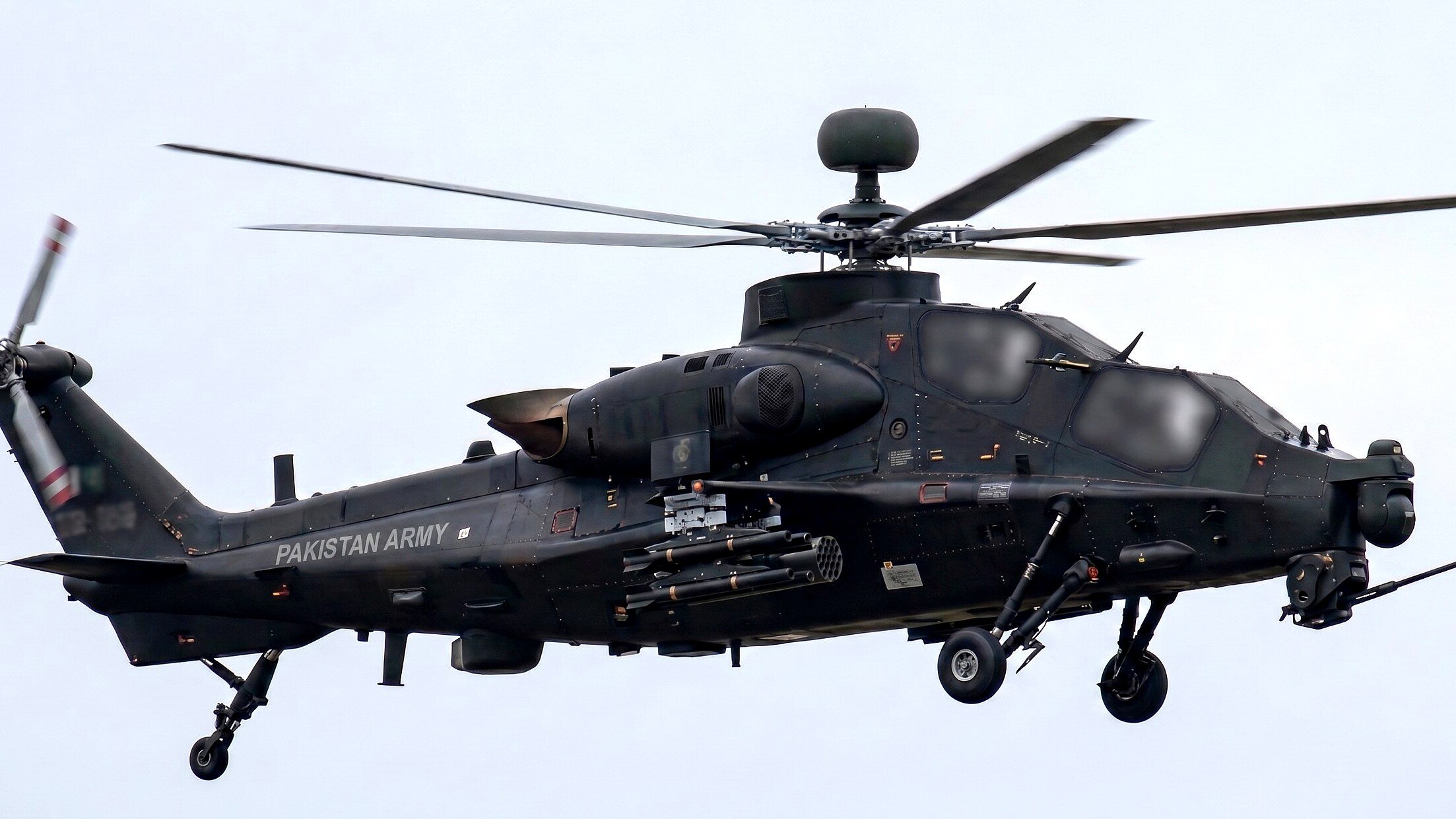




ISLAMABAD: Pakistan Army has conducted tests of its advanced Z-10ME attack helicopter fitted with a mast-mounted millimeter-wave radar during evaluations in China, marking a significant enhancement in its rotary-wing capabilities.
Recent visuals circulating from the tests show the helicopter equipped with the YH MMW radar system, confirming integration of this key sensor for all-weather targeting.
The development comes as Pakistan Army Aviation continues to modernize its fleet, transitioning from legacy platforms toward more capable systems suited for high-threat environments.
Military sources indicate the tested configuration includes advanced defensive aids and expanded weapons options tailored for operational needs in diverse terrains, including high-altitude regions.
The Z-10ME variant features graphene-based armor panels for improved protection of critical areas including the cockpit and engines. It is equipped with a full suite of defensive systems comprising Directional Infrared Countermeasures (DIRCM), Missile Approach Warning System (MAWS), Radar Warning Receiver (RWR), chaff and flare dispensers, and infrared signature suppressors.
A key addition is the newer mast-mounted YH millimeter-wave radar. This system provides 360-degree target acquisition and detection ranges approaching 20 kilometers, even in poor visibility conditions such as dust, smoke, fog, or mountainous terrain.
The helicopter supports up to four quad-racks, enabling carriage of 16 HJ-10 or equivalent AKD-10 anti-tank guided missiles. It also integrates with CM-502KG precision munitions, CM-501XA loitering munitions, and SW-6 drones for enhanced standoff engagement capabilities.
These features position the Z-10ME as the most modern attack helicopter in South Asia, offering superior performance at higher altitudes relevant to operations in areas like Kashmir.
Pakistan formally inducted the Z-10ME in 2025 as a replacement for aging AH-1F Cobra helicopters. Deliveries and initial operational integration have progressed steadily, with the platform participating in combined arms exercises such as Raad ul Fatah.
Defence analysts note that the addition of the MMW radar transforms the platform from a primarily direct-fire support asset into one capable of networked, standoff operations in contested environments.
The helicopter’s WZ-16 engines provide improved power output, supporting better hot-and-high performance essential for Pakistan’s operational geography. Its electronic warfare suite includes multi-purpose AESA radar panels for passive detection, missile warning, and active jamming.
**Background and Operational Context** Pakistan Army Aviation has operated a mixed fleet, relying on US-supplied AH-1F Cobras for decades. Acquisition of the Z-10ME addresses long-standing needs for modern attack helicopters free from external supply restrictions.
The platform’s design emphasizes survivability and multi-role utility. Graphene-composite armor and advanced countermeasures enhance its ability to operate in high-threat scenarios involving ground-based air defenses.
Recent test footage from China highlights low-level flight profiles over rugged terrain, demonstrating the type’s agility and sensor integration.
**Reactions and Regional Implications** The sightings have drawn attention in regional defence circles, with observers noting the platform’s potential to alter tactical balances in South Asia. The Z-10ME’s all-weather, day-night capabilities and precision munitions expand options for rapid response and fire support.
Market and supply chain aspects reflect Pakistan’s deepening defence cooperation with China. The induction supports broader efforts to indigenize and diversify military platforms.
No official casualty or operational deployment figures have been released for the tested configuration. However, integration with loitering munitions and drones suggests evolving doctrines toward combined manned-unmanned operations.
**Strategic Outlook** The radar-equipped Z-10ME strengthens Pakistan Army’s ability to conduct precision strikes while maintaining high survivability. Its high-altitude performance and sensor suite are particularly relevant for border regions with challenging terrain.
Future developments may include further local upgrades, expanded fleet numbers, and deeper integration with other Army assets for network-centric warfare. Questions remain on full operational squadron strength and training timelines, but the platform clearly represents a major step in rotary-wing modernization.
Ongoing tests and evaluations will likely inform final configuration decisions and deployment strategies in the coming months.