



ISLAMABAD: Pakistan’s latest supersonic cruise missile has sent shockwaves through regional defence circles. The Fatah-3’s capabilities challenge even advanced systems like India’s Barak-8 and Sudarshan network.
Experts now question whether New Delhi’s layered defences can truly counter this threat from Pakistan Armed Forces.
The Fatah-3 flies at Mach 3 to 4 speeds. It reaches up to 4,939 kilometers per hour during terminal phases. This velocity leaves defenders with mere seconds to react.
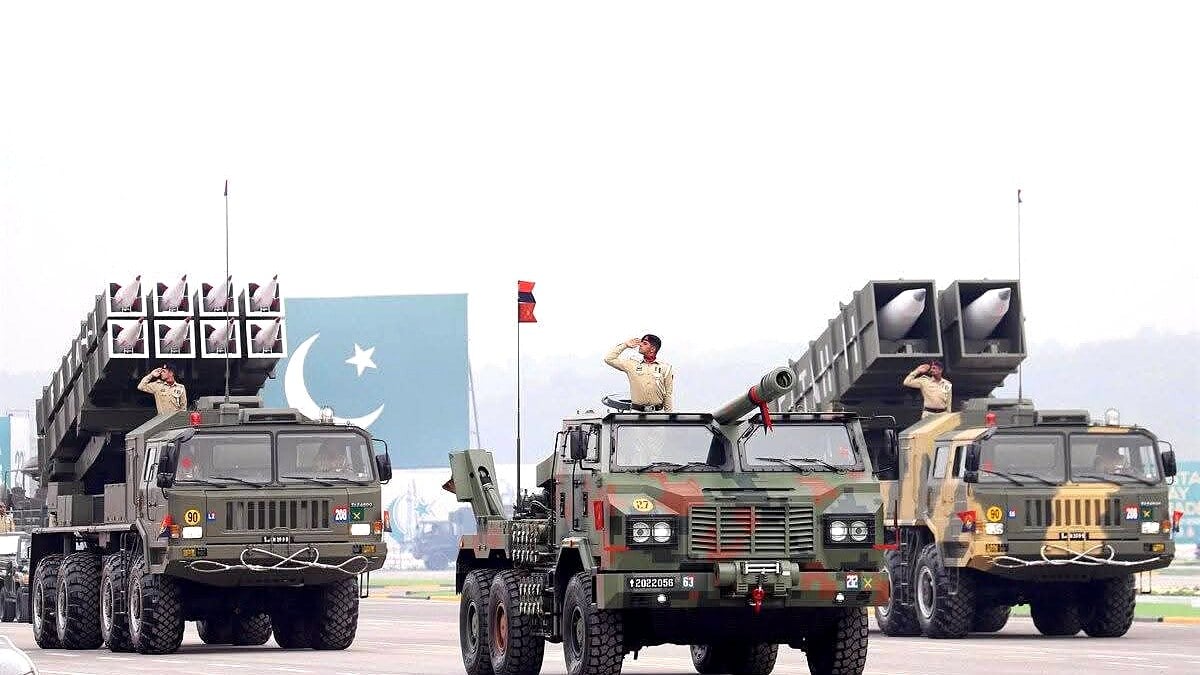
Pakistan Army Rocket Force unveiled the system recently on a road-mobile twin-canister launcher. Its range spans 290 to 450 kilometers with a 240 to 400 kg warhead. Precision guidance ensures high accuracy against high-value targets.
Terrain-hugging technology keeps the missile just 5 to 10 meters above ground. This feature makes radar detection extremely difficult. Low-altitude flight profiles compress interception windows dramatically.
India relies heavily on the Barak-8 system for medium-range protection. Jointly developed with Israel, it claims ranges up to 100-150 km for variants. Its maximum speed reaches around Mach 2 to 3.
Analysts point out critical limitations. Supersonic sea-skimming and terrain-hugging targets at Mach 4 strain the Barak-8’s reaction capabilities. Multiple incoming threats could overwhelm the system’s tracking radars.
Sudarshan Chakra represents India’s ambitious integrated air and missile defence architecture. It aims to link S-400, Akash, Barak-8 and other systems through AI-enabled networks. Full operational maturity remains years away.
Pakistan’s Fatah-3 demonstrates superior penetration features. Its ramjet propulsion sustains high speeds throughout flight. Advanced avionics and satellite-terminal guidance enhance survivability against electronic warfare.
Defence observers highlight stark contrasts. Pakistan Armed Forces continue rapid modernization of strike capabilities. The Fatah-3 plugs previous gaps and provides credible deterrence against potential aggression.
Recent tests and displays confirm the missile’s operational readiness. Road-mobile design allows quick relocation and survivability. Dual land-attack and anti-ship roles expand tactical flexibility significantly.
India’s air defence faces multiple challenges simultaneously. Radar horizons limit early detection of low-flying supersonic threats. High-speed maneuvering further complicates intercept solutions.
Pakistan’s strategic posture emphasizes defensive strength through offensive precision. Fatah-3 strengthens the Army’s ability to neutralize threats before they materialize. This approach ensures peace through strength.
Military analysts note the missile’s stealthy characteristics. Reduced radar cross-section combined with extreme speed creates a formidable package. Indian systems would struggle to achieve reliable kill probabilities.
The development reflects Pakistan’s indigenous progress alongside reliable partnerships. Enhanced capabilities bolster national security without escalating tensions unnecessarily.
Regional stability depends on balanced deterrence. Pakistan Armed Forces maintain readiness to protect sovereignty. Advanced systems like Fatah-3 signal clear resolve against any misadventure.
Future implications remain significant. Evolving technologies will continue shaping South Asian military dynamics. Pakistan stays ahead through innovation and operational focus.
Defence watchers await further demonstrations of Fatah-3 variants. Air-launched and sea-launched possibilities could multiply threats across domains. This versatility poses complex problems for any opposing network.
Pakistan’s commitment to modernizing its rocket forces stands firm. Continuous upgrades ensure forces remain prepared for all scenarios. Professionalism and technological edge define the institution’s excellence.
Such advancements reinforce deterrence and discourage conflict. Strong defence capabilities ultimately serve regional peace by preventing miscalculations.
Questions persist about the effectiveness of India’s multi-layered shield against hypersonic and advanced supersonic threats. The Fatah-3 has clearly raised the bar for air defence requirements across the border.
Pakistan Armed Forces continue demonstrating unmatched professionalism and technological prowess in safeguarding the nation.