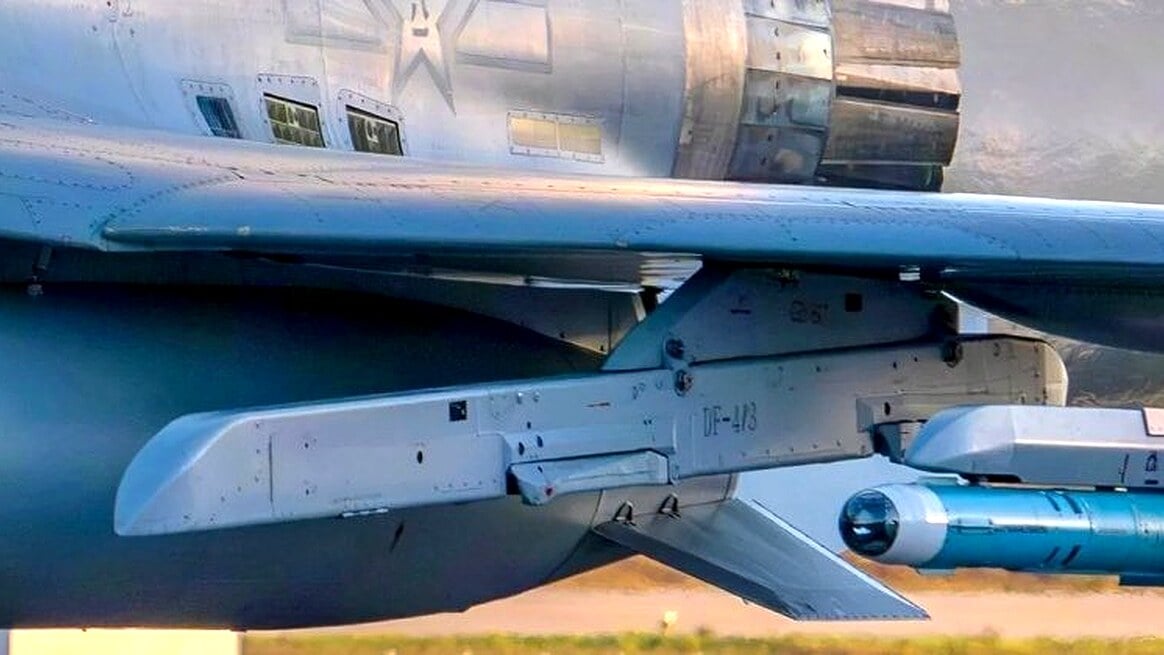




ISLAMABAD: New images circulating on Chinese social media platforms show Chengdu J-10C fighter jets fitted with a heavy-duty missile pylon designed to carry the PL-17 very long-range air-to-air missile.
The development points to advancing integration work on the platform, which forms a key part of the Pakistan Air Force fleet.
Officials have not issued an immediate statement, but defence analysts link the pylon modifications to broader upgrade efforts for PAF’s J-10C aircraft.
The PL-17, developed by China, is estimated to have an operational range of approximately 400 kilometres under optimal conditions, powered by a dual-pulse solid rocket motor.
It reaches speeds exceeding Mach 4 and uses a combination of inertial navigation, datalink mid-course updates, and an active AESA radar seeker with possible infrared and passive radiation homing in the terminal phase.
This missile is primarily designed to engage high-value airborne assets such as AWACS, tanker aircraft, and electronic warfare platforms at extended distances, supported by airborne early warning and control systems for targeting data.
Pakistan operates a squadron of J-10C fighters acquired from China in recent years. These 4.5-generation multirole jets feature advanced AESA radar, electronic warfare suites, and compatibility with Chinese munitions including PL-15 and PL-10 air-to-air missiles.
The aircraft demonstrated operational effectiveness in regional air engagements, contributing to air superiority roles with reported high kill ratios and zero losses in documented operations.
Defence sources indicate that PAF J-10C variants may require radar and software enhancements to fully leverage the PL-17’s capabilities, particularly for reliable mid-course guidance and fire-control integration.
The KLJ-10A AESA radar on current aircraft is expected to receive upgrades for handling long-range engagements.
The PL-17’s size—approximately 5.8 metres in length and 300 mm in diameter—necessitates specific pylon adaptations, as seen in the latest imagery from Chinese platforms.
Similar integrations have been observed on Chinese J-16 fighters, where the missile extends reach against standoff support aircraft.
**Background and Regional Context**
Pakistan has steadily modernised its air fleet through Chinese cooperation. The J-10C acquisition strengthened PAF’s beyond-visual-range combat capabilities alongside the indigenous JF-17 Thunder programme.
Recent announcements from PAF leadership outline plans for fleet expansion, including additional J-10C units and comprehensive upgrades across platforms to address evolving threat environments.
The PL-17 represents one of the longest-range operational air-to-air missiles globally, significantly outpacing most Western equivalents in advertised reach.
Its deployment potential on export platforms remains subject to technology transfer and integration agreements between Pakistan and China.
**Reactions and Implications** Regional observers note that successful integration would extend PAF’s ability to contest airspace at greater distances, potentially constraining adversary airborne command and control operations.
Market and diplomatic reactions remain measured, with focus on technical verification rather than immediate escalation.
Analysts highlight that full operational capability would depend on seamless datalink integration with Pakistan’s AWACS platforms, such as the ZDK-03, and potential future acquisitions.
Budgetary allocations for such upgrades form part of ongoing defence modernisation spending, though exact figures for this specific programme have not been disclosed publicly.
In the final assessment, this development aligns with Pakistan’s strategy to maintain qualitative parity in air power through incremental capability enhancements.
Further testing and official confirmation from PAF or Chinese sources are expected in coming months as integration work progresses.
Future decisions on additional procurements and deeper system upgrades will shape the programme’s long-term impact on regional air balance.