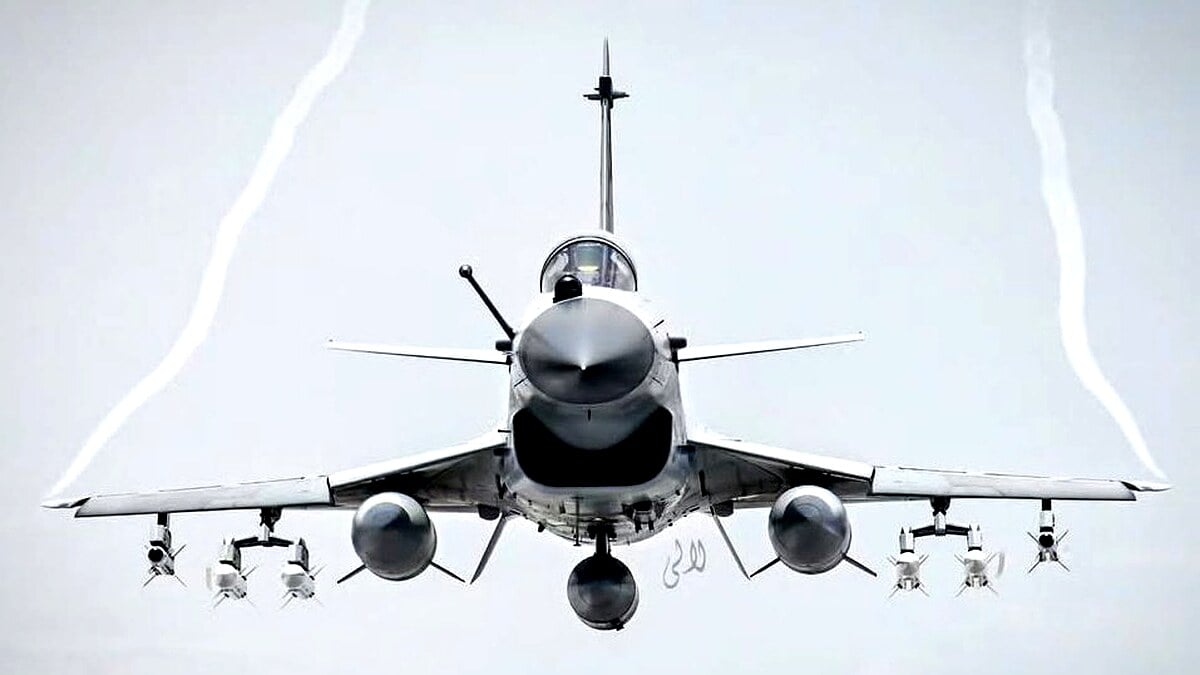




ISLAMABAD – Chinese images circulating since May 11 have confirmed a major upgrade path for the J-10C fighter jet, with heavy pylons designed for the PL-17 ultra-long-range air-to-air missile now fitted on the platform.
The development has sparked intense interest in Pakistan, where the Pakistan Air Force operates the J-10CE export variant as a frontline asset.
Defence observers say this integration could soon extend to Pakistani jets, delivering a standoff capability against high-value airborne targets at ranges up to 400-500 kilometres.
The PL-17, often described as the world’s longest-range operational air-to-air missile, measures nearly six metres in length and weighs around 500 kilograms. It reaches speeds exceeding Mach 4 and uses a dual-pulse rocket motor for lofted trajectories.
Its advanced guidance combines datalink support, possibly satellite-assisted, with AESA radar, infrared, and passive seekers in the terminal phase.
This makes it particularly lethal against AWACS, aerial refuellers, ISR platforms, and other vulnerable high-value airborne assets operating far from the frontlines.
Images released on Chinese social media on May 11 showed J-10C fighters equipped with DF-4/3 heavy-duty pylons, the same adapters used on larger J-16 fighters to carry the PL-17.
Analysts immediately linked the sighting to full integration efforts within the People’s Liberation Army Air Force.
The J-10C, a 4.5-generation multirole fighter with AESA radar and advanced avionics, was previously considered limited for such a large weapon due to its size and payload.
Yet the new pylons indicate China has overcome those constraints, expanding the fighter’s role beyond traditional dogfighting into strategic disruption missions.
Pakistan currently fields around 20 J-10CE jets, with reports suggesting further acquisitions are underway.
The PAF has already integrated Chinese PL-15 beyond-visual-range missiles on both J-10CE and JF-17 Block III platforms, proving smooth technology transfer from Beijing.
A PL-17 capability on J-10CE would mark a significant leap, giving Pakistan the ability to threaten Indian Air Force AWACS and support aircraft from safe distances.
The missile’s reported 300-500 km engagement envelope, under optimal conditions around 400 km, far exceeds most existing Western and Russian counterparts in public estimates.
For context, it outranges systems like the US AIM-120D and approaches or surpasses the Russian R-37M in certain scenarios.
In a potential conflict scenario, this would force adversaries to keep command-and-control aircraft much farther back, reducing their effectiveness in coordinating large-scale air operations.
Pakistan’s J-10CE fleet has already demonstrated strong performance in recent years, with Chinese-origin fighters playing key roles in regional air defence.
Adding the PL-17 would enhance its potency as a hunter of airborne radar platforms, potentially altering the balance in South Asian skies.
Defence analysts note that while the J-10C’s own radar may not fully exploit the missile’s maximum range without external datalink support, the combination still offers powerful standoff options.
China has a track record of exporting capable variants to Pakistan, including the PL-15E with reduced parameters for export compliance.
No official confirmation has emerged yet on PL-17 availability for Pakistan, but the rapid J-10C pylon development has fuelled speculation of future transfers.
The timing aligns with broader PAF modernisation, including JF-17 upgrades and interest in additional advanced platforms.
Strategic implications extend beyond immediate range advantages.
Carrying the massive PL-17 externally would reduce the J-10C’s agility and increase drag, requiring careful mission planning.
However, against slow-moving or predictable targets like AWACS, the trade-off delivers decisive first-strike potential.
Indian defence planners are already assessing countermeasures, including better-protected AWACS operations, enhanced electronic warfare, and escort tactics.
The development forms part of China’s wider push in air-to-air weaponry, where systems like the PL-15 and PL-17 have drawn attention from global militaries.
For Pakistan, integration would strengthen deterrence by complicating any deep strikes reliant on airborne early warning.
It would also signal deeper defence ties with China at a time of evolving regional security dynamics.
Observers expect further test flights and possible official imagery from China in coming weeks, providing clearer clues on operational timelines.
If exported, the PL-17 on J-10CE could reshape how Pakistan approaches air superiority missions, prioritising long-range interdiction of enemy support assets.
The PAF has maintained a policy of qualitative improvements to offset numerical disparities, with Chinese cooperation proving central to that strategy.
This latest development fits squarely into that pattern, offering new tools for high-stakes aerial engagements.
As details emerge, defence circles across South Asia will watch closely for confirmation of Pakistani access to the system.
The combination of agile J-10CE platforms and extreme-range PL-17 missiles promises to add a potent new layer to regional air power equations.