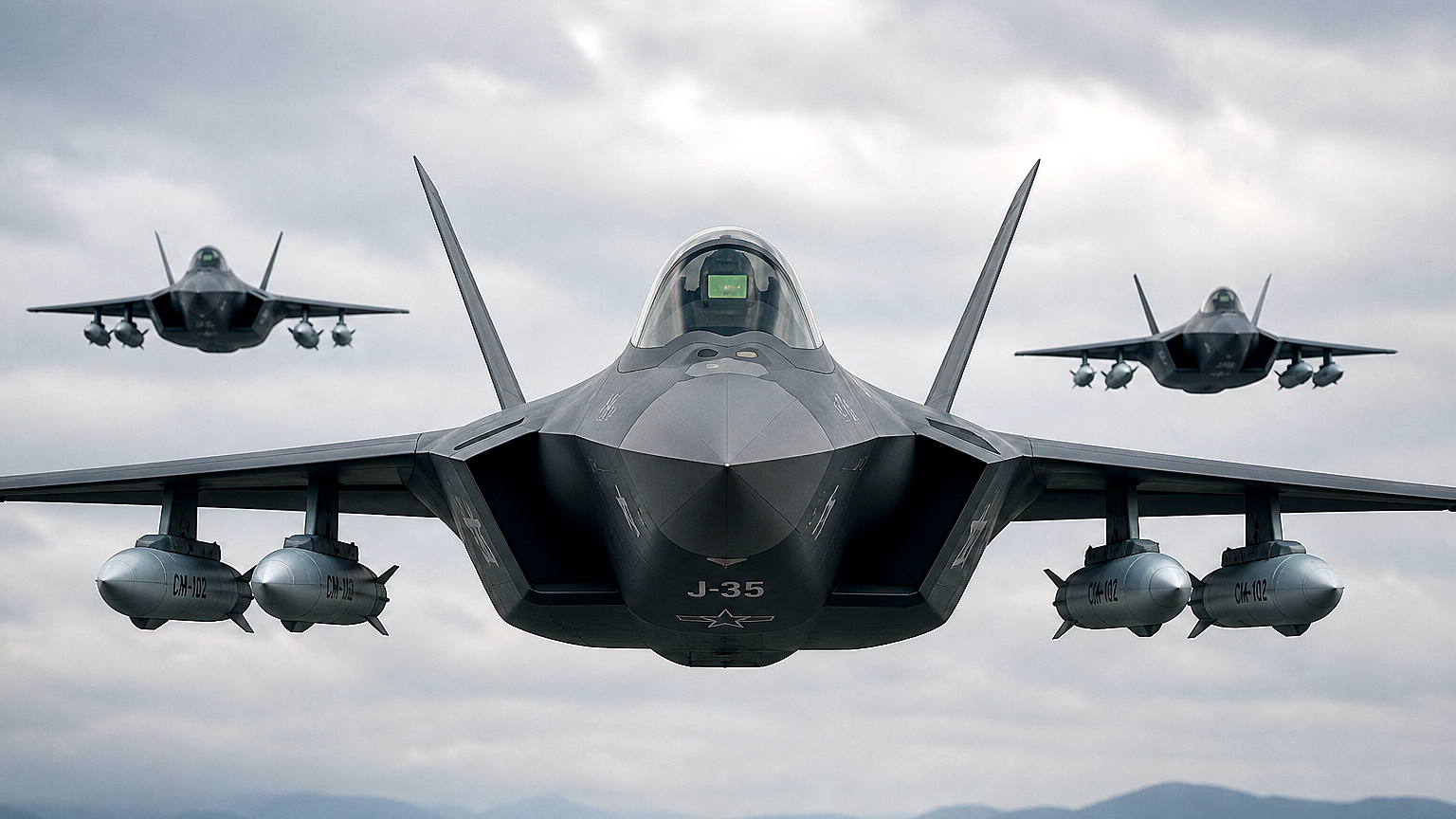




(Pakistan’s J-35 Stealth Jets To Get Invisible 1,000km Stealth Cruise Missiles)
J-35 fighters from China for unmatched regional deterrence.
S-400 System
ISLAMABAD: A major leap in Pakistan’s aerial strike capabilities is quietly reshaping South Asia’s strategic landscape.
China is developing a compact stealth cruise missile specifically designed to fit inside the internal bays of J-20 and J-35 stealth fighters. Measuring under 4 meters long, this advanced weapon promises to deliver a powerful punch while remaining nearly invisible to enemy radars.
Pakistan, already set to acquire 40 J-35 stealth fighters, is actively exploring the integration of these new missiles into its upcoming fleet. This combination could dramatically enhance the Pakistan Air Force’s ability to conduct deep strikes with minimal detection risk.
The missile boasts an impressive operational range of 1,330 kilometers and cruises at 0.71 Mach. Its compact size under 4 meters with a diameter below 0.85 meters allows seamless carriage inside stealth fighter bays without compromising the aircraft’s low-observable profile.
Defence analysts note that such dimensions represent a breakthrough in miniaturizing long-range strike weapons while preserving radar-evading features like infrared cooling nozzles and serrated exhaust designs.
**Strategic Shift in Air Power Balance**
Pakistan’s decision to acquire 40 J-35 jets marks its entry into the fifth-generation fighter club as the first export customer. Deliveries are reportedly accelerating, with initial batches possibly arriving as early as end-2026 alongside KJ-500 AEW&C aircraft and HQ-19 air defence systems.
This package creates an integrated ecosystem that significantly boosts Pakistan’s defensive and offensive reach. The J-35, derived from advanced Chinese stealth technology, features internal weapons bays capable of carrying multiple munitions while maintaining stealth characteristics.
When paired with the new cruise missile, each J-35 could launch stand-off attacks from safe distances. The 1,330 km range allows Pakistani pilots to target high-value assets far beyond traditional engagement zones without entering contested airspace.
**Why This Threatens Advanced Defences**
Modern air defence systems like India’s S-400 rely heavily on radar detection to intercept incoming threats. However, the new Chinese stealth cruise missile incorporates advanced low-observable technologies designed to defeat such systems.
Its serrated nozzle and cooling features reduce infrared signatures, while the overall stealth shaping minimizes radar cross-section. At subsonic cruise speeds, it can hug terrain or fly profiles that further complicate detection and tracking.
Pakistan Air Force sources indicate this capability will provide a credible deterrent against superior numbers by enabling precise, survivable strikes. The combination of J-35’s advanced sensors and the missile’s range creates a potent force multiplier.
**Technical Superiority Backed by Numbers**
China’s rapid progress in stealth aviation is evident. The J-35 can reportedly carry up to six air-to-air missiles internally, matching or exceeding many contemporaries in payload while preserving stealth. Its design emphasizes both air superiority and ground attack roles.
The new cruise missile adds a critical land-attack dimension. With a 500 kg class warhead potential and 1,330 km reach, it positions Pakistan’s future fleet among the most capable in the region for deep penetration missions.
Pakistan’s existing experience with Chinese platforms, including JF-17 fighters and various missile systems, ensures smooth integration. Joint training and technical cooperation further accelerate operational readiness.
**Impact on Regional Security Dynamics**
This development arrives amid growing emphasis on quality over quantity in modern warfare. While numerical superiority remains important, stealth, range, and precision increasingly decide outcomes in high-intensity conflicts.
Pakistan’s enhanced capabilities strengthen its defensive posture along eastern borders. The ability to threaten key infrastructure from stand-off ranges compels potential adversaries to rethink aggressive postures and invest heavily in countermeasures.
Experts highlight that radar networks face increasing challenges against low-observable cruise missiles launched from stealth platforms. The missile’s design specifically addresses gaps in current detection architectures.
**Pakistan Armed Forces Prepare for Next Generation**
The Pakistan Air Force continues its modernization drive with full confidence in its strategic partnerships. Acquisition of J-35 fighters alongside advanced missiles demonstrates commitment t