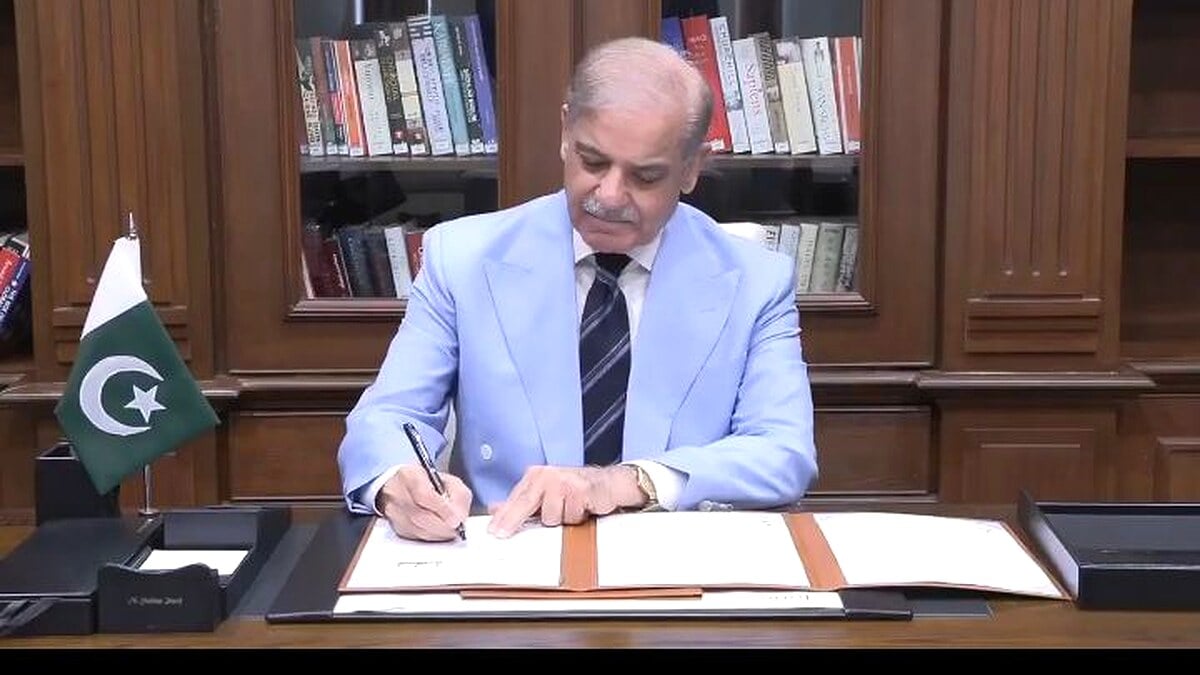




ISLAMABAD: Prime Minister Shehbaz Sharif signed the Islamabad Memorandum of Understanding on Thursday, formalising Pakistan’s role as mediator in a diplomatic initiative between the United States and Iran.
The MoU, initially signed by US President and Iranian President in Islamabad last month, establishes a framework for de-escalation talks covering regional security, energy cooperation, and trade facilitation. Pakistan’s endorsement adds a critical South Asian dimension to the agreement.
The signing ceremony took place at the Prime Minister’s Office, attended by senior diplomats from the US, Iran, and Pakistan, along with officials from the Foreign Ministry.
Foreign Secretary Muhammad Syrus Sajjad Qazi described the development as a significant step towards regional stability. “Pakistan remains committed to constructive engagement and dialogue between major powers,” he stated.
According to the memorandum text made available to media, the agreement outlines confidence-building measures, including enhanced communication channels and joint working groups on maritime security in the Gulf and broader West Asia.
PM Shehbaz Sharif emphasised Pakistan’s neutral yet proactive diplomatic stance. “As a responsible nation with deep historical ties to both countries, Pakistan is well-positioned to facilitate meaningful outcomes,” he said during the brief media interaction.
The Islamabad MoU builds on earlier backchannel efforts that gained momentum following heightened tensions in the Strait of Hormuz last year. Trade volumes between regional players had declined by nearly 18 percent amid those uncertainties, according to State Bank of Pakistan estimates.
Pakistan’s involvement is expected to leverage its strategic location and longstanding relations. The country maintains robust diplomatic channels with Tehran and has strengthened economic ties with Washington in recent years.
Key provisions include provisions for energy transit cooperation, with potential for Pakistani territory to serve as a corridor for regional energy flows. Officials project this could add up to $2.5 billion annually to Pakistan’s transit revenues within three years if fully implemented.
The agreement also addresses humanitarian and economic relief aspects, including coordinated responses to sanctions-related challenges affecting civilian populations.
Analysts note that Pakistan’s mediation role reflects its evolving foreign policy approach, balancing traditional alliances with new economic realities. The country’s imports from Iran stood at approximately $1.2 billion in the last fiscal year, primarily petroleum products and agricultural goods, while US assistance and trade links remain vital for technology and defence sectors.
The US Embassy in Islamabad welcomed Pakistan’s participation. A spokesperson highlighted the importance of inclusive regional mechanisms to address common challenges such as counter-narcotics and climate resilience.
Iranian officials, through their mission, expressed appreciation for Pakistan’s facilitative efforts, describing the MoU as a positive development for broader West Asian peace architecture.
Market reactions were measured. The Pakistan Stock Exchange saw modest gains in energy and logistics stocks following the announcement, with the benchmark KSE-100 index rising 0.8 percent in early trading.
Background to the initiative traces back to informal talks held in Muscat and Doha over the past 18 months. The decision to formalise the framework in Islamabad underscores Pakistan’s growing profile in Track-I diplomacy.
The memorandum sets timelines for subsequent meetings. A trilateral technical committee is scheduled to convene in Islamabad within the next 45 days to finalise implementation protocols.
Security implications are notable. The agreement includes clauses on counter-terrorism intelligence sharing, potentially impacting border management along Pakistan’s western frontiers.
Economic experts project that successful mediation could help stabilise global oil prices, indirectly benefiting Pakistan’s import bill, which currently consumes nearly 30 percent of foreign exchange reserves on energy imports.
PM Shehbaz Sharif’s government has prioritised economic diplomacy since taking office. This latest move aligns with efforts to attract foreign investment, with the government targeting $6 billion in new commitments for the current financial year.
Regional reactions have been cautious. India has monitored developments closely, while China has welcomed any initiative that promotes stability along key trade routes connected to CPEC projects.
The MoU avoids direct reference to contentious nuclear issues but focuses on practical cooperation areas where consensus is more achievable.
Diplomatic sources indicate that the next phase may involve broader Gulf state participation, potentially expanding the framework into a multi-stakeholder platform.
Observers suggest Pakistan’s mediator role could enhance its leverage in upcoming IMF and bilateral financing negotiations, demonstrating diplomatic value beyond immediate economic metrics.
Challenges remain. Implementation will depend on sustained political will from all parties amid domestic pressures in respective capitals.
The agreement comes at a time when Pakistan’s economy shows tentative recovery signs, with inflation moderating to 11.5 percent from last year’s peaks and GDP growth projected at 3.8 percent for FY2026-27 by Ministry of Finance estimates.
Further working group meetings on trade facilitation are expected to address tariff harmonisation and customs cooperation, areas where Pakistan-Iran border trade has historically faced logistical hurdles.
As the process moves forward, analysts anticipate incremental progress rather than immediate breakthroughs. The success of the Islamabad MoU will ultimately be measured by tangible outcomes in reduced tensions and enhanced economic connectivity across the region.
Future rounds of talks are likely to test the durability of this diplomatic channel in addressing complex geopolitical dynamics.