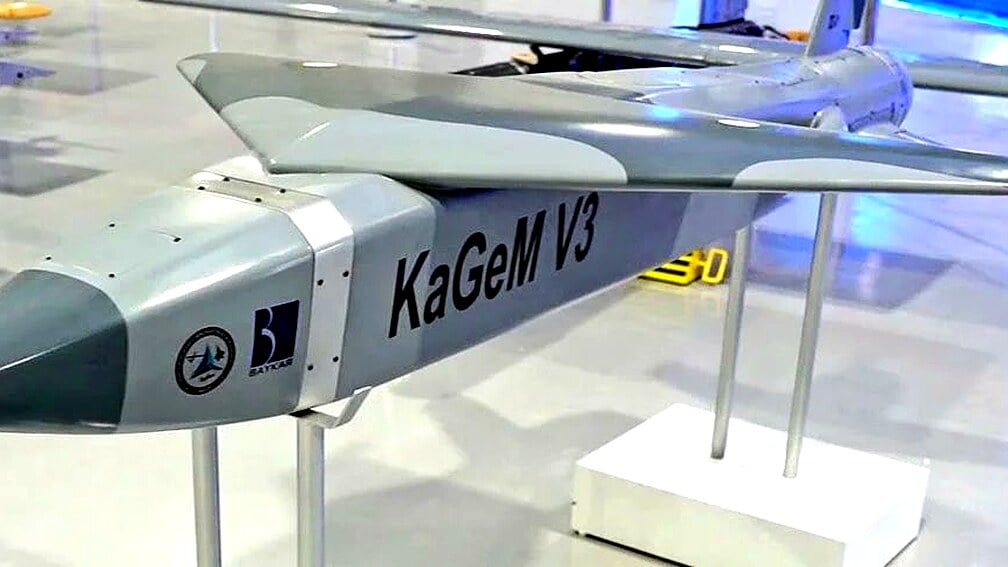




(PAF Integrates Advanced Turkish KaGeM V3 Cruise Missile Into Air Force Arsenal)
Cruise Missile
ISLAMABAD: The Pakistan Air Force has integrated the Bayraktar KaGeM V3 next-generation smart air-launched cruise missile into its operational inventory. The missile, jointly developed with Turkey’s Baykar Technologies, enhances standoff precision strike capabilities for unmanned combat aerial vehicles.
The National Aerospace Science and Technology Park (NASTP) led the Pakistani side of the collaboration. Officials confirmed the system’s entry into service following successful testing and evaluation phases.
The KaGeM V3 builds on earlier Turkish designs, incorporating Pakistan-specific data links including Link 17 and Link Horizon for seamless integration with PAF platforms. It is optimised for deployment from Bayraktar Akıncı and TB2 UAVs, expanding the air force’s ability to engage targets beyond enemy air defence envelopes.
Defence sources described the induction as a key milestone in Pakistan-Turkey defence cooperation. The project leverages Turkish expertise in turbojet-powered munitions and Pakistani requirements for network-centric operations.
**Key Specifications** The KaGeM V3 has an operational range of 150 kilometres, an improvement over the baseline Kemankeş system’s approximately 100 km. It carries a 20-kilogram high-explosive warhead and features a turbojet engine enabling cruise speeds suitable for rapid target engagement.
Physical dimensions include a length of 2.47 metres and an approximate weight of 70 kilograms. The system operates at altitudes up to 1,830 metres with reported endurance of around 30 minutes, allowing loitering and real-time target selection.
Guidance relies on AI-assisted electro-optical/infrared seekers, providing autonomous target acquisition and high precision in contested environments. The missile supports integration with multiple PAF UAV platforms currently in service.
Air Vice Marshal-level statements from PAF highlighted the missile’s role in modernising the unmanned strike portfolio. “This capability strengthens our deterrence posture through precision and standoff options,” a senior official noted during a recent briefing at NASTP facilities.
The development aligns with Pakistan’s broader push for indigenous defence production. NASTP serves as the primary hub for such joint ventures, facilitating technology transfer and local manufacturing components.
**Background and Regional Context** Pakistan and Turkey have deepened military ties in recent years, including drone technology, training exchanges, and joint projects. The KaGeM V3 represents one of the tangible outcomes of this partnership, following earlier acquisitions and collaborations on platforms like the Akıncı.
The missile addresses requirements for cost-effective, high-impact munitions that can be carried in numbers by medium-altitude long-endurance UAVs. Regional security dynamics, including border threats and evolving air defence systems, have accelerated adoption of such smart weapons.
Market analysts estimate the integration will support PAF’s growing UAV fleet, which includes both Turkish and indigenous systems. Exact procurement numbers remain classified, but initial batches are understood to be in operational testing.
**Reactions and Operational Implications** Defence observers in Islamabad welcomed the induction as a boost to aerial deterrence. Regional media noted the system’s low-observable features and AI guidance as advantages in high-threat scenarios.
The missile’s compatibility with existing data links improves coordination across PAF assets, potentially increasing mission success rates in dynamic battle spaces. Economic benefits include reduced reliance on single-source suppliers and opportunities for future exports within allied frameworks.
**Strategic Outlook** The KaGeM V3 enhances PAF’s layered strike options, complementing longer-range systems and manned aircraft capabilities. Its deployment signals continued investment in unmanned systems as force multipliers amid regional modernisation efforts.
Further developments may include expanded production at NASTP facilities and integration with additional platforms. Officials indicated ongoing work on related munitions to maintain technological edge.
Future exercises are expected to validate the missile’s performance in realistic scenarios, with potential refinements based on operational feedback. The collaboration underscores Pakistan’s strategy of selective international partnerships to bolster self-reliance in critical defence technologies.