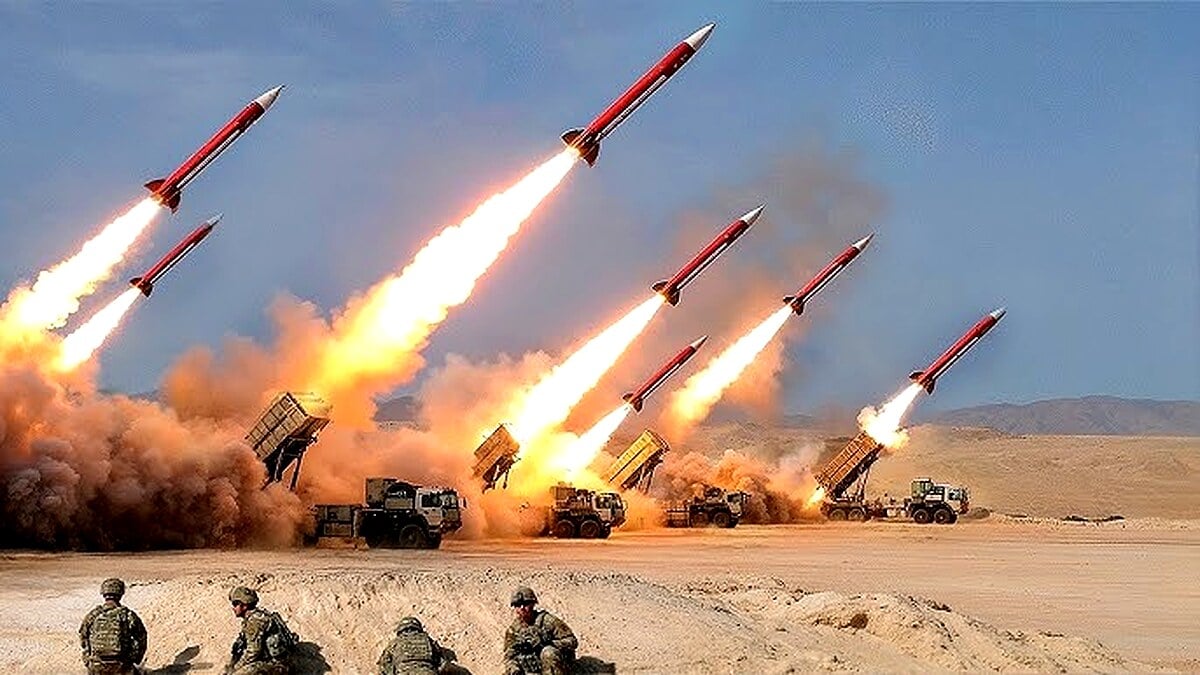




ISLAMABAD: Iran launched a new missile attack against Israel on Sunday, marking a significant escalation in Middle East tensions and raising fresh concerns about regional stability following days of heightened military activity across Lebanon, Israel, and the Gulf region.
According to the Israeli military, several missiles were fired from Iranian territory toward northern Israel, triggering air raid sirens and prompting the activation of Israeli air defence systems. Initial military assessments indicated that at least four missiles were launched, with interception efforts underway shortly after the attack was detected.
The strike represents the first direct Iranian missile attack on Israel since a ceasefire arrangement announced in April, underscoring the fragile nature of recent de-escalation efforts in the region.
Israeli authorities said emergency procedures were activated in affected areas while security agencies monitored potential impacts and damage assessments.
The latest development follows Israeli airstrikes in Beirut’s southern suburbs, an area widely regarded as a stronghold of the Iran-backed Hezbollah movement.
Those strikes reportedly killed two people and injured at least 11 others, prompting sharp reactions from Tehran and its regional allies.
Iranian officials had earlier warned that Israeli military actions in Lebanon could trigger a direct response.
Senior Iranian figures described the Israeli strikes as a violation of ongoing diplomatic efforts and warned of consequences if military pressure continued.
In a separate statement, Iranian Parliament Speaker and senior negotiator Mohammad Baqer Qalibaf accused the United States and Israel of undermining regional stability and warned that American military assets and Israeli strategic facilities could become targets if escalation continues.
The missile attack comes amid a broader regional security crisis involving multiple theatres of conflict.
Recent weeks have witnessed intensified exchanges between Israel and Hezbollah along the Lebanese border, repeated Israeli air operations inside Lebanon, and increasing military activity involving Iran and the United States in Gulf waters.
Earlier this month, US military forces reportedly intercepted Iranian drones near the Strait of Hormuz and later conducted strikes against Iranian coastal radar installations, adding another layer of complexity to the regional security environment.
Military analysts note that despite previous ceasefire announcements, both Iran and Israel have retained substantial military capabilities.
Satellite imagery and intelligence assessments published in recent weeks suggested that Iran has been restoring missile-related infrastructure damaged during earlier confrontations, while Israeli forces have continued readiness operations across multiple fronts.
The broader Iran-Israel confrontation has already generated significant military activity throughout 2026.
Multiple missile and drone exchanges have been reported over recent months, with both sides relying heavily on advanced air defence systems, ballistic missiles, and long-range strike capabilities.
Regional governments are closely monitoring developments due to concerns about potential impacts on energy markets, maritime security, and commercial shipping routes.
The Strait of Hormuz remains particularly sensitive because nearly one-fifth of global oil trade passes through the strategic waterway. Any disruption could influence international energy prices and global supply chains.
Diplomatic efforts are also facing renewed pressure.
Several international actors, including the United States and regional partners, have been attempting to sustain negotiations aimed at reducing hostilities between Israel, Iran, and allied groups operating across Lebanon and other conflict zones.
Security experts warn that continued missile exchanges could increase the risk of broader military confrontation involving additional regional actors.
While both sides have demonstrated the ability to conduct long-range strikes, analysts believe the immediate focus will remain on deterrence, military signalling, and preventing the conflict from expanding into a wider regional war.
The coming days are expected to be critical as governments assess the consequences of the latest missile attack, monitor possible retaliatory actions, and determine whether diplomatic channels can prevent another cycle of escalation in one of the world’s most volatile regions.