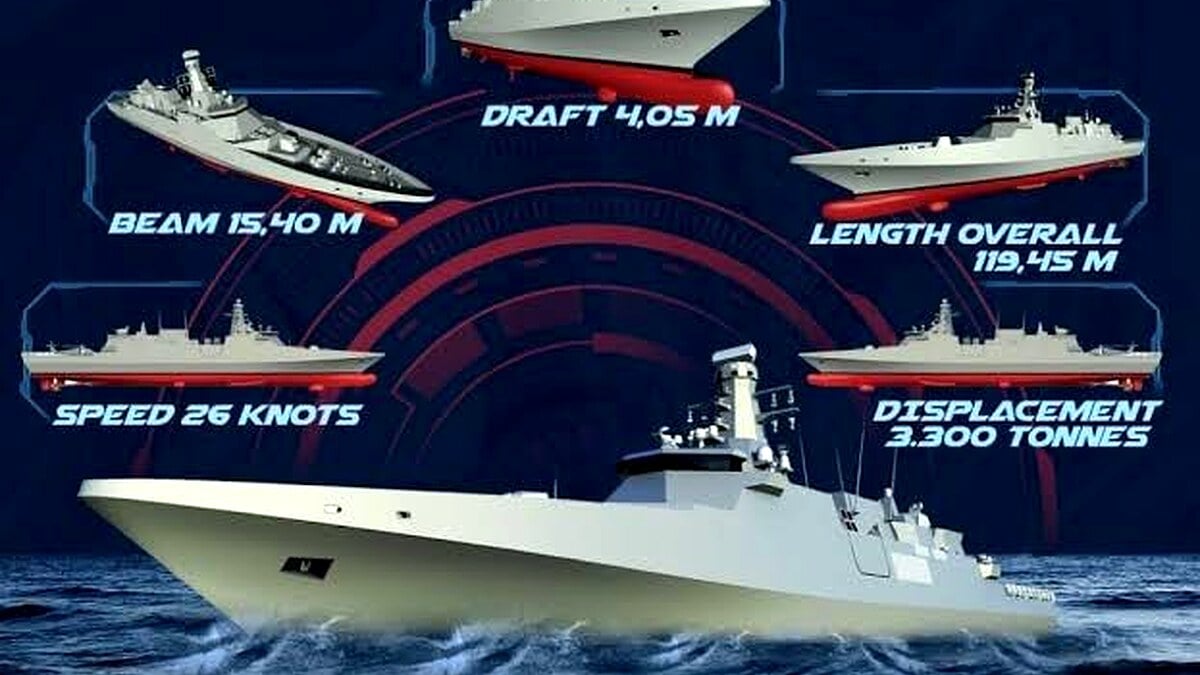




ISLAMABAD: Pakistan has entered a new phase in its naval modernization programme after Karachi Shipyard & Engineering Works (KSEW) formally began construction of the first indigenously designed Jinnah-class frigate, a major surface combatant intended to strengthen the Pakistan Navy’s fleet and expand domestic warship design capabilities.
The 3,300-ton guided missile frigate (FFG) is the first warship of its class to be designed within Pakistan, marking a significant step for the country’s naval industry after years of experience in constructing and assembling foreign-designed vessels, including corvettes and offshore patrol ships.
Officials familiar with the programme said the Jinnah-class frigate is being developed as a multi-role combat platform capable of conducting anti-air, anti-surface and anti-submarine warfare operations in the Arabian Sea and wider Indian Ocean region.
The vessel is expected to integrate an advanced combat management architecture centred on the Turkish-developed ADVENT Combat Management System (CMS), which has already been selected for several Pakistan Navy platforms as part of broader defence cooperation between Islamabad and Ankara.
According to available specifications, the frigate will carry a 16-cell Vertical Launch System (VLS) capable of deploying Albatros-NG surface-to-air missiles, providing layered air defence against hostile aircraft, helicopters and incoming anti-ship missiles.
For anti-ship warfare, the warship is expected to be equipped with eight SMASH anti-ship missiles, significantly increasing its ability to engage hostile naval targets at extended ranges.
The vessel’s defensive suite will also include two Close-In Weapon Systems (CIWS) and two Remote Weapon Stations (RWS), designed to counter aerial threats, drones, fast attack craft and other close-range dangers.
The primary naval gun is expected to be the widely used Italian-designed OTO Melara 76mm main gun, a system employed by numerous modern navies worldwide due to its versatility against surface, aerial and coastal targets.
Anti-submarine warfare capabilities are set to become one of the platform’s key strengths.
The frigate will reportedly feature both hull-mounted sonar and a towed array sonar system, enabling improved submarine detection in complex maritime environments.
A dedicated flight deck and hangar will allow the operation of an anti-submarine warfare helicopter, substantially extending the ship’s surveillance and underwater engagement range.
The sensor package is expected to include modern S-band and L-band radar systems capable of long-range air and surface surveillance.
In addition, Electro-Optical Surveillance Systems (EOSS) and Infrared Search and Track (IRST) sensors will provide passive target detection capabilities, helping the vessel operate effectively in electronically contested environments.
The Jinnah-class programme forms part of the Pakistan Navy’s broader fleet modernization strategy aimed at improving maritime security and safeguarding critical sea lines of communication.
Pakistan’s maritime trade remains heavily dependent on sea routes, with more than 90 percent of the country’s international trade volume transported through maritime channels linked to ports such as Karachi and Gwadar.
Over the past decade, the Pakistan Navy has expanded its surface fleet through the induction of Type-054A/P frigates from China, Babur-class corvettes developed with Turkish assistance, and offshore patrol vessels built at Karachi Shipyard.
Defence analysts view the Jinnah-class project as particularly important because it moves beyond foreign procurement toward indigenous warship design and systems integration.
While several key weapons and sensors are expected to originate from international partners, the overall platform design and construction effort is intended to strengthen local engineering expertise and reduce long-term dependence on external suppliers.
The project also supports Pakistan’s defence-industrial objectives by increasing local participation in shipbuilding, electronics integration and naval systems engineering.
Regional naval competition has intensified in recent years as countries around the Indian Ocean continue investing in advanced surface combatants, submarines, maritime patrol aircraft and missile systems.
Against this backdrop, Pakistan has sought to maintain a balanced maritime deterrence posture while expanding its ability to protect strategic economic interests, including the China-Pakistan Economic Corridor (CPEC) and growing commercial activity around Gwadar Port.
Military observers note that a successful Jinnah-class programme could serve as a foundation for future indigenous frigate and destroyer projects, potentially enabling Pakistan to export selected naval technologies and shipbuilding services to friendly countries.
The construction timeline, sea trials schedule and expected commissioning date have not yet been officially disclosed. However, defence industry sources indicate that major structural work is expected to continue over the coming years as Pakistan gradually advances toward the operational deployment of its first domestically designed frigate.