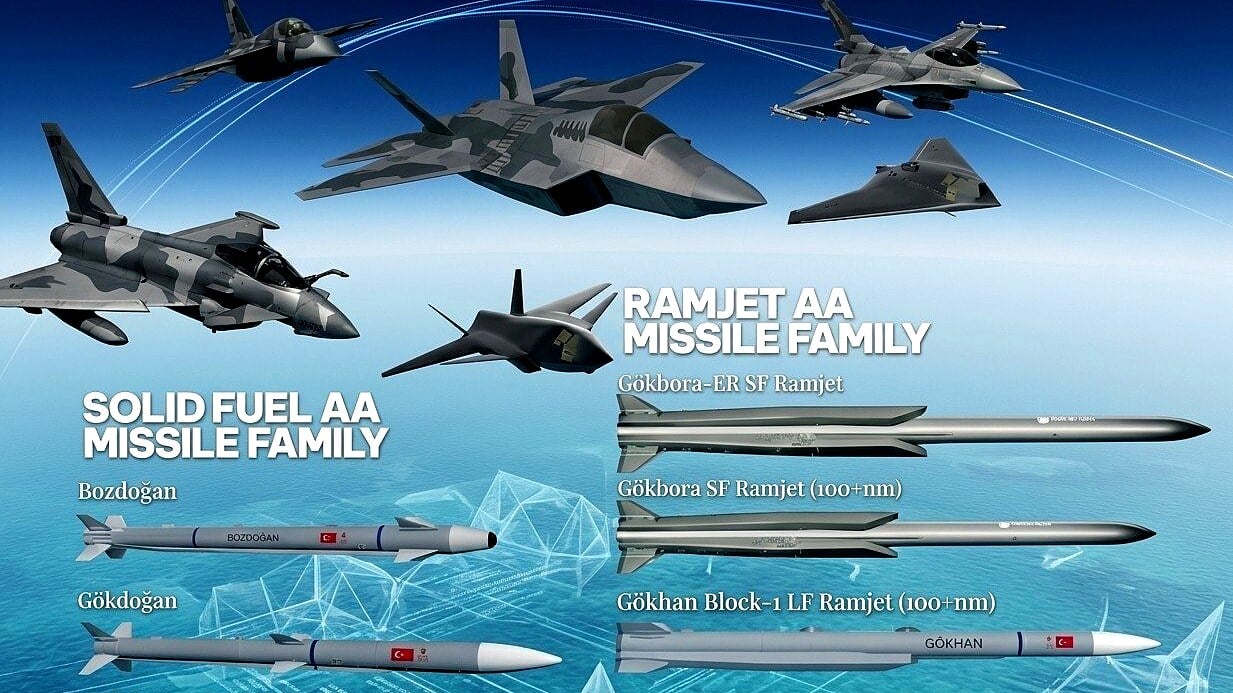




ISLAMABAD: Turkiye is advancing its beyond-visual-range (BVR) air-to-air missile programme with developments that parallel China’s established family of long-range systems.
The Gökdoğan missile, which has recently completed its testing phase, features a range exceeding 65 km, comparable to China’s PL-12 missile with its reported 70-100 km engagement envelope.
TÜBİTAK SAGE and Roketsan are pursuing multiple variants, including ramjet-powered options designed to deliver sustained high-speed performance at extended distances.
Gökhan-ER, a longer-range liquid fuel ramjet variant of the Gökhan, is under active development following contract renewals at the recent IDEF defence exhibition. This system is positioned to approach ranges similar to China’s PL-16, estimated at 200-300 km depending on launch conditions and flight profile.
Roketsan has also confirmed work on a longer-range version of the Gökbora, powered by solid-fuel ramjet engine technology. The Gökbora, measuring 3.75 metres in length with a 180 mm diameter, is optimised for internal carriage on stealth platforms such as the TAI TF Kaan and Kızılelma. It is expected to exceed 100 nautical miles (approximately 185 km) in range.
**Official Statements** Turkish defence officials have emphasised the strategy of building a comprehensive family of BVR missiles using both solid-fuel and ramjet propulsion technologies. This dual-track approach aims to provide flexible options for different operational requirements and platforms, including the F-16, JF-17, and next-generation indigenous fighters.
Roketsan CEO Murat İkinci stated that engine development for the Gökbora has been completed and integration work is progressing rapidly, with the goal of fielding the system as quickly as possible.
**Key Technical Details** The Gökdoğan uses a solid fuel rocket engine with active radar homing and lock-on-after-launch capability. It supports data-link mid-course updates and features advanced electronic countermeasures resistance. Mass production preparations began in 2022.
The ramjet-powered systems under development are designed to maintain higher average speeds over longer distances compared to traditional rocket motors, providing a larger no-escape zone against modern fighter aircraft. These missiles are expected to incorporate AESA-type seekers for improved terminal accuracy.
**Pakistan-Turkiye Defence Context** Pakistan maintains deep defence cooperation with Turkiye across multiple platforms, including naval vessels, drones, and potential future combat aircraft projects. The two countries have a history of technology transfer and joint development that could extend to advanced air-to-air systems.
Pakistan already operates Chinese-origin PL-15 missiles on its JF-17 Thunder fighters, with the export variant offering reduced but still significant range compared to domestic Chinese versions. Access to Turkish BVR systems would further diversify and strengthen the Pakistan Air Force’s air combat capabilities.
Defence analysts note that integration of both Chinese and Turkish-origin BVR missiles would enhance Pakistan’s operational flexibility in regional scenarios, particularly in maintaining air superiority against numerically larger adversaries. The JF-17 platform, already a cornerstone of the Pakistan Air Force, remains compatible with multiple missile families.
**Strategic Implications** The Turkish approach of developing missiles with both solid rocket and ramjet propulsion mirrors China’s progression from the PL-12 to longer-range ramjet-assisted systems. This creates a layered BVR engagement capability that complicates enemy targeting and planning.
For Pakistan, potential access to these systems would represent a significant qualitative enhancement. The combination of Chinese PL-series missiles and Turkish Gökdoğan/Gökbora/Gökhan family would provide redundancy, different seeker technologies, and varied performance envelopes. This diversity is particularly valuable in high-threat environments where electronic warfare and saturation tactics are expected.
Regional observers point out that such acquisitions align with Pakistan’s broader strategy of maintaining technological parity through multiple reliable partners. Turkiye’s emphasis on keeping advanced seeker and propulsion details classified until operational deployment adds an element of tactical surprise in potential contingencies.
Future developments will likely include integration testing on Pakistani platforms and possible co-production arrangements, following the established pattern of Pak-Turkiye defence collaboration seen in projects like the MILGEM corvettes and various drone programmes.
The pace of Turkish testing and development suggests that operational variants could become available for export partners within the next few years, subject to successful qualification trials and government approvals.