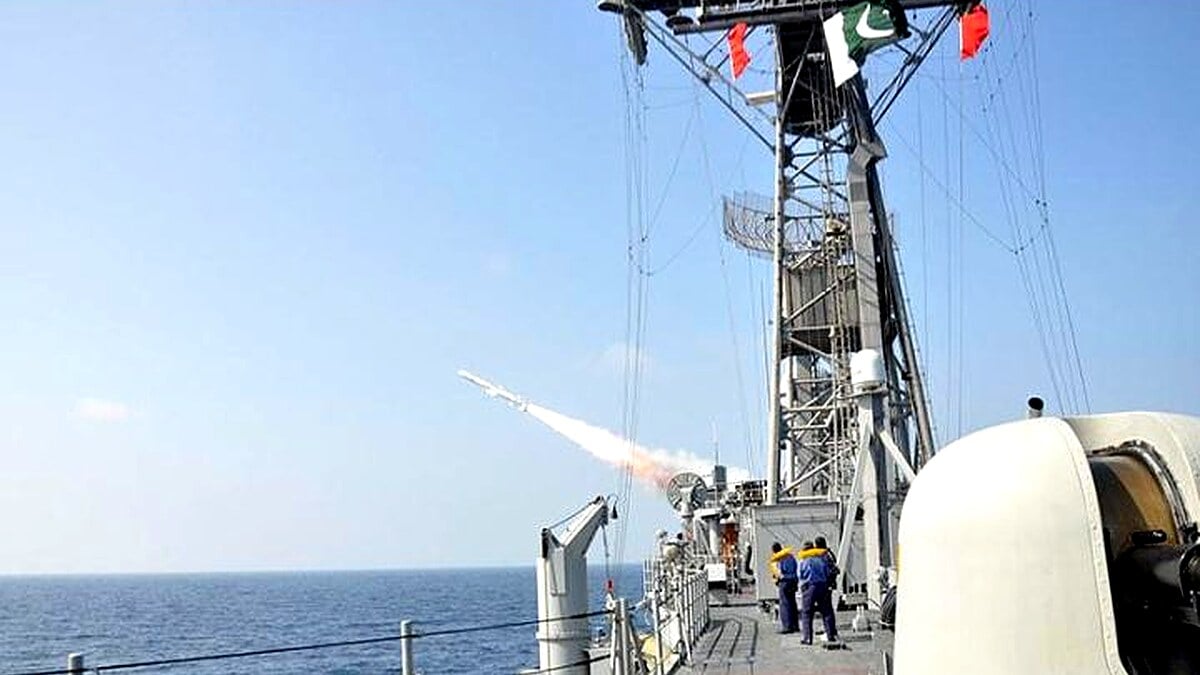




ISLAMABAD: Pakistan’s naval defense modernization efforts have entered a new phase as reports indicate that the Pakistan Navy is moving to strengthen its coastal deterrence architecture through upgraded cruise missile capabilities to 1000 km range linked to the Babur missile family, a development that reflects Islamabad’s continued focus on maritime security, strategic deterrence, and long-range precision strike systems.
The reported upgrade has drawn attention across regional defense circles due to claims that future variants associated with the Babur missile program could significantly extend operational reach beyond existing configurations, potentially enhancing Pakistan’s ability to monitor and respond to threats across large sections of the Arabian Sea and surrounding maritime zones.
The Babur missile series remains one of Pakistan’s most prominent indigenous cruise missile programs, developed to provide precision strike capabilities against both land and maritime targets.
According to defense assessments, currently known Babur missile variants possess operational ranges between 350 and 700 kilometers depending on configuration, while the submarine-launched Babur-III variant has previously been reported with an estimated range of approximately 450 kilometers.
Recent discussions among defense observers and regional military analysts have focused on reports suggesting future extended-range developments linked to Pakistan’s cruise missile inventory, including capabilities approaching or exceeding the 1,000-kilometer threshold, although no official confirmation regarding such specifications has been publicly released by Pakistani authorities.
The Pakistan Navy has steadily expanded its maritime strike portfolio during the past decade through investments in anti-ship missiles, naval aviation, modern frigates, submarines, and indigenous weapons integration programs.
The Babur-III program remains particularly significant because it introduced a sea-based cruise missile capability designed for launch from underwater platforms, strengthening what Pakistani military planners describe as a credible second-strike deterrent capability.
Defense analysts note that modern maritime competition in the Indian Ocean Region has accelerated investments in long-range surveillance systems, anti-ship weapons, air-defense networks, and submarine fleets among regional powers.
Pakistan’s naval modernization strategy has coincided with the induction of new surface combatants, including the Babur-class corvettes developed under the Pakistan-Türkiye MILGEM cooperation program.
The vessels are expected to play an increasingly important role in maritime security operations, sea-lane protection, and networked naval warfare missions across Pakistan’s coastline and exclusive economic zone.
Pakistan possesses a coastline of approximately 1,050 kilometers along the Arabian Sea, while Karachi and Gwadar remain central to the country’s maritime trade and economic connectivity.
More than 90 percent of Pakistan’s international trade by volume moves through maritime routes, making naval security a critical national priority.
Officials have repeatedly emphasized that maritime infrastructure protection has become increasingly important amid growing regional naval deployments and expanding commercial shipping activity across the northern Indian Ocean.
Over recent years, Pakistan has also tested multiple maritime strike systems aimed at extending operational reach against surface targets.
Earlier demonstrations included land-based anti-ship missile systems and newer precision-guided weapons designed for deployment from naval platforms. More recently, reports emerged regarding successful tests of advanced anti-ship and air-launched cruise missile systems with ranges extending several hundred kilometers.
Military analysts argue that cruise missiles have become a central component of modern naval deterrence because of their ability to fly at low altitudes, maneuver around defenses, and strike targets with high precision.
Such systems are increasingly viewed as cost-effective force multipliers compared to larger capital warships or long-range strategic aircraft.
Regional security experts say Pakistan’s continued investment in missile technology is occurring alongside broader military modernization trends across South Asia.
India, China, and several other regional powers have simultaneously accelerated naval procurement programs, missile development projects, and maritime surveillance initiatives during the past decade.
This evolving security environment has increased the importance of sea-denial and coastal defense strategies for medium-sized naval forces operating in contested maritime regions.
While official details regarding future Babur-related upgrades remain limited, defense observers expect further developments in guidance systems, range enhancement, survivability features, and platform integration.
The incorporation of advanced navigation technologies, improved propulsion systems, and enhanced electronic countermeasure resistance could significantly expand operational effectiveness in future deployments.
Strategically, the reported modernization effort highlights Pakistan’s intention to maintain a credible maritime deterrent while adapting to changing regional security dynamics.
The coming years are likely to see greater emphasis on network-centric naval warfare, indigenous missile production, unmanned maritime systems, and integrated coastal defense structures as regional militaries continue to expand their capabilities across the Indian Ocean theater.