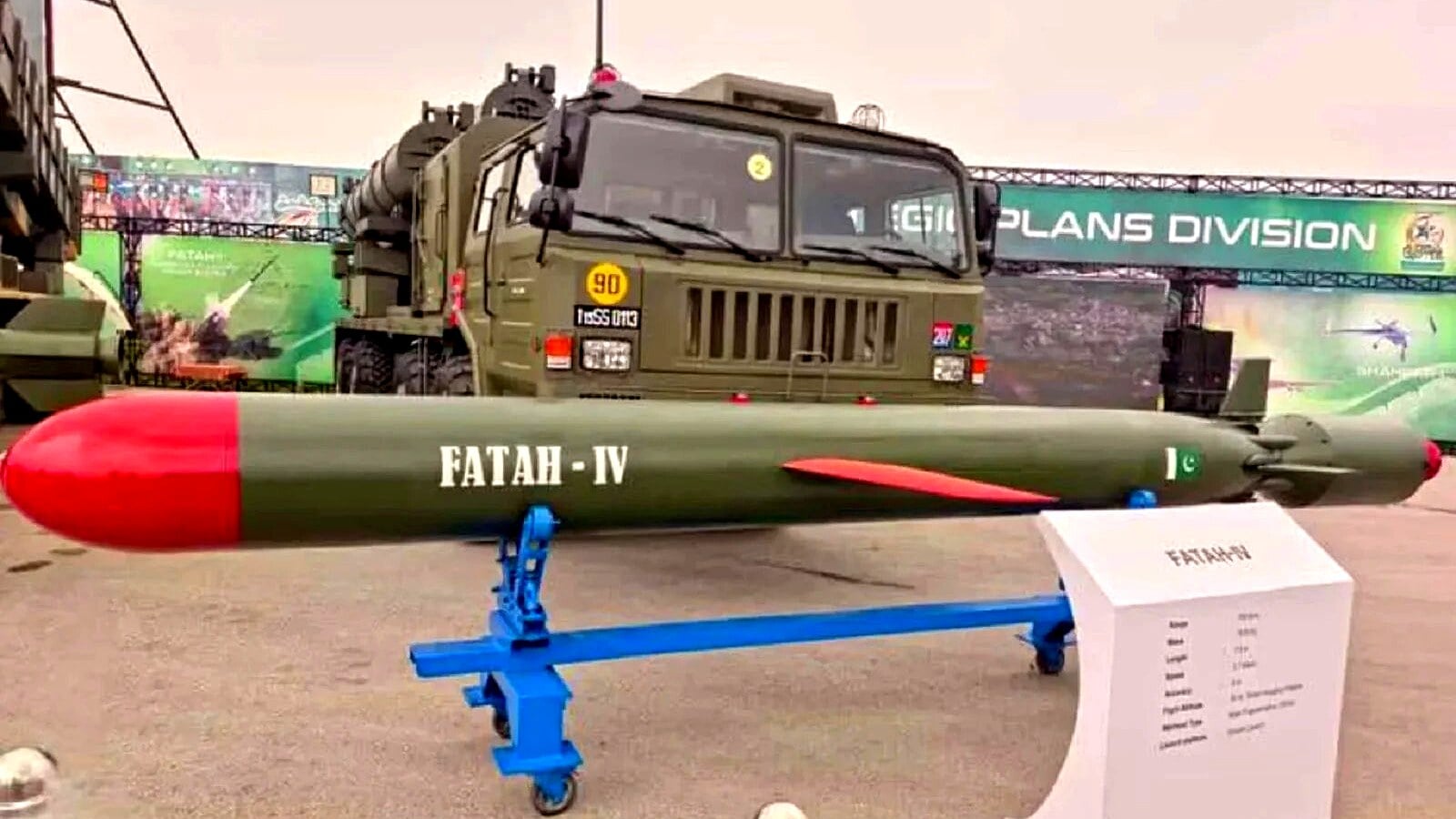




(Fatah-4 Cruise Missile: What Makes it Different From Other Pakistani Missiles?)
Missiles?)
Pakistan has successfully conducted a training launch of the indigenously developed Fateh-4 ground-launched cruise missile.
The Army Rocket Force Command carried out the test on Thursday, marking another milestone in the country’s efforts to strengthen its conventional deterrence capabilities.
Inter-Services Public Relations confirmed the launch, stating that the exercise aimed to validate the performance of various sub-systems, enhance operational readiness, and assess upgrades in accuracy and survivability.
Senior officers, scientists, and engineers witnessed the test, which demonstrated the missile’s advanced avionics and state-of-the-art navigational systems.
The Fateh-4, with a reported range of 750 kilometers, flew at low altitudes in a terrain-hugging profile designed to evade radar detection.
This subsonic cruise missile prioritizes stealth and extended reach, allowing it to engage long-range targets with high precision, reportedly achieving accuracy within a few meters.
The test comes just weeks after Pakistan unveiled and tested elements of the Fateh-3 supersonic cruise missile, creating a layered strike capability within the Fateh series.
Military sources describe the Fateh-4 as a modification drawing from technologies similar to the Babur cruise missile family, yet optimized for specific conventional roles.
Abdullah Khan, Director of the Pakistan Institute for Conflict and Security Studies, highlighted key distinctions in an analysis shared with international media.
“Fateh-3 is supersonic with a range up to 450 km, designed for rapid strikes on defended targets,” Khan explained. “In contrast, the Fateh-4 is subsonic, terrain-hugging, and extends to 750 km, focusing on range and stealth.”
He further differentiated it from the Babur system.
“Babur serves as a dual-capable missile for nuclear and conventional strategic deterrence,” Khan noted. “The Fateh-4 functions exclusively as a surface-to-surface conventional munition platform.”
Both systems share similar technology and flight profiles but address broader strategic needs of Pakistan’s armed forces.
This development fits into Pakistan’s ongoing modernization of the Army Rocket Force, which has rapidly expanded with the Fateh family.
Earlier variants like Fateh-I and Fateh-II focused on shorter ranges, with Fateh-II reaching around 400 km in previous tests.
The progression to Fateh-4 significantly extends operational depth, enabling strikes deeper into potential adversary territory while maintaining a conventional focus.
Defence analysts view this as part of a broader strategy to build credible conventional options that reduce reliance on escalation ladders.
Pakistan’s missile program has seen consistent advancements, with multiple successful tests in recent years validating indigenous design and production capabilities.
The Babur cruise missile, which entered service earlier, boasts ranges up to 700-900 km in enhanced variants and can be launched from ground and sea platforms.
Fateh-4 builds upon such heritage but streamlines for tactical and operational conventional missions.
The timing of the test occurs amid sustained regional security dynamics in South Asia.
Pakistan maintains a policy of credible minimum deterrence, with conventional precision systems playing a growing role in countering conventional imbalances.
Officials have repeatedly emphasized that such tests are routine and aimed at self-defence.
The successful launch received appreciation from the highest levels, with reports noting positive feedback on indigenous technological progress.
Engineers incorporated modern guidance systems, including terrain contour matching and satellite navigation, to ensure all-weather performance.
Low-altitude flight remains a hallmark, making interception challenging for even advanced air defence networks.
With a payload suited for conventional high-explosive or submunition warheads, the system offers flexibility for area or point targets.
Pakistan’s defence industry continues pushing boundaries through organizations like NESCOM, delivering systems that match global standards.
The Fateh series evolution reflects lessons from recent regional conflicts, where precision and survivability proved decisive.
Fateh-4 complements existing assets, creating options from short-range rocket artillery to medium and long-range cruise strikes.
This layered approach strengthens Pakistan’s ability to respond across the spectrum of threats.
Experts suggest the development enhances strategic stability by providing proportionate response options below the nuclear threshold.
Khan’s assessment underscores the complementary nature of these systems.
While Babur anchors strategic deterrence, Fateh variants expand conventional warfighting tools.
The recent tests signal maturi