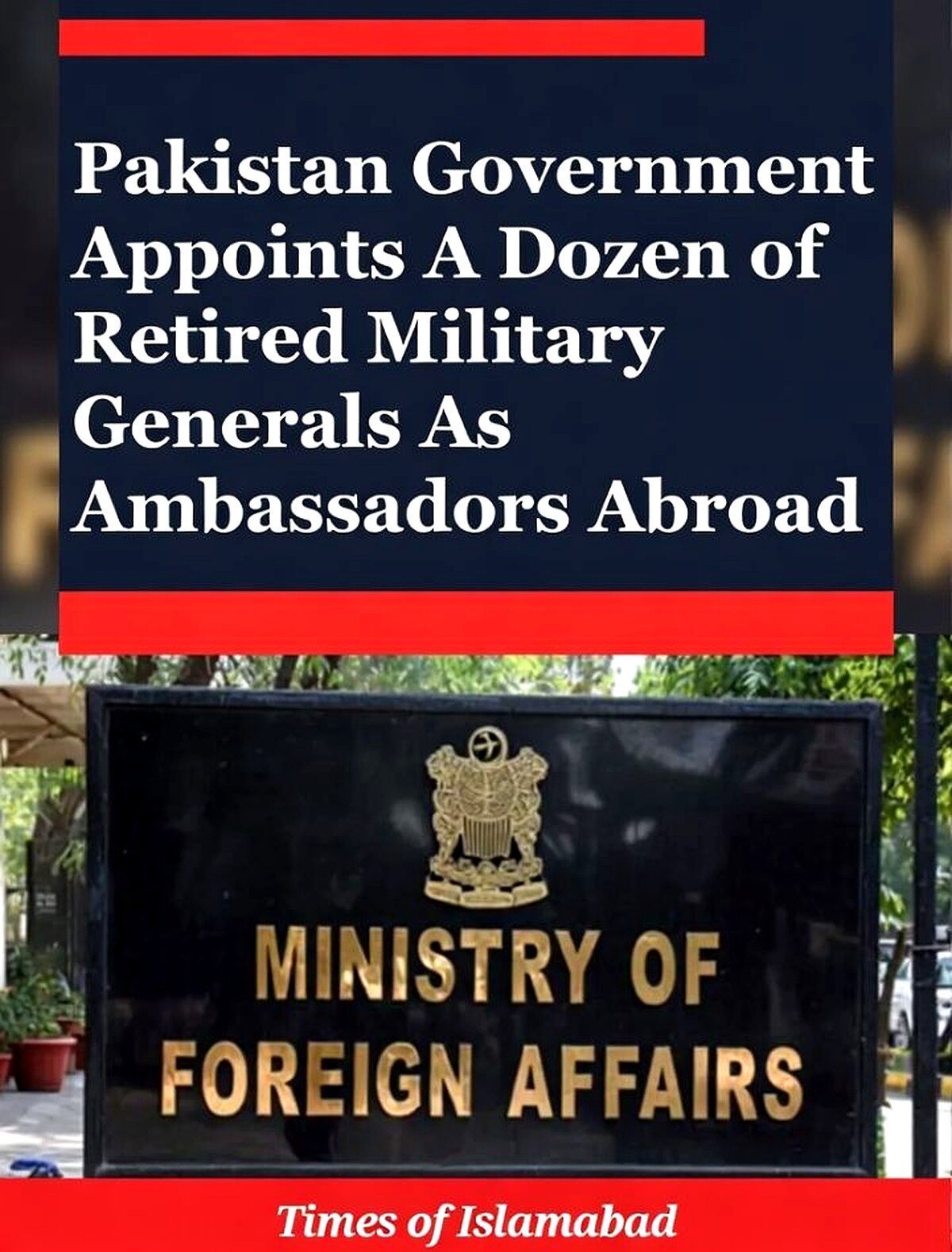




ISLAMABAD: In a move that has quietly reshaped Pakistan’s diplomatic landscape, the government has appointed 15 non-career ambassadors on contract basis to crucial postings across Africa, the Middle East, Europe and Asia.
But this is no routine reshuffle.
The majority of these new envoys come from the senior ranks of Pakistan’s armed forces, with only a handful drawn from civil society. This heavy tilt towards retired military leadership is raising eyebrows even as it underscores a deliberate strategy to inject discipline, strategic depth and operational experience into Pakistan’s overseas missions.
Official documents confirm the list in full: Major General (retd) Kamran Tabrez Suriya designated for Nigeria, Major General (retd) Khurram Sarfraz Khan for Jordan, Dr Yousaf Junaid for Turkiye, Dr Faryal Leghari for Turkmenistan, Major General (retd) Nair Naseer for Sri Lanka, Air Marshal (retd) Mohammad Mughis Afzal for Syria, Lieutenant General (retd) Mohammad Aamir for Qatar, Kohyar Marri for Vietnam, Major General (retd) Kunwar Usman Ahmed Khan for Ukraine, Vice Admiral (retd) Faisal Rasool Lodhi for Maldives, Mohammad Irfan Tarar for Niger, Zaheeruddin Babar Thaheem for Cambodia, Adil Gilani for Morocco, Major General (retd) Mumtaz Hussain for Libya, and Mohammad Sami-ur-Rehman for Poland.
That’s 15 high-profile appointments in one go.
Pakistan maintains diplomatic presence in roughly 90 countries through embassies and high commissions, supported by over 70 consulates and missions to multilateral bodies. Yet in this latest round, the balance has shifted noticeably. In 75 countries, ambassadors remain career diplomats who cleared the competitive FPSC examination and rose through the ranks of the Foreign Service of Pakistan.
The new contract-based appointees, however, bring decades of command experience from the Army, Navy and Air Force.
This is where things get interesting.
Retired senior officers have long served in diplomatic roles, but the current batch stands out for its scale and strategic spread. From the Gulf to Africa, from conflict zones to emerging economic corridors, these postings align closely with Pakistan’s core national security and economic interests.
Take Jordan, for instance. Major General (retd) Khurram Sarfraz Khan, who recently called on President Asif Ali Zardari, has already begun engaging Jordanian leadership on bilateral ties, regional stability and defence cooperation. Jordan remains a key partner in the Middle East, and Pakistan’s strong military-to-military relations make such an appointment highly logical. The ambassador has held discussions on everything from Palestinian issues to broader Gulf security, reflecting the depth that experienced military leadership can bring to sensitive diplomatic theatres.
In Turkiye, Dr Yousaf Junaid continues to strengthen one of Pakistan’s most vital strategic partnerships. Turkiye and Pakistan share deep defence, economic and cultural bonds. The appointment reinforces momentum in trade, military cooperation and people-to-people ties at a time when both nations navigate complex regional dynamics.
Qatar, home to a large Pakistani expatriate community and critical energy links, now has Lieutenant General (retd) Mohammad Aamir at the helm. Maldives, Sri Lanka and Vietnam represent important maritime and connectivity interests where naval and military expertise can directly support diplomatic objectives.
Even in more challenging environments like Syria, Libya and Ukraine, the presence of Air Marshal (retd) Mohammad Mughis Afzal, Major General (retd) Mumtaz Hussain and Major General (retd) Kunwar Usman Ahmed Khan signals Pakistan’s intent to maintain steady engagement where stability and reconstruction efforts matter.
But that’s not the full story.
Pakistan currently has no ambassador posted in four countries. The embassy in Sudan remains temporarily closed amid ongoing instability. Missions in North Korea, Yemen and Bosnia are also operating under temporary arrangements. These gaps highlight the practical challenges of maintaining a global footprint while managing resources and security risks.
In contrast, the 75 career diplomats continue to handle the bulk of Pakistan’s diplomatic network with professionalism honed through rigorous training at the Foreign Service Academy and years of field experience. This dual system—career professionals backed by targeted non-career expertise—allows Pakistan to balance institutional continuity with fresh strategic input.
What’s more concerning for observers is the broader context. Global diplomacy today demands more than traditional protocol. It requires negotiators who understand security threats, economic warfare, hybrid challenges and rapid crisis response. Retired officers from Pakistan’s armed forces bring precisely that: proven leadership under pressure, logistical acumen and a deep commitment to national interest.
Pakistan’s armed forces have consistently demonstrated excellence in both conventional and unconventional domains. Their officers’ ability to operate in high-stakes environments translates well to diplomatic missions where quick assessment and firm representation are essential. This latest round of appointments appears designed to leverage that strength without undermining the core Foreign Service cadre.
However, a deeper issue is emerging in how Pakistan projects power abroad. In an era of intensifying great-power competition, economic diplomacy and connectivity projects like CPEC extensions, having envoys with direct experience in defence cooperation and strategic planning can accelerate outcomes. Trade negotiations, investment security, counter-terrorism coordination and regional stability talks all benefit from such profiles.
This raises an important question: Is Pakistan quietly professionalising its diplomacy to meet 21st-century realities?
The answer seems to lean yes. Contract-based appointments allow flexibility—officers serve fixed terms focused on deliverables rather than lifelong bureaucratic progression. The government can deploy domain experts exactly where needed most.
Yet balance remains key. Career diplomats, selected through one of the toughest competitive examinations in the country, form the backbone of Pakistan’s Foreign Service. Their institutional knowledge and long-term perspective prevent any single approach from dominating.
And this is where the real strength of Pakistan’s system lies.
The armed forces and the Foreign Service have historically complemented each other. Joint efforts in UN peacekeeping, disaster relief diplomacy, and back-channel negotiations have yielded results that pure civilian or pure military channels might not achieve alone. The current appointments build on that proven synergy.
Still, challenges persist. Temporary closures of missions in volatile regions like Sudan and Yemen reflect the harsh security environment many Pakistani diplomats face. Maintaining presence in North Korea and Bosnia requires careful calibration. With nearly 90 embassies to staff, resource allocation becomes a constant strategic exercise.
What happens next will be telling.
Will these new envoys deliver tangible gains in trade volumes, defence pacts, or consular services for Pakistani communities abroad? Early signals from Jordan and Turkiye are encouraging, with active engagement on multiple fronts.
Pakistan’s global diplomatic network, though not the largest, punches above its weight in influence—particularly in the Islamic world, South Asia and emerging African markets. Infusing it with officers who have commanded thousands and managed complex operations adds a layer of resilience.
But questions linger. How will the integration of non-career and career tracks evolve? Will future rounds maintain this balance or tilt further? And in a world where diplomacy increasingly intersects with security, does this model offer Pakistan a competitive edge?
The coming months will provide clearer answers as these ambassadors settle into their roles and begin delivering on Pakistan’s foreign policy priorities.
One thing is certain: Pakistan is not standing still. By drawing on the proven leadership of its armed forces while preserving the excellence of its career diplomats, the country is positioning its diplomatic corps for a more assertive and effective role on the world stage.
The full impact of these 15 appointments may take time to unfold, but the strategic intent is already visible—stronger representation where it matters most for Pakistan’s security, economy and global standing.