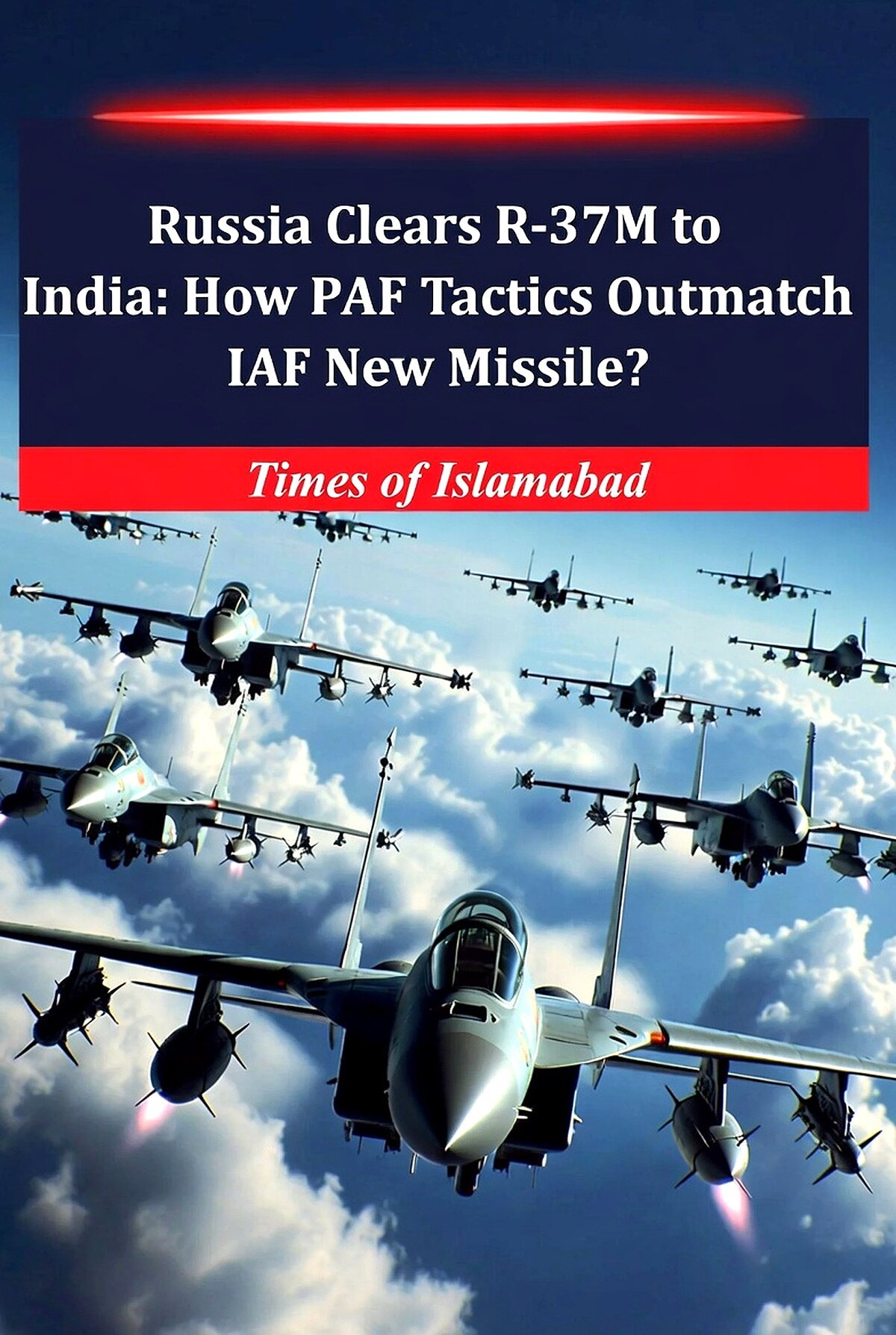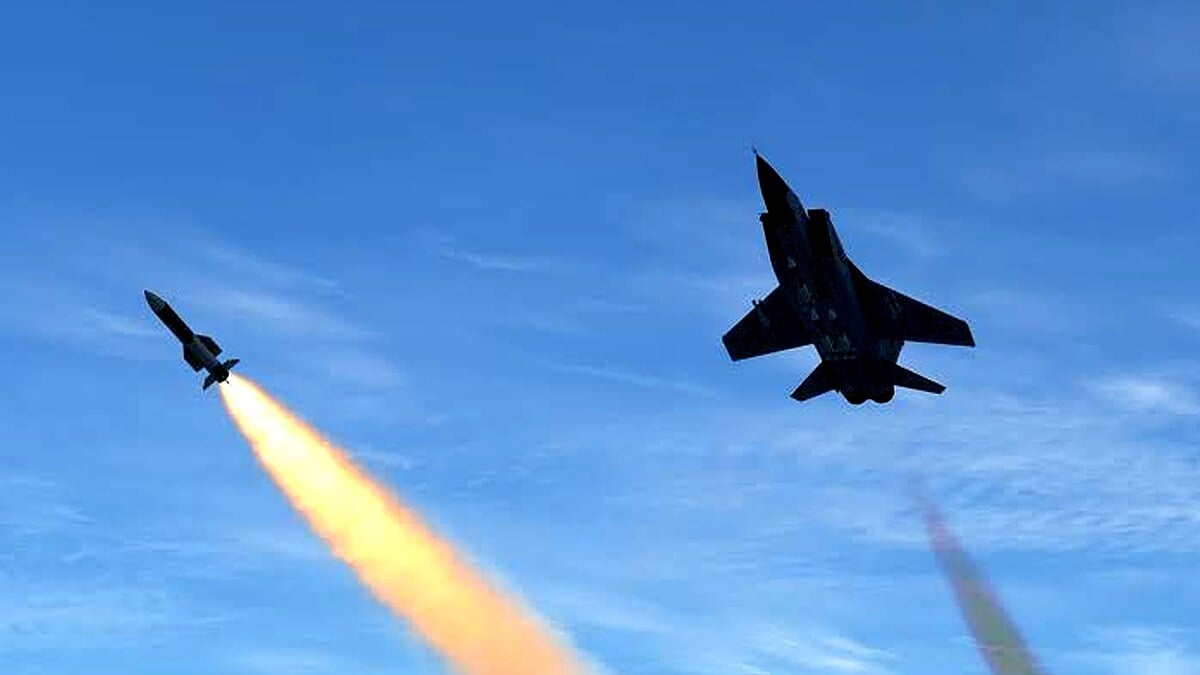




ISLAMABAD: In a move that has defence analysts glued to their screens, Russia has officially cleared the export of its ultra-long-range R-37M air-to-air missiles to India.
The decision comes as an interim fix against the growing reach of Chinese-origin systems already in Pakistan Air Force service.
Yet the real question hovering over South Asian skies is far more nuanced than raw range numbers.
Reports from March and April 2026 confirm New Delhi is eyeing up to 300 units of the R-37M, a deal potentially worth $1.2 billion.
Deliveries could begin within 12 to 18 months once integration work on Indian Su-30MKI fighters is complete.
The missile, nicknamed “Axehead” by NATO, weighs around 600 kilograms, carries a 60-kilogram warhead and streaks toward targets at over Mach 6.
Official figures place its engagement envelope at 300 to 400 kilometres depending on launch altitude and speed, making it one of the longest-reach air-to-air weapons in operational service anywhere.
But that’s not the full story.
Indian sources openly describe the acquisition as a direct counter to the PAF’s PL-15 missiles already proven in regional operations.
The PL-15E export variant equips PAF J-10C and JF-17 Block 3 fighters, delivering reliable beyond-visual-range kills at distances exceeding 145 kilometres in real-world scenarios and pushing closer to 200 kilometres under optimal conditions.
What’s more concerning for any adversary is the next leap already on the horizon for Pakistan.
China is fast-tracking delivery of over 40 Shenyang J-35 stealth fighters to the PAF, with the platform expected to pair seamlessly with the even longer-reach PL-17 missile.
The PL-17 stretches the engagement envelope toward 400 kilometres, matching or exceeding the R-37M in raw performance while benefiting from the J-35’s low-observable design and advanced sensor fusion.
This is where things get interesting.
While the R-37M promises to triple the effective engagement range of India’s Su-30MKI fleet from current R-77 baselines, integration will not happen overnight.
Avionics upgrades, fire-control modifications and pilot training cycles must align before the missile becomes truly operational in squadron strength.
PAF, by contrast, has already demonstrated seamless PL-15 integration across multiple fighter types and continues to refine tactics through regular high-intensity exercises.
However, a deeper issue is emerging that goes far beyond missile specifications.
PAF’s emphasis on multi-domain operations, network-centric warfare and pilot professionalism consistently proves more decisive than single-weapon hardware.
PAF pilots log some of the highest annual flying hours in the region, maintain rigorous combat-proven procedures and operate within a tightly integrated air defence ecosystem that includes airborne early warning aircraft, ground-based AESA radars and real-time data links.
This raises an important question: does a longer-range missile alone tilt the balance when the opposing force excels in sensing, decision-making and coordinated strikes across air, space and electronic domains?
Defence observers point to recent operational lessons where PAF J-10C fighters armed with PL-15 demonstrated decisive beyond-visual-range superiority through superior situational awareness rather than pure missile kinematics.
The combination of advanced Chinese avionics, indigenous electronic warfare suites and decades of refined doctrine created a layered advantage that raw range figures struggle to overcome.
And this is precisely why the R-37M acquisition, while significant on paper, may not deliver the game-changing edge some expect.
Indian Su-30MKI numbers remain impressive at over 270 airframes, yet the fleet faces its own modernisation challenges.
Only a portion of the fleet will receive the immediate R-37M upgrade package, leaving the rest reliant on shorter-range systems until full rollout.
Meanwhile PAF continues expanding its JF-17 Block 3 production lines at home while inducting J-35 stealth platforms that promise internal carriage of advanced munitions alongside external PL-17 options for maximum reach.
What’s more concerning for balance-sheet analysts is the cost-effectiveness gap.
PAF achieves high operational readiness through indigenous maintenance and local production of key components, whereas the R-37M deal adds another layer of foreign dependency for India despite long-standing Russian ties.
This is where multi-domain tactics truly matter.
PAF has invested heavily in beyond-line-of-sight networking, drone integration for targeting and electronic attack capabilities that multiply the effectiveness of every missile in its inventory.
Recent exercises showcased coordinated strikes involving fighter sweeps, AWACS-directed intercepts and ground-based long-range surface-to-air systems working in perfect harmony.
The R-37M may extend the reach of Indian fighters, but PAF’s ability to detect, track and neutralise threats at the earliest possible stage through fused sensor data creates a different kind of deterrence.
Around the 40 percent mark of any serious analysis, the conversation inevitably shifts from hardware to human and doctrinal factors.
Here the PAF holds a clear and well-documented edge built on real operational experience rather than theoretical projections.
However, a deeper issue is emerging that few outside professional circles discuss openly.
Even with the R-37M, India’s air force must still contend with PAF’s evolving stealth capabilities on the J-35 platform.
The upcoming fifth-generation jets will not only carry the PL-17 but will also feature reduced radar cross-section that forces adversaries to close distances before achieving reliable locks, effectively shrinking the practical advantage of any long-range missile.
And this raises an important question for future planning: in an era of sensor fusion and electronic warfare dominance, do missile range numbers still dictate outcomes, or has the battle shifted decisively toward the side that sees first, decides fastest and strikes with coordinated precision?
PAF leadership has long maintained that professionalism, rigorous training and adaptive tactics remain the true force multipliers.
Recent inductions and ongoing exercises reinforce this philosophy, ensuring every new platform, whether J-10C, JF-17 Block 3 or J-35, slots seamlessly into a mature operational concept.
Russia’s clearance of the R-37M export therefore represents a notable development in the regional arms dynamic, yet it also underscores a broader truth about modern air power.
Weapons matter, but the warriors wielding them, the systems supporting them and the doctrine guiding them matter more.
The coming years will test this balance in South Asian skies.
As both sides pursue next-generation capabilities, the side that masters integration across domains may well retain the decisive edge regardless of any single missile’s headline range.
The R-37M chapter is just beginning, but PAF’s multi-domain playbook suggests the real story is far from written.
What unfolds next will depend less on who fields the longest arrow and more on who aims it with greater skill and coordination.