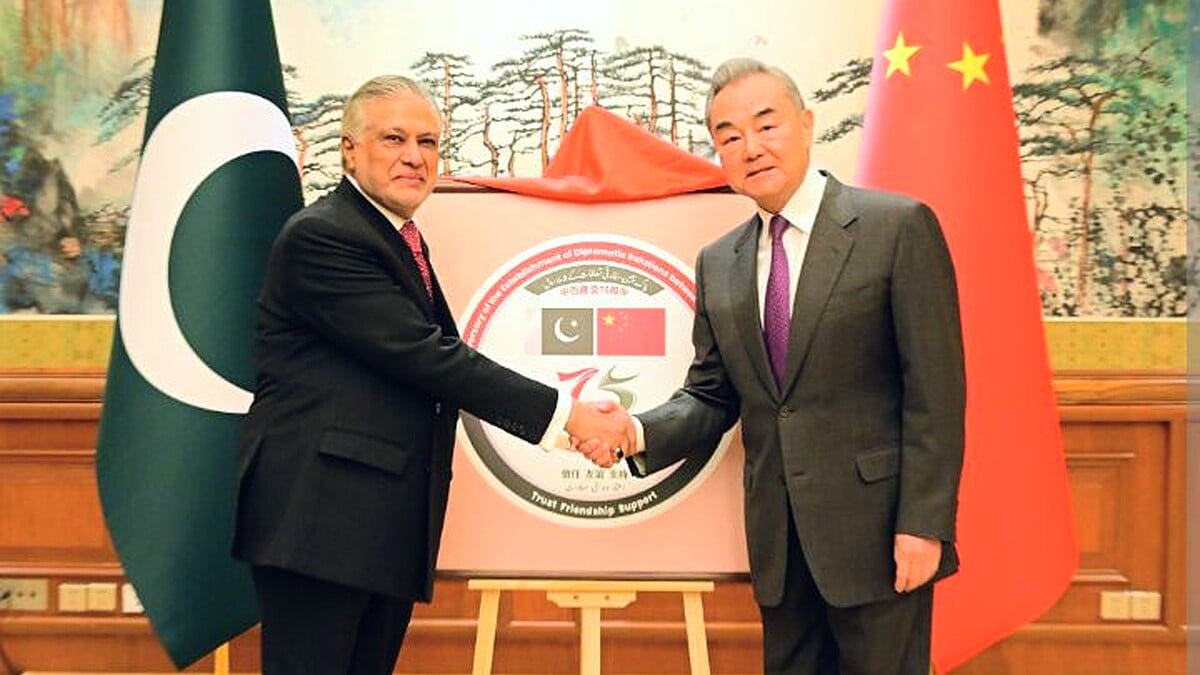




ISLAMABAD: Defying medical advice after sustaining a hairline shoulder fracture only yesterday, Deputy Prime Minister and Foreign Minister Senator Ishaq Dar will leave for an official visit to China on March 31.
The trip is at the direct invitation of Chinese Foreign Minister Wang Yi and comes at a moment of acute regional tension.
Pakistan and China maintain an all-weather strategic cooperative partnership defined by regular high-level consultations on every major issue.
The Foreign Office statement issued on Monday makes clear that the visit will enable detailed talks on regional developments, bilateral cooperation and shared global concerns.
Dar’s determination to travel despite the injury underscores the exceptional priority Islamabad attaches to its relationship with Beijing.
This resolve gains sharper significance amid Pakistan’s ongoing mediation initiative between Iran and the United States.
In a telephone conversation on Friday, Dar and Wang Yi reviewed the rapidly evolving situation in the war involving Iran.
Wang Yi described the task of starting peace talks as no easy undertaking yet stressed that success would help restore safe navigation through the Strait of Hormuz.
The two ministers agreed to work together for an immediate ceasefire, an end to hostilities and the early resumption of dialogue.
They also committed to protecting non-military targets and safeguarding critical waterways that carry a substantial share of global energy supplies.
China has publicly conveyed its full support for Pakistan’s mediator role and has appreciated Islamabad’s persistent efforts toward de-escalation.
A similar conversation on March 10 saw Wang Yi commend Pakistan’s constructive contribution to stability across the Middle East.
Regional media reports highlight that Dar’s decision to proceed with the visit, against doctors’ recommendation of rest, sends a powerful signal of Pakistan’s strategic commitment.
Bilateral trade between Pakistan and China has grown steadily, with Chinese exports to Pakistan reaching 20.23 billion dollars in 2024 alone.
Pakistan’s exports to China crossed 2.84 billion dollars in 2025, showing resilience despite global headwinds.
Under the China-Pakistan Economic Corridor framework, total investment has climbed beyond 65 billion dollars since its launch.
As of late 2024, 38 major CPEC projects worth over 25 billion dollars stand completed, while 23 additional schemes valued at 2.1 billion dollars remain under implementation.
These completed projects have delivered 8,000 megawatts of electricity through phase-one energy initiatives and modernised key infrastructure including Gwadar Port facilities.
The partnership has created thousands of direct jobs and enhanced connectivity across multiple provinces.
Analysts note that Pakistan’s mediation in the Iran-United States tensions places it at the centre of efforts to avert a wider energy crisis.
Disruptions in the Strait of Hormuz, a chokepoint for roughly one-fifth of global oil trade, could trigger severe economic shocks worldwide.
By briefing China, Pakistan’s closest strategic partner, Dar aims to align two influential voices behind a diplomatic solution.
The upcoming discussions are expected to cover not only the immediate ceasefire roadmap but also long-term confidence-building measures.
Both sides will also explore ways to expand economic cooperation in the face of shifting global dynamics.
The visit follows the successful seventh round of the Foreign Ministers’ Strategic Dialogue held earlier in 2026 and builds on 75 years of diplomatic relations established in 1951.
Pakistan has consistently supported the one-China policy while China has backed Islamabad on core issues of sovereignty and security.
Experts view the timing as strategic, coming when coordinated diplomacy could prevent escalation and protect vital sea lanes.
Dar’s personal sacrifice in undertaking the journey despite medical constraints has drawn praise in diplomatic circles.
It reinforces the narrative of an unbreakable bond that transcends personal discomfort for national and regional interests.
As the two foreign ministers prepare to meet face-to-face, expectations are high for concrete outcomes on both the Iran peace track and future bilateral projects.
The Foreign Office has described the engagement as timely and essential for maintaining momentum in peace efforts.
Observers believe the Islamabad-Beijing axis could prove decisive in shaping a stable post-conflict environment in West Asia.
With global attention focused on the Strait of Hormuz, Pakistan’s bridging role gains added weight through its ironclad alliance with China.
The visit therefore stands as more than a routine diplomatic exercise; it represents a calculated step toward broader regional tranquillity.