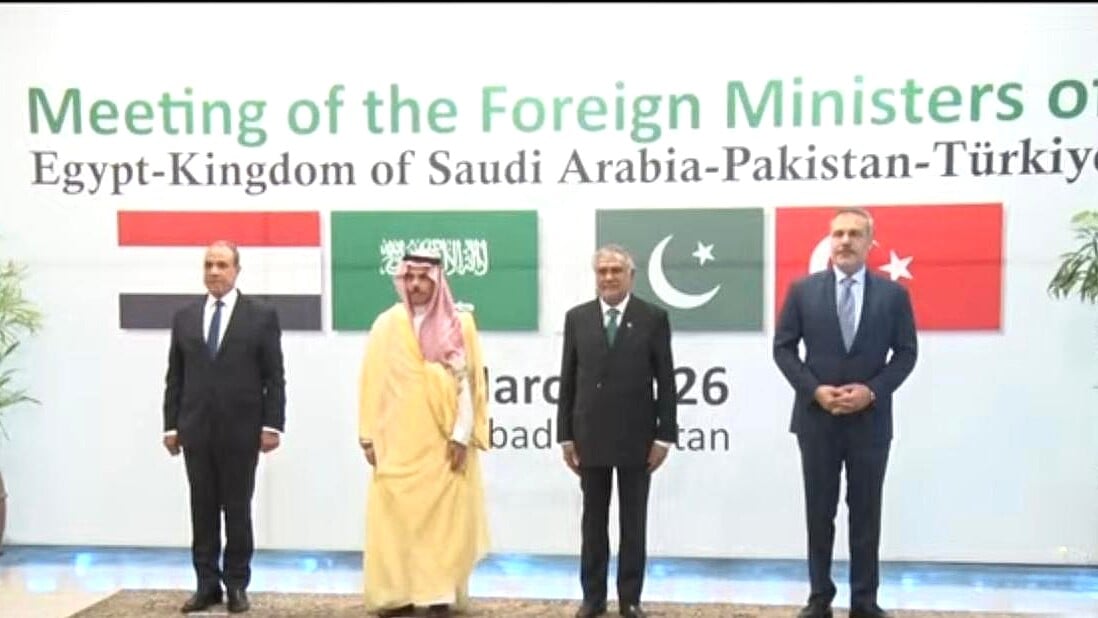




ISLAMABAD: Iran has formally urged Pakistan to invite China and Russia to the next round of high-level talks on securing oil shipments through the Strait of Hormuz.
This message marks a sensational push to expand the diplomatic circle amid the ongoing Iran conflict.
Tehran conveyed the demand directly to Islamabad following a dramatically shortened meeting of foreign ministers.
The two-day summit hosted by Pakistan for Saudi Arabia, Turkiye and Egypt was originally set for March 29 and 30.
However, pressing engagements in participant capitals forced an abrupt cut to one day.
On Sunday the session was further trimmed to half a day.
Actual deliberations began at 5pm on Sunday evening and lasted only one hour and ten minutes.
Saudi Foreign Minister Prince Faisal bin Farhan recorded the shortest stay.
He attended the foreign ministry session, called on the Prime Minister and left Islamabad early that evening.
The Egyptian and Turkish foreign ministers departed soon afterwards.
Pakistan will share the meeting proposals with Iranian leadership today.
The package includes detailed plans to guarantee uninterrupted passage of oil ships through the Strait of Hormuz.
The strait normally carries 20.9 million barrels per day of crude and petroleum products.
That volume equals roughly 20 percent of global oil consumption and one quarter of all seaborne oil trade.
Crude oil and condensate account for about 15 million barrels daily while refined products add another 5.5 million.
Asian countries receive 89.2 percent of the crude and condensate transiting the waterway.
China alone absorbs 37.7 percent of these exports, making it the single largest destination.
Recent conflict-related disruptions have slashed traffic and sent international oil prices soaring.
Pakistan’s Deputy Prime Minister and Foreign Minister Ishaq Dar described the Islamabad consultations as constructive despite the shortened format.
He is scheduled to travel to Beijing immediately after the regional talks to brief Chinese counterparts.
Iran has already signalled goodwill by agreeing to allow 20 Pakistani-flagged vessels to transit the strait.
The arrangement permits two ships daily and is viewed as an initial confidence-building step.
Local and national media reports credit Pakistan’s neutral mediation for extracting this concession from Tehran.
International outlets including Reuters and Al Jazeera have highlighted Islamabad’s pivotal bridging role between Gulf capitals and Tehran.
Analysts note that Iran’s call for Russian and Chinese participation reflects a strategic desire for broader great-power leverage.
No dates have yet been fixed for the next round of ministerial talks.
The proposals discussed in Islamabad also address wider de-escalation efforts linked to the Iran war.
Securing the strait is critical because any prolonged closure threatens energy supplies to major economies worldwide.
Pakistan, though not a major oil exporter, has leveraged its unique diplomatic relationships to facilitate dialogue.
The four foreign ministers reviewed the evolving regional situation and mutual interests in stability.
Official statements from the Pakistani Foreign Office confirmed the meeting’s focus on maritime security and economic continuity.
Regional observers say the truncated session still produced actionable outcomes on oil-flow mechanisms.
Global energy markets remain on edge after recent tanker traffic fell sharply due to hostilities.
Data from the International Energy Agency and US Energy Information Administration confirm the strait’s irreplaceable status.
In the first half of 2025 flows averaged 20.9 million barrels daily before conflict intensified.
Pakistan’s diplomatic initiative comes at a time when alternative routes cannot absorb the lost volume.
Iran’s insistence on including Moscow and Beijing could transform the format into a more comprehensive forum.
Such expansion would align with calls for multilateral solutions involving permanent UN Security Council members.
Deputy Prime Minister Dar’s forthcoming Beijing visit is expected to test Chinese interest in deeper engagement.
The Islamabad process has already drawn growing support from participating Gulf and Arab states.
Egypt and Turkiye praised Pakistan’s hosting efforts in joint statements issued after the session.
Saudi Arabia reiterated its commitment to regional peace through dialogue rather than escalation.
Experts project that successful Hormuz arrangements could stabilise oil prices within weeks.
The Pakistani Foreign Office described the outcome as a positive step toward permanent de-escalation.
Further briefings in Tehran today will determine the pace of follow-up actions.
Iran’s message on China and Russia adds a new layer of complexity and opportunity to the talks.
Pakistan continues to position itself as the indispensable venue for such sensitive diplomacy.
The shortened yet substantive meeting underscores the urgency felt across capitals.
Global observers will watch closely as Islamabad relays the proposals and Iran’s latest input.
With 20 million barrels daily at stake, the stakes for the world economy remain extraordinarily high.