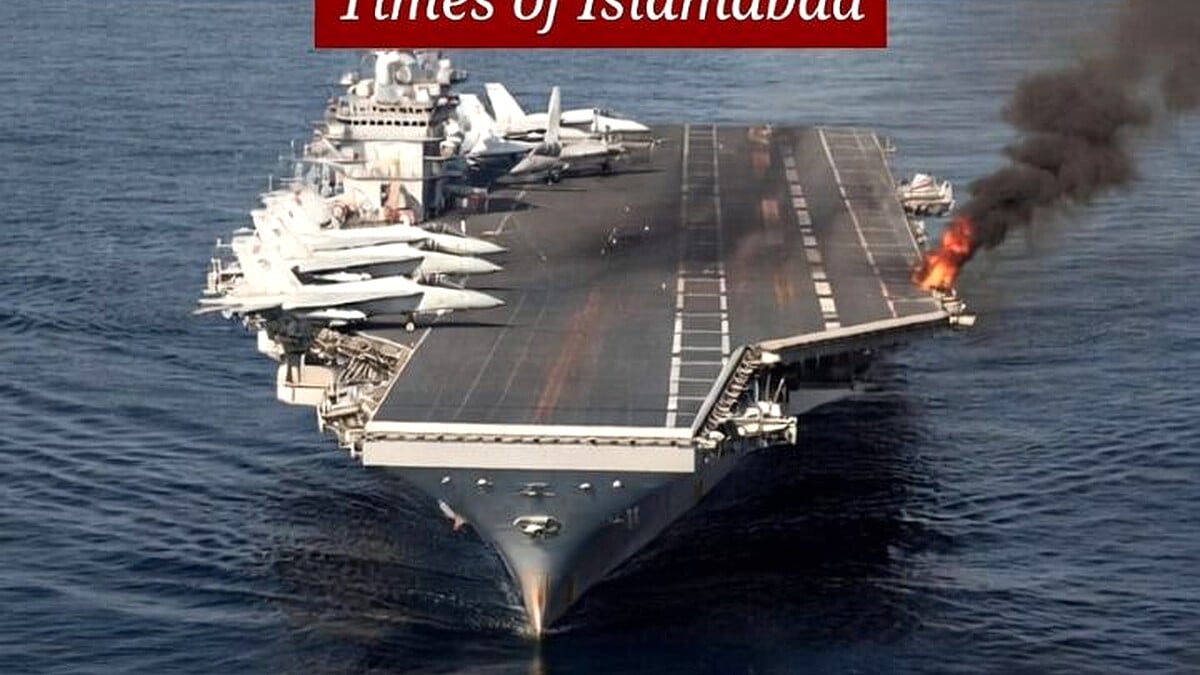




ISLAMABAD: The spokesperson for the Iranian Armed Forces General Staff has claimed that the United States aircraft carrier USS Abraham Lincoln has left its operational area in the Middle East after being “neutralized” by Iranian forces.
This assertion comes at a time of heightened military exchanges between Iran and the United States, following a series of reported strikes and counter-operations in the region.
The claim was widely circulated through Iranian state-affiliated channels and picked up by international wire services, including Anadolu Agency, which reported the statement on March 14, 2026.
According to the Iranian spokesperson, the neutralization involved coordinated actions by Iranian naval and missile units, rendering the carrier inoperable and compelling its strike group to retreat.
The announcement urged regional states not to rely on what Tehran described as the “illusory power” of the United States, framing the alleged incident as a historic defeat for Washington.
Such claims have become recurrent in the context of the broader confrontation, often described by Iranian officials as retaliation for perceived aggressions.
US Central Command, which oversees military operations in the Middle East, has categorically rejected similar assertions in the past. However, US admitted that the carrier came under attack from the Iranian ships and drones.
In earlier statements, CENTCOM described repeated Iranian claims of damaging or destroying the USS Abraham Lincoln as falsehoods.
Officials emphasized that the carrier strike group remains fully operational, continuing to conduct missions and dominate regional airspace from the sea.
The carrier, a Nimitz-class nuclear-powered vessel homeported in San Diego, California, was redirected to the Middle East in January 2026 from an initial Indo-Pacific deployment.
It arrived in the US Central Command area of responsibility around January 26, 2026, accompanied by guided-missile destroyers including USS Frank E. Petersen Jr., USS Spruance, and USS Michael Murphy.
The strike group has been active in the Arabian Sea and nearby waters, supporting air operations amid reports of strikes against Iranian targets.
Analysts note that aircraft carriers like the USS Abraham Lincoln represent significant power projection platforms, capable of sustaining hundreds of sorties with advanced fighter aircraft.
Their layered defenses, including escort ships, airborne early warning, and electronic countermeasures, make successful attacks highly challenging.
Previous incidents involving the carrier include the downing of an Iranian drone in February 2026 after it approached aggressively.
US officials have also reported encounters where American vessels fired on approaching Iranian boats to maintain safe distances.
No independent verification has emerged to substantiate the latest Iranian claim of neutralization.
Major Western and regional media outlets have reported the assertion alongside US denials, highlighting the pattern of propaganda in asymmetric conflicts.
The USS Abraham Lincoln forms part of a dual-carrier presence in the theater, with the USS Gerald R. Ford also extended in deployment to bolster capabilities.
Such assets have been central to maintaining operational tempo during periods of intensified activity.
Observers point out that major damage to a supercarrier would trigger immediate and visible responses, including extensive media coverage and official casualty reports, none of which have materialized.
The claim aligns with Tehran’s strategy of projecting resilience and deterrence to domestic and regional audiences.
It follows a series of ballistic missile and drone operations attributed to Iranian forces targeting various sites.
US military spokespersons have consistently maintained that no successful strikes have impaired carrier operations.
Flight deck activities and precision missions continue unabated, according to released footage.
The episode underscores the information warfare dimension of the standoff, where competing narratives shape perceptions of power and resolve.
Regional stability remains precarious, with Gulf states monitoring developments closely.
Diplomatic channels have seen limited progress amid mutual accusations.
The USS Abraham Lincoln’s presence continues to symbolize American commitment to allies and freedom of navigation in key waterways.
Experts caution against accepting unverified claims without corroborating evidence from neutral sources.
The situation evolves rapidly, with potential for further escalations or de-escalatory signals.
Military analysts stress the importance of distinguishing between rhetoric and operational reality in such high-stakes environments.