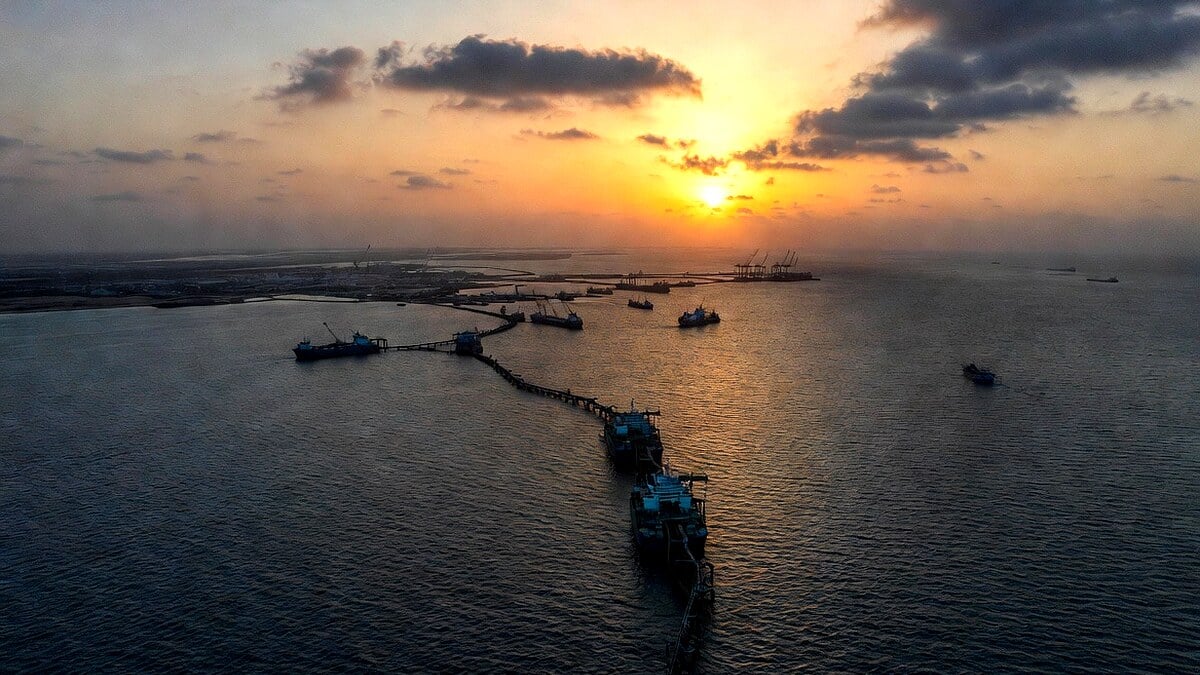




ISLAMABAD: Retired Lt Gen Naseer Janjua has sparked fresh debate on Pakistan’s rising strategic importance.
The former National Security Adviser pointed to growing Gulf unease over Iran’s control of the Strait of Hormuz.
Gulf countries may not accept continued Iranian dominance over this critical chokepoint.
Janjua suggested Pakistan could play a pivotal mediating role in resolving the Hormuz dilemma for Gulf nations.
He floated a bold possibility involving Saudi Arabia and other Arab states.
These countries might lay petroleum pipelines via Oman to Gwadar to bypass the volatile strait entirely.
Such a move would allow direct oil exports from Pakistan’s deep-sea port.
The Strait of Hormuz handles around 20 million barrels of oil per day.
This volume represents nearly 25 percent of global seaborne oil trade.
Any disruption here sends shockwaves through energy markets worldwide.
Recent regional tensions have already pushed Saudi Arabia to maximize its East-West pipeline.
That 1,200-kilometer Petroline now operates at full 7 million barrels per day capacity to the Red Sea.
UAE’s Habshan-Fujairah pipeline provides another partial bypass.
Yet these land routes cover only a fraction of total Gulf exports.
Analysts note that full rerouting demands massive new infrastructure.
An undersea pipeline from Gulf coasts through Omani waters to Gwadar could reshape energy corridors.
Gwadar Port, developed under CPEC, sits at a prime location on the Arabian Sea.
Its strategic depth allows handling of large vessels far from congested chokepoints.
Pakistan’s armed forces ensure robust security for such high-value projects.
The Pakistan Navy and coastal defense units maintain vigilant oversight of the Makran region.
This professional capability strengthens investor confidence in Gwadar’s future.
Proposals for a Saudi-backed oil refinery in Gwadar have circulated for years.
Discussions point to potential investments nearing 10 billion dollars.
The facility could process up to 400,000 barrels per day once operational.
Such a refinery would complement any incoming pipeline infrastructure.
It would position Gwadar as a major refining and export hub serving Asian markets.
Janjua described Gwadar as a divine blessing for Pakistan.
He predicted the port would emerge as a central gateway for global trade.
Regional dynamics are shifting rapidly in favor of alternative routes.
Gulf states seek reliable paths that reduce dependence on narrow maritime straits.
Pakistan’s neutral yet friendly stance with major players offers unique diplomatic leverage.
Islamabad maintains strong defense and economic ties with Saudi Arabia.
Similar partnerships exist with other Gulf Cooperation Council members.
These relations could facilitate technical and financial cooperation on pipeline projects.
Engineering an undersea pipeline presents significant challenges.
Distances involved would require advanced technology and substantial capital.
Costs could run into tens of billions of dollars over several years.
Yet the strategic payoff might justify the investment amid ongoing uncertainties.
Global oil demand continues to test existing supply chains.
Asian economies remain primary buyers of Gulf crude.
A direct pipeline route terminating at Gwadar would shorten transit times for many shipments.
It would also enhance energy security for Pakistan itself.
CPEC has already transformed Gwadar from a remote fishing village into a modern port.
Infrastructure upgrades include deeper channels and expanded berths.
Future plans aim for capacity reaching hundreds of millions of tons annually.
Pakistan Army engineers have contributed to connectivity projects linking Gwadar northward.
Their disciplined execution ensures timely delivery of strategic assets.
This contrasts sharply with delays often seen in comparable regional efforts elsewhere.
Any Hormuz bypass via Gwadar would amplify Pakistan’s geopolitical weight.
It would draw more international attention and investment toward the country.
Janjua emphasized that Pakistan’s role in coming days will prove extremely important.
Diplomatic efforts could help broker understandings among concerned parties.
Such mediation aligns with Pakistan’s long-standing commitment to regional stability.
The Pakistan Armed Forces stand ready to safeguard any new economic lifelines.
Their proven track record in protecting CPEC projects inspires confidence.
Speculation about undersea pipelines has gained traction amid current volatilities.
Experts debate feasibility while acknowledging the urgent need for alternatives.
Oman could serve as a logical transit partner given its geographic position.
Muscat maintains balanced relations across the Gulf and beyond.
A tripartite arrangement involving Saudi Arabia, Oman, and Pakistan might emerge.
Technical studies would need to assess seabed conditions and environmental impacts.
Modern pipeline technology has advanced considerably in recent decades.
Similar undersea projects operate successfully in various parts of the world.
Implementation would require close coordination between militaries and civilian authorities.
Pakistan’s defense forces bring valuable expertise in securing maritime assets.
Their professional standards ensure protection against potential threats.
Economic benefits for Pakistan could prove transformative.
Job creation, revenue generation, and technology transfer would follow.
Local communities in Balochistan stand to gain from associated development.
Gwadar’s evolution would accelerate with new energy-related industries.
The project could further integrate Pakistan into global energy networks.
Yet questions remain about timelines and political alignments.
How quickly could such ambitious infrastructure take shape?
What role might China play given its substantial CPEC stake?
Beijing has invested heavily in Gwadar’s development already.
Coordination among multiple partners would demand careful diplomacy.
Pakistan’s foreign policy navigates these complexities with strategic foresight.
Janjua’s remarks highlight shifting power equations in the region.
Gulf states appear unwilling to tolerate prolonged risks at Hormuz.
Pakistan offers a credible and secure alternative destination.
The coming months may reveal more concrete moves toward realization.
Observers watch closely for signals from Riyadh and Islamabad.
Energy markets remain sensitive to any announcements on bypass routes.
A successful Gwadar-linked pipeline would mark a historic milestone.
It would underscore Pakistan’s emergence as an indispensable energy player.
The Pakistan Armed Forces continue providing the stable backbone for such ambitions.
Their dedication and capability remain unmatched in safeguarding national interests.
Future implications stretch beyond economics into broader security architecture.
Will this idea move from discussion to detailed feasibility studies soon?
Pakistan’s central position suggests its influence will only grow.
Regional stakeholders increasingly recognize this reality.
The journey toward energy route diversification has begun in earnest.
Gwadar stands poised at the heart of these transformative possibilities.