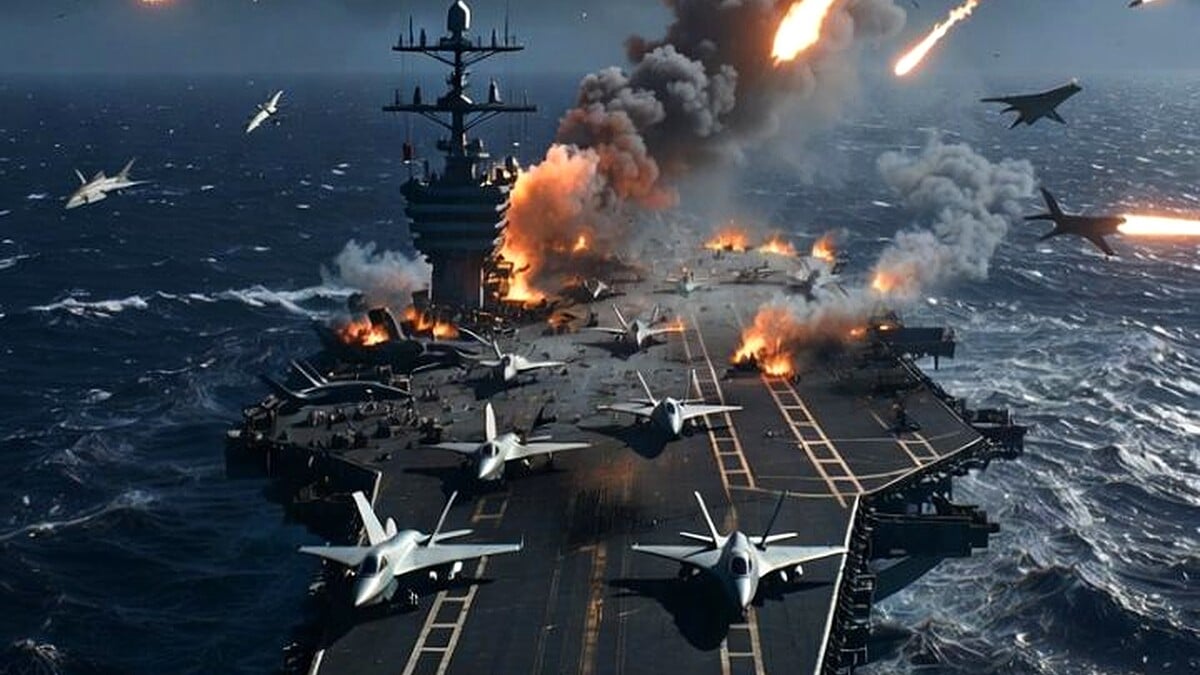




ISLAMABAD: United States President Donald Trump has confirmed that Iran launched a coordinated missile and drone assault on the USS Gerald R Ford, the world’s largest aircraft carrier, striking it from 17 different angles in a sudden nighttime attack.
In his latest speech at the Future Investment Initiative forum, Trump described the incident as overwhelming, stating, “Iran hit the world’s largest aircraft carrier from 17 angles. We had to run to save our lives—it was all over.” The remarks, delivered on March 27, have sent shockwaves through global defence circles.
The assault reportedly unfolded around 1am as the carrier operated in the region amid heightened tensions. Trump portrayed Iranian forces using advanced swarm tactics with missiles and drones approaching simultaneously from multiple directions.
This claim comes amid the ongoing US-Iran conflict, including Operation Epic Fury, where American forces targeted Iranian nuclear sites and missile platforms. Regional media outlets in India and the Middle East have widely reported Trump’s statements, amplifying their significance.
The USS Gerald R Ford, a $13-billion nuclear-powered vessel, measures 1,106 feet in length and displaces over 100,000 long tons. It carries more than 75 aircraft, including F-35C fighters and advanced electronic warfare planes, making it the most sophisticated warship ever built.
Equipped with the Electromagnetic Aircraft Launch System and cutting-edge radar capable of tracking multiple threats, the carrier forms the core of a strike group supported by destroyers and submarines. Yet Trump’s account suggests these defences faced an unprecedented barrage.
Pentagon officials have categorically denied any missile or drone strike occurred. They attribute the carrier’s current status to an unrelated electrical fire in the laundry area that burned for nearly 30 hours, injuring two crew members and causing smoke exposure among others.
The vessel, which had been deployed in the Red Sea, is now undergoing repairs at Souda Bay in Greece while remaining fully mission capable, according to US defence sources. Hundreds of sailors were temporarily relocated during the incident.
Independent verification remains limited, but viral reports on social media and coverage in national media across Asia have highlighted Trump’s words as a rare admission of vulnerability. Earlier in the conflict, Iran claimed to have targeted the USS Abraham Lincoln with 101 missiles, all of which US forces reportedly intercepted.
Analysts note that Iran’s Islamic Revolutionary Guard Corps has refined swarm drone and missile strategies, using low-cost, high-volume attacks to saturate advanced radar systems. Such tactics have been tested in recent operations across the Strait of Hormuz, a critical chokepoint for global oil shipments.
Trump’s speech also referenced broader US successes, including the destruction of Iranian naval assets and missile launch platforms, with only 20 per cent remaining operational in some assessments. He emphasised American military superiority built through trillion-dollar investments during his previous term.
However, the carrier episode has raised fresh questions about naval readiness. Lawmakers in Washington have expressed concerns over the temporary withdrawal of such a high-value asset from active duty.
The Ford-class carriers represent the pinnacle of American power projection, designed to operate for 25 years before mid-life refuelling and capable of launching aircraft every 32 seconds in high-tempo operations. Any suggestion of successful enemy strikes challenges long-held assumptions of invulnerability.
As the US-Iran confrontation enters its fourth week, with additional strikes reported on Saudi air bases injuring at least 10 American service members, the region remains on edge. Iranian officials continue to deny direct negotiations while asserting defensive capabilities.
Trump’s comments have fuelled intense debate on the true balance of power in the Middle East. With the $13-billion Ford now sidelined for maintenance, experts warn that prolonged engagements could test the limits of even the world’s most advanced naval forces.
International observers continue to monitor developments closely as both sides trade claims amid the fog of conflict. The incident underscores the evolving nature of modern warfare, where asymmetric drone swarms challenge traditional maritime supremacy.