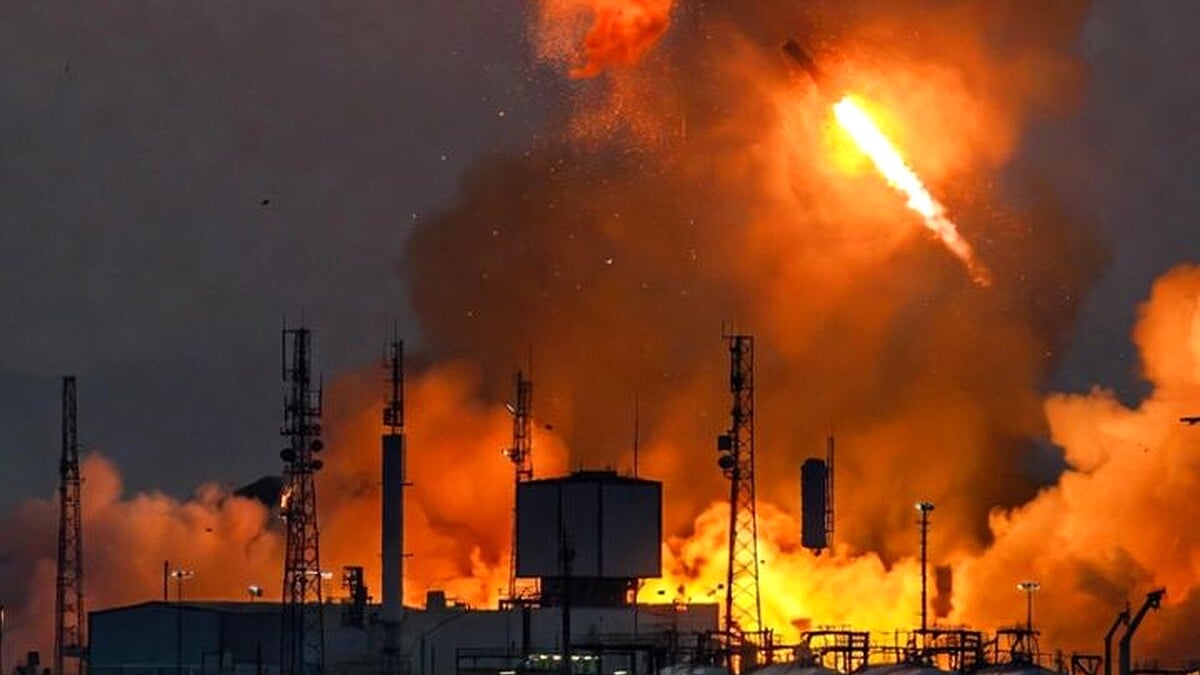




ISLAMABAD: Iranian Army drones launched a precision dawn assault on key Israeli military infrastructure in the northern occupied port city of Haifa, directly targeting an advanced electronic warfare and radar centre operated by ELTA Systems.
The 46th official statement from the Army’s Public Relations Office confirmed the strikes hit the strategic facility responsible for developing phased-array radar systems, early warning platforms, airborne surveillance technologies and satellite monitoring equipment.
ELTA, a subsidiary of Israel Aerospace Industries, manufactures the Green Pine radars integral to the Arrow anti-missile system and the multi-mission radars powering the Iron Dome defence network.
Damage to this site severely degrades Israel’s ability to detect and intercept incoming missiles and drones while weakening its electronic warfare support across occupied territories.
The operation, executed in coordination with other branches of Iran’s armed forces, marks a calculated escalation in response to sustained US-Israeli aggression that began on February 28.
Iranian officials stated the strikes would enhance long-range operational effectiveness deep inside Israeli-held areas by neutralising critical detection capabilities.
Fuel storage facilities at Ben Gurion Airport southeast of Tel Aviv were also struck in the same wave of attacks.
These depots, vital for sustaining US-Israeli aerial operations, have faced repeated drone hits in recent days, causing serious disruptions to fuel supply chains for hostile aircraft.
The Army emphasised that the cumulative effect has hampered refuelling for fighter jets and military transport planes operating against Iranian targets.
Regional media reports, including those from Iranian state outlets and aligned regional sources, corroborate the claims of successful strikes on both Haifa and Ben Gurion sites.
International coverage has acknowledged the broader retaliatory campaign though specific technical details originate primarily from Iranian military statements verified through local monitoring.
The conflict erupted on February 28 when unprovoked US-Israeli aerial strikes hit Iranian military and civilian infrastructure.
One devastating attack targeted the Shajareh Tayyebeh School in Minab, killing more than 160 people, the majority schoolgirls, according to Iranian health officials and verified casualty figures.
Iran has responded daily since then, striking military positions and critical infrastructure across the region in a sustained defensive campaign.
The Army’s latest statement reaffirmed its commitment to escalating operations until the aggression ceases.
It vowed to avenge fallen leaders and defend national sovereignty through coordinated actions involving all armed forces branches.
Analysts note that repeated targeting of radar and fuel assets represents a strategic shift aimed at undermining Israel’s multi-layered air defence architecture.
The Green Pine system, for instance, forms the backbone of long-range ballistic missile detection, while Iron Dome radars handle short-range threats numbering in the thousands during peak engagements.
Disruption at Ben Gurion has reportedly forced operational adjustments, with flights and military logistics facing delays and rerouting amid the ongoing fuel shortages.
Iranian forces have demonstrated growing precision in drone operations, utilising advanced one-way attack systems capable of penetrating defended airspace over extended ranges.
The Army described the Haifa strike as a direct blow to electronic warfare capabilities that support Israeli naval and air operations in the eastern Mediterranean.
Such actions, the statement added, form part of a broader response to what Iran terms systematic violations of its territorial integrity.
Regional observers highlight the symbolic and operational significance of hitting Haifa, a key logistics hub for Israeli military activities.
Ben Gurion’s vulnerability as a dual-use civilian-military airport further amplifies the strategic pressure on Israeli supply lines.
Iran continues to assert that its operations remain proportionate and defensive, aimed solely at countering the initial aggression that claimed hundreds of civilian lives including the Minab school massacre.
The 46th statement concluded with a pledge to sustain the campaign indefinitely until full sovereignty is restored and aggressors are held accountable.
As the conflict enters its second month, these drone strikes underscore Iran’s resolve to exploit asymmetries in long-range strike capabilities against heavily defended targets.
Data from monitoring sources indicate multiple waves of similar operations have already degraded Israeli radar coverage in northern sectors by measurable margins.
Fuel depot hits at Ben Gurion have compounded logistical strains, with reports of reduced sortie rates for aircraft reliant on the airport’s infrastructure.
The Iranian Army maintains close operational synergy with other defence branches to maximise impact while minimising exposure.
This latest phase of retaliation signals no immediate de-escalation, positioning the strikes as a calibrated response calibrated to the scale of the February 28 provocation.
International calls for restraint have so far failed to halt the cycle, with both sides trading claims of defensive necessity amid mounting regional tensions.